
Most SaaS teams still treat paid social advertising like boosted posts or extra distribution. Then the results come in: clicks look fine, but the leads aren’t coming in.
That shows a problem with your campaign structure.
At the same time, 2026 changed the rules.
Buyers now research deeply before talking to sales. Platforms rely more on creative and automation than manual targeting. And with rising customer acquisition costs, a weak setup gets expensive fast.
So instead of adding more campaigns, it helps to step back and rethink the system.
In this article, we'll break down how to structure paid social by revenue model, buying stage, platform role, creative system, and measurement. Here, you’ll see what to change, and after that, you’ll know where to start.
Let’s dive in.
P.S. If your strategy makes sense but execution feels slow, Creative Milkshake can help you build and test the creative side of your system faster. Contact us today to learn more!
TL;DR
Paid social works when you treat it like a revenue system.
Start with your GTM motion, not your ad account.
Map end users, managers, and budget owners separately.
Give LinkedIn, Meta, and Reddit different jobs.
Match each offer to buyer awareness and intent.
Let the creative do more of the targeting work.
Keep the ad-to-page message match tight after the click.
Measure activation, deal quality, CAC payback, and revenue.
Budget by ARR stage, ACV, and sales motion.
What Changed about Paid Social for SaaS in 2026
Paid social in SaaS changed because buyers now arrive informed, faster, and harder to influence with a single touchpoint.
Let's start with buyer behavior.
According to SurveyMonkey and Reddit, 83% of buyers do more research before speaking to sales.
At the same time, AI tools can speed this process up. In fact, Forrester reports 89% of B2B buyers use AI to research vendors, which shortens the gap between “problem aware” and shortlist decisions.
So we need you to understand that paid social still matters in 2026, but its role has shifted.
Instead of just lead generation, paid social now supports trust, education, retargeting, and demand capture at once. That means each touchpoint has to connect.
Then there’s platform change.
Automation now handles most audience targeting, so structure and ad creatives drive performance more than manual setup.
In simple terms, social works but only when it fits into a full system that reflects how SaaS buyers actually decide.
As a side note, here's why your experimentation doesn't work anymore:
This leads us to our next point.
Why SaaS Cannot Use a Generic Paid Social Playbook
SaaS cannot use a generic paid social playbook because revenue does not come from clicks, forms, or even signups. It comes from what happens after.
At first glance, most paid social media advertising advice you can find online looks reasonable. Run campaigns, test audiences, drive conversions.
But take it from us: SaaS works differently, and that difference changes how your campaign structure should look.
To make that clear, here are the realities that shape how paid social actually performs in SaaS:
Buying cycles take longer, so one ad rarely drives SaaS buyers to an instant decision on its own.
The decision to buy SaaS products isn’t made by a single user; it’s taken collectively by multiple B2B decision makers in the company.
A signup does not mean activation or real product use.
Demo requests typically look strong on paper, but fail to turn into real sales opportunities.
Even paying customers don’t guarantee success without retention or expansion.
From our experience, you should judge performance on activation, qualified deal flow, CAC payback, and revenue quality. Always try to avoid surface-level metrics.
Because of this, a generic playbook underperforms quickly.
What looks efficient at the top of the funnel can quietly damage downstream results. That is exactly why structure matters more than activity.
So, in the rest of this article, we’ll focus on building a system that matches how SaaS actually grows.
Let's go over that next.
The 2026 Framework for Structuring Paid Social in SaaS
Once generic playbooks fall short, a clearer system becomes necessary. Below are the building blocks that shape how paid media strategies should work across your SaaS sales funnel.
1. Start with Your Revenue Model, not Your Ad Account
Everything that follows depends on this: your revenue model defines what a “conversion” actually means.
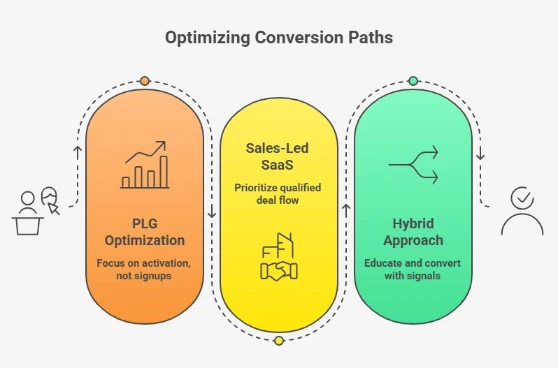
So, start with PLG.
Here, a trial signup looks like progress, but the real signal you want to see is activation. That is why your performance marketing campaigns should be optimized toward product-qualified users rather than raw signups. After all, only activated users turn into revenue.
Now compare that to sales-led SaaS. Your demo request may look strong, but the truth is many never turn into real sales opportunities. That’s why you should focus on qualified deal flow and deal creation, and not cheap form fills.
Then comes hybrid. This is where things usually get mixed. Cold campaigns should educate and drive interest, while high-intent traffic converts later using product or behavioral signals.
Do that split from the get-go to avoid pushing every click into the same path.
And this is where execution typically breaks.
Your strategy might be clear, but without enough creative-led campaigns, your testing slows down.
That is exactly where Creative Milkshake can support your team. We can help you produce and iterate on concepts fast enough to keep the system moving.
For B2C SaaS, the structure is simpler, but speed matters more.
Most products rely on free trials or freemium models, so the focus shifts toward fast activation and early retention signals.
In this case, you should optimize toward events like first key action, subscription start, or early feature usage, because high signup volume without activation leads to churn.
Remember: Unlike B2B, where deal cycles are longer, B2C performance depends on how quickly users experience value. That means your creative and funnel need to set the right expectations from the first click.
2. Map the Buying Committee Before You Choose Campaigns
Before choosing platforms or budgets, it helps to understand who actually makes the decision. In SaaS, that is rarely one person. Gartner reports that 6-10 stakeholders are involved in most B2B purchases, which means your campaign strategy has to speak to more than a single role.
So, we recommend starting with the three core groups: the end user, the manager, and the executive or budget owner. Each one evaluates your product differently. That difference shapes how your social campaigns should look.
For example, end users care about ease and workflow. Managers focus on efficiency and team outcomes. Executives look at risk, ROI, and long-term impact. Because of that, one message will not move all three forward.
To keep this practical, you can use this simple structure:
Persona
Pain point
Message angle
Proof type
CTA
This is where strong demand generation comes from. Clear mapping leads to relevant messaging, which leads to better engagement and ultimately, better deal quality.
In B2C SaaS, the buying process is usually individual, but that does not make it simpler. Instead of multiple stakeholders, you are dealing with different user intents and motivations at scale.
Some users are problem-aware and ready to try, while others are browsing, comparing, or reacting to emotional triggers like convenience, cost savings, or lifestyle improvement.
Because of that, segmentation shifts from job roles to behavioral and psychographic signals, such as urgency, frequency of need, or willingness to pay. Your messaging still needs variation, but it’s driven by use case and mindset, not internal alignment across teams.
3. Give Each Platform One Clear Job
Once roles and buyers are clear, the next step that you need to remember is: each social media platform needs a defined job. That’s because buyer behavior, expectations, and usage patterns differ according to the social channel they’re using.
So when you think of how your potential customers use each channel, you get more clarity and, as a result, better outcomes across your full-funnel ad strategies.
Here’s a framework we use at Creative Milkshake that you can also apply internally:
The key point is simple. Not every platform should drive qualified leads directly.
Instead, each one supports a different stage. When you align it with search and content marketing, the system becomes easier to scale and defend.
Pro tip: If you want to learn more about creative testing, feel free to check out our other guides on why most brands fail at it and our 9-step creative testing framework.
For B2C SaaS, platform roles tend to be more performance-driven and creative-led. Channels like Meta and TikTok often carry more weight because they allow for rapid testing, broader reach, and faster feedback loops.
In this context, platforms are less about role-based targeting and more about creative distribution and signal generation. One platform may validate hooks, another scales them, and another captures intent.
4. Match the Offer to the Awareness Stage
Once you’ve picked the channels, the next step is to match the offer to where the buyer is in their journey. Otherwise, even strong content creation struggles to convert.
Side note: The lead conversion rate for B2B ranges between 2% and 5% and you want to maximize that as much as possible.
So, think in stages.
Cold audiences are not ready to act, so pushing demo CTAs too early usually wastes ad spend. Warm audiences need proof, while high-intent users expect a clear next step.
Here is how that typically breaks down:
Cold: Category POV, buyer guide, problem-led asset, sharp educational angle.
Warm: Comparison guide, proof asset, use-case page.
Hot: Demo, trial, pricing, customer story, ROI page.
The key point is simple. You should not use the same CTA for every audience.
That is where many B2B SaaS companies lose efficiency. Misaligned offers create friction, which lowers conversion quality and slows deal progression.
So instead of forcing action, we think you should match the offer to intent. That shift improves engagement, filters better prospects, and sets up stronger downstream results.
Here's how to maximize your B2B sales through each of these stages:
In B2C SaaS, transitions between stages happen faster, and users are more willing to act without heavy nurturing. That means your offers should reduce friction and make the next step feel immediate.
Cold audiences respond better to quick wins, free tools, or interactive experiences.
Warm users are more likely to convert with limited-time trials, discounts, or clear product demonstrations.
Pro tip: At the high-intent stage, simplicity matters most. A clear value proposition, transparent pricing, and low commitment can significantly improve conversion rates.
5. Treat Creative as Part of Targeting
Creative now does a large part of the targeting.
Platforms push broad delivery, so relying on setup alone no longer works. That means each ad campaign needs a sharper message variation.
Remember: Instead of one generic angle, each concept should focus on one persona, one pain, and one proof point. That clarity improves signal quality and filters better prospects.
For example, a founder-focused message about cost control will not resonate with an operator focused on workflow efficiency. Different message, different outcome. That difference directly impacts how well you generate leads that actually convert later.
For B2C SaaS, this becomes even more important. You’re not targeting job roles but mindsets and use cases at scale, so creative needs to quickly signal who the product is for and why it matters in seconds.
A simple way to structure this is through a repeatable test stack:
Problem-first ad
Outcome-first ad
Testimonial ad
Founder/expert video
Comparison or “why teams switch” ad
Execution speed is essential here. Without a steady flow of new angles, testing slows and performance plateaus.
That is exactly where Creative Milkshake can help.
Our team turns performance data into fresh concepts and creator-style assets fast, which keeps testing cycles moving and prevents creative fatigue from slowing results.
For example, for N26, we shifted toward diversified, creator-led content, which led to a 65% lower cost per registration. This shows how faster iteration and better creative angles directly improve performance.
6. Build Post-Click Paths That Fit the Motion
You’re not done after the first click. In fact, this is where many marketing budgets quietly lose efficiency.
Here's what you should do:
Start with message match: The landing page should continue the same conversation the ad started. If the angle changes, trust drops, and conversion rates follow.
Structure matters: Separate pages by use case, buyer type, or funnel stage when needed. A generic page usually tries to speak to everyone and ends up converting no one.
Then comes friction: Research shows that 81% abandon forms after starting, yet reducing fields to five or fewer can double conversion rates. That means every extra field has a cost.
Now consider intent: Trial pages should reduce friction but still filter out low-quality users. Demo pages, on the other hand, should set clear expectations and screen weaker leads.
Finally, place proof early: Social proof, outcome proof, and simple value framing should appear before the fold.
That alignment improves conversion quality and leads to stronger customer lifetime value over time.
Pro tip: In B2C SaaS, post-click paths need to be faster and lighter. Users expect instant access (trial, app, or tool), so reducing friction and shortening the path to first value has a direct impact on conversion.
7. Measure Paid Social All the Way to Revenue
Once the click and post-click paths are working together, measurement needs to follow the same logic. Otherwise, paid social gets judged on activity instead of business impact.
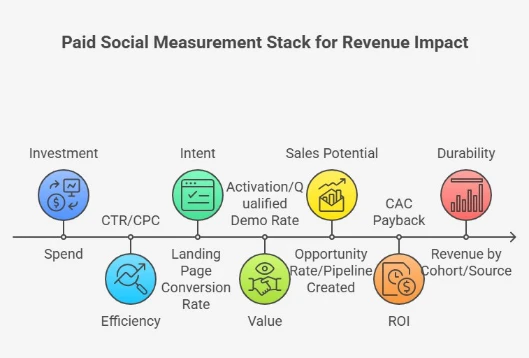
Here's a simple metric stack that keeps that clear:
Spend: Shows how much you are putting at risk.
CTR/CPC: Shows whether the ad earns attention efficiently.
Landing page conversion rate: Shows whether the click turns into real intent.
Activation rate or qualified demo rate: Shows whether the conversion had actual value.
Opportunity rate/pipeline created: Shows whether sales see real potential.
CAC payback: Shows how fast the acquisition cost comes back.
Revenue by cohort or source: Shows whether paid social brings in durable revenue.
This order matters because each layer explains the next one. Good clicks with weak activation usually point to a weak message match or the wrong conversion goal. Strong demo volume with poor opportunity quality usually means the system attracted the wrong people.
So do not stop at lead volume. CRM sync matters because it connects platform activity to the pipeline. Server-side tracking, CAPI, and clean UTMs matter because weak data leads to false lessons.
That is how you decide whether paid social is working: not by volume alone, but by revenue quality and payback.
Pro tip: For B2C SaaS, measurement cycles are shorter, so you can rely more on early signals like activation rate, retention, and payback speed.
A Simple Paid Social Budget Model for SaaS by Stage
When you tie measurement to revenue, budget decisions get much easier to defend. At that point, the question is no longer “how much should you spend?” but “what should paid social do at this stage of growth?”
That distinction matters because there is no universal spending number. Budget should follow ACV, GTM motion, sales cycle length, and proof that conversions turn into real revenue.
So, early on, the goal is learning. Later, the goal becomes an efficient paid social scale. If low-cost conversions fail to activate, convert, or retain, spend is still too high, even when headline metrics look strong.
Example Paid Social Structures by SaaS Model
Next, you need to choose a structure that fits how your company actually sells. That matters because the same paid social setup will not work equally well across self-serve, hybrid, and enterprise motions.
Here's what you should consider:
In B2C SaaS, most models resemble PLG, but with more emphasis on high-volume acquisition, fast activation, and retention loops, rather than sales-assisted conversion.
Here are a few practical notes from our team to make this easier to apply:
Do not run enterprise ABM logic for a low-ACV tool. The sales motion is too heavy, so conversion costs usually rise faster than value.
Likewise, do not run self-serve trial logic for a high-touch enterprise sale. That creates low-intent volume instead of sales-ready demand.
Most importantly, budget allocation should follow revenue quality rather than the platform that produces the cheapest top-level conversion.
For B2C SaaS, the same rule applies: do not chase cheap installs or signups if they don’t convert into paying or retained users, as this quickly breaks your unit economics.
Pro tip: Read our guide on UGC vs. influencer marketing to learn the key differences and when to use each in your paid social campaigns.
Mistakes That Break SaaS Paid Social
You need to avoid the mistakes that quietly drain your budget and weaken your pipeline. Most of them look harmless at first. Then performance stalls, and the reporting gets harder to trust.
Here are the mistakes that break SaaS paid social from our experience:
Treating boosted posts as a paid social strategy.
Running the same CTA for every audience.
Using too many channels at once.
Over-targeting instead of testing better creative.
Optimizing for trials, demos, or leads without checking downstream quality.
Sending all traffic to one generic landing page.
Treating LinkedIn like a cheap direct response.
Ignoring retargeting and re-engagement.
Keeping paid social disconnected from SEO, content, and search demand.
Reporting activity instead of pipeline and revenue.
Not using unconventional social media channels like Reddit, TikTok, or Twitch.
The pattern behind these mistakes is simple: they optimize for visibility and volume instead of revenue and deal quality.
For example, a campaign can drive demos and still fail if those demos never turn into real sales opportunities. In the same way, an omnichannel campaign can look ambitious, but it reduces your learning speed if the platforms you’re using don’t have clear roles.
So the fix is not “do more.” It is to tighten the system, remove low-impact activity, and judge performance by revenue quality.
Is Paid Social Worth It for SaaS Companies in 2026?
Yes and no.
We can say yes, but only when the fundamentals are already in place.
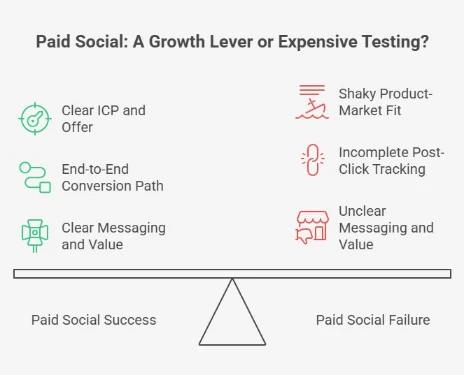
So, if the ICP is clear, the offer matches real demand, and the conversion path is mapped end-to-end, paid social becomes a strong driver of the revenue growth. In that case, it amplifies what already converts.
On the other hand, if product-market fit is still shaky, messaging feels unclear, or post-click tracking stops at leads, results tend to look good on the surface but fall apart later. That gap creates wasted spend and misleading signals.
So the answer depends on your readiness. Paid social does not fix weak positioning or unclear value. It exposes it faster.
Remember: When used inside a structured system, paid social becomes a reliable growth lever. Outside of that, it turns into expensive testing without direction.
Turn Paid Social into a System That Actually Drives Revenue
So when everything comes together, the pattern is clear. Paid social works when it follows your revenue model, reflects how buyers decide, and connects every step from first click to closed revenue.
At that point, structure helps you scale faster. Platforms get clear roles, offers match intent, creative drives targeting, and measurement ties back to pipeline quality. That is what turns activity into predictable growth.
Now the next step is execution. If your strategy is clear, but creative testing feels slow or inconsistent, Creative Milkshake helps you build and run that side of the system faster. Contact us today so we can help you out.