
You scale spending, and performance starts slipping even though your offer, audience targeting, and landing page look the same.
CTR softens, CPA creeps up, and ROAS gets tighter in a way that feels unfair, because nothing “broke” on paper.
That moment usually triggers a scramble. Teams swap a few ad creatives, tweak the copy, maybe adjust targeting, and hope the account finds its footing again.
Sometimes it does, but the relief rarely lasts, and the cycle repeats as soon as you push the budget.
This pattern is Meta creative fatigue.
And no, this is not a “make better-looking ads” problem. At scale, fatigue is what happens when your best ideas get exposed too fast, and your creative production cannot keep up with the pace of delivery.
In this article, we’ll define:
What Meta creative fatigue actually is and how to diagnose it
Why fatigue accelerates as you scale spend
Why most brands fall behind on creative production
A practical system to outproduce it through creative velocity and structured testing
P.S.: Does performance drop the moment you scale Meta spend? That’s usually a structural creative issue. At Creative Milkshake, we build performance-first creative systems for Meta and TikTok that help you outproduce fatigue through structured testing and creative velocity.
TL;DR
If you only take a few things from this guide, take these:
Meta-creative fatigue is performance decay caused by repeated exposure to the same creative within the same or overlapping audience segments.
Meta’s own guidance explains the mechanism clearly: when people see the same creative too many times, they engage less, and costs per result can rise.
The decay can be fast. The median ad lost half of its original CTR by day 11, which makes slow refresh cycles a losing game at scale.
Campaigns using a diverse set of creatives across formats and messaging types saw up to a 32% improvement in CPA and a 9% increase in incremental reach.
Advantage+ Shopping campaigns with 20 or more creatives saw a 29% reduction in median incremental cost per purchase.
Most brands fall behind because creative output does not scale with spending, and production bottlenecks slow down iteration.
The fix is building a system that can test, iterate, and scale continuously without burning out your team.
What Is Meta Creative Fatigue?
According to the definition provided by Meta’s Business Help Center:
“Meta creative fatigue is what happens when an audience has seen the same creative too many times, which makes them less likely to engage and often leads to a higher cost per result.”
But in practice, you usually see a pattern that looks like this:
Your click-through rate declines over time, even if targeting and spending stay stable.
Engagement drops, which weakens delivery signals.
Frequency climbs, and performance gets more expensive.
CPA rises while your funnel elements remain unchanged.
The reason this matters is speed. Creative fatigue is not something that slowly appears over a quarter anymore. Alison.ai tracked campaigns and found that the median ad lost half of its original CTR by day 11.
This changes what “good” looks like operationally.
If you refresh creative once a month, you’re basically operating one step behind the platform. By the time a new batch goes live, your last “winner” has already decayed, and you’re spending to recover instead of spending to grow.
When you ship structured variations weekly, you stay ahead of fatigue. You rotate in fresh angles before performance slips, and you keep learning without disrupting what’s scaling.
Why Does Meta Creative Fatigue Accelerate as You Scale?
Creative fatigue exists at every budget level, but scaling makes it show up faster because your best ads hit saturation sooner.
When spending increases, impressions stack up quickly inside the same audience segments. Frequency rises, novelty drops, engagement weakens, and delivery gets less efficient.
The result is usually the same pattern: CTR trends down, CPA trends up, and ROAS tightens even though the offer and landing page stay the same.
Sellbery notes that after 3 to 5 impressions, users ignore repetitive ads, which pushes engagement down and costs up.
On top of that, consumer behavior is not forgiving. The Trade Desk reported 66% of consumers tune out repetitive single-channel ads, and MI-3 cited research showing 73% ignore repetitive ads in that same context.
From what we’ve seen across scaling accounts, higher spend does not create fatigue. It accelerates exposure.
So scaling compresses the timeline of winning creatives, which is why creative velocity matters more than ever.
Are You Facing Creative Fatigue, or Is Something Else Breaking?
Before you fix anything, diagnose. A performance dip can come from creative fatigue, but it can also come from the offer, the landing page, tracking, or a scaling jump that your creative volume cannot support.
Signs It’s Truly Meta Creative Fatigue
When fatigue is the issue, the pattern is usually consistent. It shows up even when the rest of the account stays stable:
Performance declines around similar spend levels, even when targeting stays stable.
The same offer and landing page, with different ad creatives, produce clearly different results.
A creative refresh temporarily restores efficiency.
Winners decay on a predictable schedule.
Metadata cited by AppsFlyer also supports the “variation fixes efficiency” idea. Campaigns with diverse creatives across formats and messaging types saw up to a 32% improvement in CPA and a 9% increase in incremental reach.
In our experience working with scaling teams, variation mostly restores efficiency faster than targeting tweaks.
When It’s Not Creative Fatigue
Not every dip is fatigue. These are common situations where the problem is somewhere else:
CTR is stable, but the conversion rate drops, which usually points to landing page friction.
Results changed after tracking or attribution changes.
The offer stopped converting because demand shifted, or the message stopped matching the market.
Spend scaled faster than creative variation, so you forced repetition before the account had room to breathe.
This is where most teams misread the account. They push new creatives into a structural problem or blame fatigue for an offer issue.
If the problem is not creative fatigue, shipping more variations will not fix performance. When creative fatigue is the issue, a one-time refresh will not hold. You need a system that keeps variation ahead of saturation.
Why Most Brands Fall Behind On Creative Production
You fall behind because your production system cannot keep up with paid social delivery.
Meta rewards novelty and variation. If the budget scales but creative output stays flat, fatigue is inevitable.
Let’s look at where that gap usually comes from:
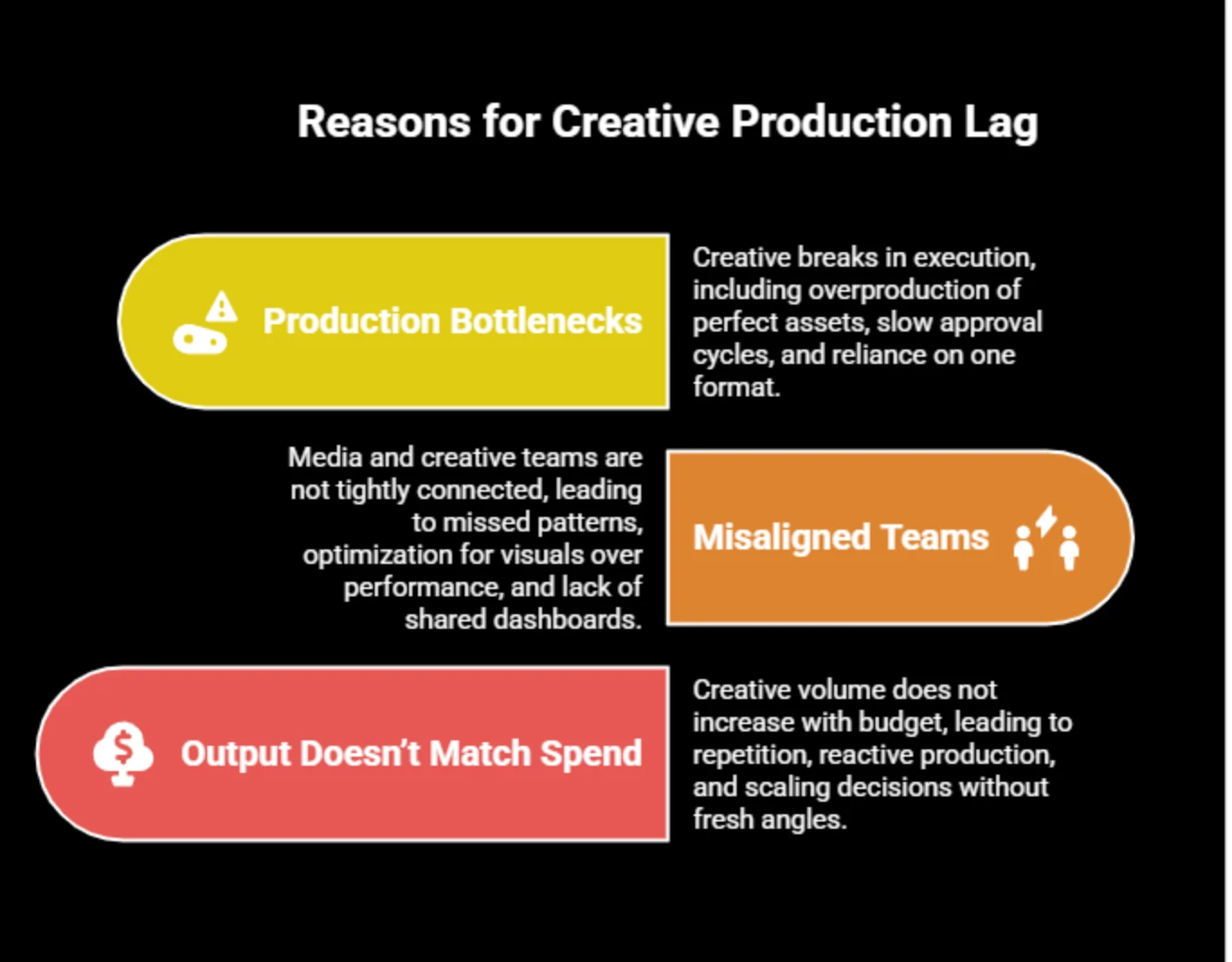
1. Production Bottlenecks
Creative breaks in execution, but here’s what that looks like in practice:
Teams overproduce a few “perfect” assets instead of shipping steady variations.
Approval cycles slow everything down, so refreshes arrive late.
The team relies on one format, so every new concept feels heavy.
The result is simple: output stays low while exposure stays high.
P.S.: We have noticed that approval loops usually look harmless until you realize they slow refresh cycles below the pace of creative decay.
2. Misaligned Teams
Even strong teams underperform when media and creative are not tightly connected.
When that alignment is missing, you usually see:
Media buyers spot patterns that never make it into briefs.
Creative teams are optimizing for visuals instead of performance signals.
No shared dashboard that ties angles and hooks to CPA or ROAS.
In our daily practice, a focused weekly review prevents this drift. We center it on three things: what scaled, what decayed, and what needs to be built next based on performance data.
In our daily practice, a focused weekly review prevents this drift. We center it on three things: what scaled, what decayed, and what needs to be built next based on performance data.
3. Output Doesn’t Match Spend
If the budget grows but creative volume does not, repetition increases faster than variation.
This usually shows up as:
Creative volume increases only after performance drops.
Production is becoming reactive instead of planned.
Scaling decisions are happening without fresh angles ready.
More diversity improves efficiency, and that’s a structural advantage.
Why “Finding The Next Winner” Is The Wrong Strategy
When performance drops, the instinct is to hunt for the next winner. This approach works on small budgets, but it breaks once spending grows.
The issue is that they do not last. To understand why, we need to look at how creatives behave over time:
The Myth Of The Evergreen Winner
Most “winners” are situational. They perform in a specific moment, inside a specific delivery context, to a specific audience mix.
As repetition increases, performance typically softens. And when you push the budget harder into the same concept, returns usually shrink.
We have observed that teams usually over-scale one asset because early performance looks strong. This short-term spike creates long-term decay.
The Real Shift High-Growth Brands Make
High-growth teams stop chasing single assets. They scale systems instead.
They move:
From hero ads to modular variations built around strong angles.
From campaign launches to rolling experimentation.
From “what won” to “why it won,” documented in a way the team can reuse.
This is where most teams hesitate. They celebrate the asset instead of extracting the pattern.
When the system is built for throughput, fatigue stops being a surprise.
Creative As A Throughput Game
This is the core reframing: creative advantage is pace plus structure.
This means:
Velocity over perfection.
A predictable testing cadence.
Separate lanes for testing and scaling so learning doesn’t interrupt growth.
From what we have seen, when the system supports throughput, fatigue becomes manageable instead of disruptive.
If spending is scaling, variation has to scale with it, otherwise performance will eventually give out.
How To Avoid Meta Creative Fatigue Without Burning Out Your Team
You avoid fatigue when production grows in structure, instead of chaos.
If your solution to fatigue is “just make more ads,” your team will burn out. But if your solution is a structured creative testing engine, the output becomes predictable.
Here’s what that looks like in practice:

Step 1: Define Creative Angles Systematically
Before you produce anything, define the angles you are testing. An angle is a strategic entry point into your offer.
Start with:
Core value propositions.
Persona-specific hooks.
Objection-driven messaging.
Proof-driven positioning.
This is where most teams rush. They jump into execution without defining the belief behind the message.
Instead of asking, “What ad should we make?” ask, “What belief are we testing?” This keeps production focused and prevents random variation.
In our experience, teams that document angles before production reduce wasted creative volume significantly.
P.S.: Most high-performing UGC hooks on Meta and TikTok succeed because they frame the belief before they sell the product.
Step 2: Build A Variation Engine
Once the angle is defined, the variation becomes easier. You are no longer reinventing the concepts; you are swapping components within a structured framework:
Hook swaps.
CTA swaps.
Visual swaps.
Background variations.
UGC script variations.
This is where modular thinking wins. One strong structure can produce multiple platform-native ads without multiplying effort.
We have noticed that teams that build variations this way scale faster because they separate thinking from execution.
Pro tip: If you are running Meta and TikTok, this matters even more. TikTok’s 2025 SMB Creative Playbook emphasizes how critical format-native elements like audio are to performance. Creatives built for the platform behave differently from recycled assets.
Step 3: Separate Testing From Scaling
Most accounts mix testing and scaling inside the same campaigns. That muddies signals and creates instability.
A cleaner structure looks like this:
Testing campaigns explore new angles.
Scaling campaigns refresh validated angles with new variations.
This separation protects what is working while still feeding the system new insight. It also prevents the classic mistake of cutting a promising test too early because it is competing with established winners.
In our daily practice, separating these lanes improves decision clarity almost immediately.
Step 4: Track Creative Lifespan
If fatigue is predictable, lifespan should be tracked. Instead of reacting when performance drops, document:
Average spend before decay.
Frequency of decay.
CTR drop-off patterns.
Once you understand how long a concept holds efficiency, you can schedule refreshes instead of waiting for a decline.
We have learned that teams that track lifespan stop reacting emotionally to dips. They operate on timing instead of panic.
Step 5: Create A Feedback Loop Between Media And Creative
Creative and media should operate as one growth system.
A simple loop keeps them aligned:
Weekly performance review.
Hook-level reporting, not just ad-level.
Angle tagging in your tracker.
Clear “kill, iterate, scale” decisions.
Clarity is the objective. Every week, the team should know what to double down on, what to iterate on, and what to retire. That rhythm keeps velocity high without overwhelming production.
Pro tip: Ad creative testing works when the method is clean: one main variable changes, and promotion rules are decided before launch.
How Does a Good Meta Creative Strategy Look in Practice
In theory, it’s easy to agree with creative systems. But when the budget goes up, that’s when the real test comes.
At Creative Milkshake, we have applied this structured creative velocity model across multiple accounts at different spend levels.
In this section, we’ll break down how we implemented the system and how it helped brands maintain efficiency while scaling.:
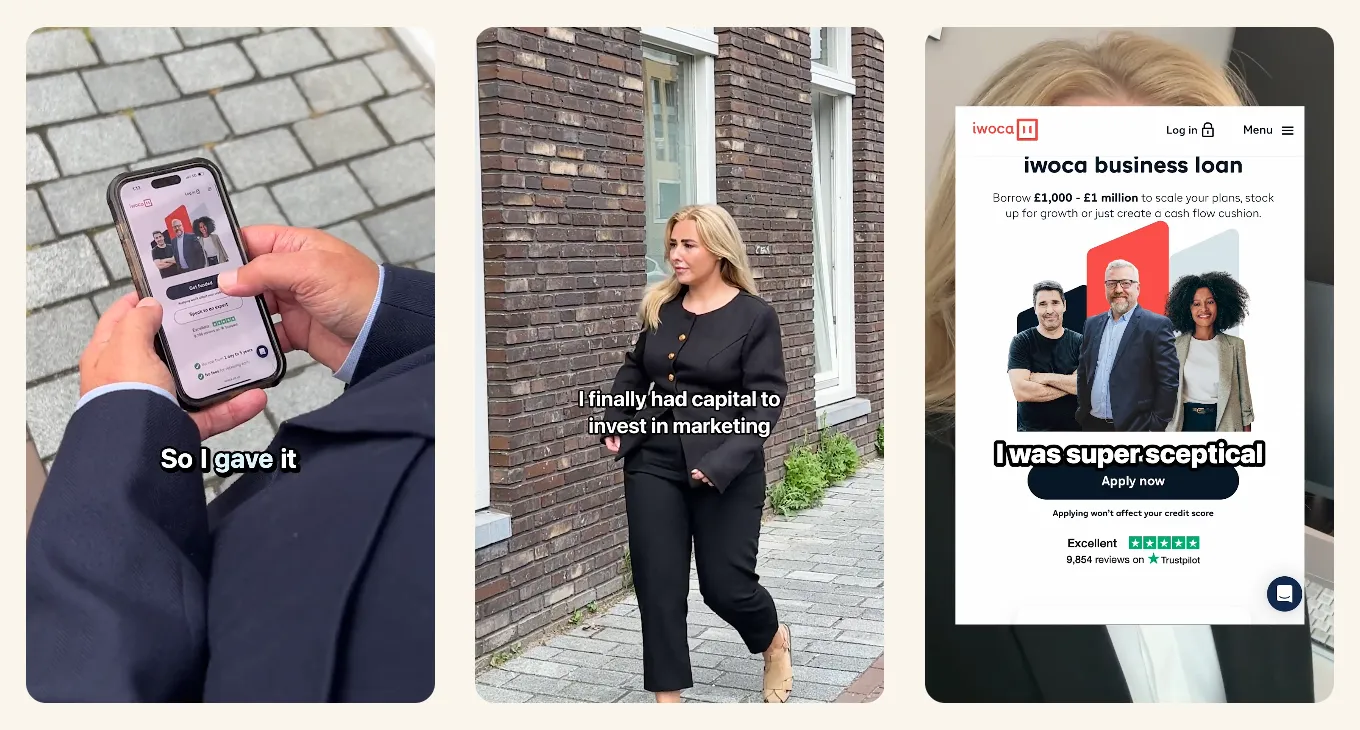
1. iwoca
iwoca needed to scale paid social without losing efficiency or control. Instead of chasing isolated winners, the focus shifted to building consistent variation output.
Instead of chasing isolated winners, our team focused on building a consistent variation engine tied to performance data.
We developed 15 new ad concepts, produced 5 structured iteration rounds, and generated 60 ads across formats. That creative volume supported sustainable growth and enabled iwoca to double its Meta ad spend while maintaining efficiency.
What made the difference was structured variation aligned with live performance signals. That structure reduced fragility as the budget increased.
2. N26
When we partnered with N26, acquisition efficiency on Meta was under pressure. Our focus shifted toward creative diversification built around lo-fi UGC and platform-native execution.
We expanded variation across hooks, scripts, and delivery formats while keeping performance data at the center of iteration.
That structured approach reduced cost per mobile registration by 65%, while stabilizing performance at scale.
This is what outproducing fatigue looks like in practice. Instead of stretching one polished asset, we introduced new angles and formats at a controlled pace, keeping exposure ahead of saturation.

3. LOLA
When we worked with LOLA, we combined repurposed assets with net-new creative production under a data-led testing framework.
Our team structured variation across formats while prioritizing performance signals in every iteration cycle.
That system drove 165% quarter-over-quarter revenue growth and reduced CPA on Meta by 40%.
Remember that when the creative output is structured and diversified, efficiency improves because variation stays ahead of repetition.
Across all three examples, the common thread is not a single breakout ad. It’s a repeatable creative system designed for paid social environments where fatigue is inevitable, and velocity is an advantage.
Insider tip: The best Meta ads agencies in the US combine media thinking and performance creative, so scaling your brand does not depend on one hero asset.
Overcome Meta Creative Fatigue with Creative Milkshake
Scaling on Meta puts pressure on the creative. The brands that stay efficient are the ones that treat creative like a growth lever.
When testing is structured, output is consistent, and media and creative work are one system, performance stops swinging every time budgets increase. You gain control, clarity, and scale with intent.
If your team is constantly refreshing ads without building momentum, it’s time to upgrade the system behind them.
At Creative Milkshake, we build creative performance and paid social systems designed to support real scale.
Ready to build a creative engine that keeps pace with your spend? Let’s talk.
FAQs
How Is Creative Fatigue Different From Ad Creative Fatigue?
Creative fatigue refers specifically to performance decline caused by repeated exposure to the same messaging or formats. Ad fatigue, in contrast, is broader. It can include creative repetition, but it may also result from offer issues, targeting changes, placement problems, or tracking shifts.
How Do You Reduce Meta Creative Fatigue?
Increase creative velocity, run a clean A/B test structure, monitor frequency caps, and refresh before performance declines.
What Metrics Signal Creative Fatigue Early?
Watch CTR, video completion rate, rising frequency, and cost trends inside Meta Ads Manager to spot early decay.
How Many Creatives Should You Test per Week?
There’s no fixed number, but common practice scales with spend. Smaller accounts often aim for about 4–8 new creatives per month (roughly 1–2 per week), while larger accounts testing high volumes may run 8–20+ new creatives per month (about 2–5 per week) to keep variation ahead of saturation.
Can Attribution Platforms Help Identify Creative Fatigue?
Yes, but only partially. Attribution platforms can show performance shifts and trend changes across channels. However, they do not replace structured creative testing. They provide context around performance movement, not a direct diagnosis of creative fatigue in isolation
How Does Creative Milkshake Prevent Creative Fatigue?
We build structured testing systems, align creative briefs with media strategy, and use performance dashboards to turn insights into the next round of ads.