Sometimes, you can launch a campaign with a solid plan, and the numbers still behave like they have their own agenda.
One creative drives clicks but not conversions, another converts at a painful CPA, and a third performs well for a week before quietly fading.
At that point, it’s tempting to blame the algorithm, the audience, or the offer. In most cases, the real issue is simpler: you’re not deriving clear signals from your ad creatives, so you don’t have a clean way to prove what works.
That’s why you need to implement solid ad creative testing. Platforms automate targeting and delivery better than ever, so creative has become the most controllable lever in your account.
It’s what stops the scroll, sets expectations, and tells the platform who should see your ad.
In this blog, we show you what to test first and how to set up clean experiments. Keep reading to scale what works without burning your creative out.
P.S.: If your testing feels unstructured, it’s probably time to rethink the system behind it. That’s exactly what we help brands build at Creative Milkshake.
TL;DR
If you only have time to take a few things from this guide, take these:
Ad creative testing is a structured way to pinpoint what drives performance, allowing you to stop making random tweaks.
Creative is the lever you control most in paid social, especially now that platforms automate targeting and delivery.
On Meta, creative can account for 56–80% of outcomes, depending on the analysis.
Up to 65% of campaigns miss their objectives due to creative problems, which is why “good targeting” rarely saves weak ads.
Test the big levers first: angles, hooks, and formats. Save small edits (CTA wording, length, captions, thumbnails) for after you have a clear winner.
Separate testing from scaling so experiments stay clean and winners keep momentum.
Don’t judge ads by CPA alone. Use CTR, hook rate, hold rate, and conversion alignment to diagnose what’s broken.
Refresh creative proactively to avoid fatigue. At scale, many top-performing ads last fewer than 30 days, so a steady testing rhythm protects performance.
Social proof hooks can drive very strong Day 7 retention (around 21%) yet tend to be underfunded; structured testing can uncover missed opportunities exactly like this.
What Is Ad Creative Testing, and Why Does It Matter So Much Today?
Ad creative testing is a structured approach of comparing ad creatives so you can see what improves performance and why. It’s a controlled test with a clear variable, a clear goal, and clean performance data.
This matters more now that paid social has become more widely used. Besides, in a TripleLift survey, over 80% of marketing professionals agreed that creative drives ad performance, which is why testing it with structure is worth the effort.
And it’s true: good creative can be extremely persuasive. It sets expectations, earns attention, and signals relevance to both the audience and the algorithm.
That impact is measurable. The Adamigo and the Enrich Labs analyses put creatives’ influence on Meta outcomes in the 56–80% range, depending on the model used.
Toluna also reports that up to 65% of campaigns miss objectives due to creative issues. The takeaway is simple: if the creative is weak or unclear, “better targeting” rarely fixes it.
Why Is Creativity Now Your Biggest Advantage
Platforms optimize quickly, but they optimize based on how people respond. Creative shapes that response. It’s what grabs attention first and drives the engagement and conversions the algorithm learns from.
When your creative is specific, you usually see stronger click-through rates and cleaner conversion intent.
When it’s generic, CPM tends to rise, and CTR tends to decrease. CPA follows after that, even if the offer and audience are unchanged.
This is also why creative velocity and testing cadence matter. Winning ads do not stay fresh forever, and many top performers at scale have a short lifespan, sometimes under 30 days.
Testing keeps you ahead of fatigue, instead of reacting after costs spike.
Key Stat: If you ever doubt how much creative can move results, PointCard saw a 240% increase in CTR and a 275% boost in conversion rates after refreshing campaign creatives. That’s the upside you’re aiming for when you test with structure.
What Counts as Ad Creative Testing?
Ad creative testing includes any intentional comparison where you can attribute performance shifts to a specific creative decision, such as:
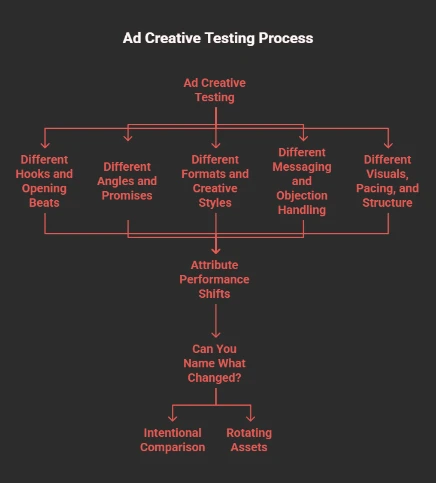
Different hooks and opening beats: These are how you earn attention in the first seconds. You might open with a sharp pain point, a bold claim, or a visual that breaks the scroll. The goal is to see which entry point pulls people in.
Different angles and promises: Here, you’re playing with the core idea behind the ad. One version might focus on speed, another on savings, and the other on status or simplicity. The angle changes how the same product is perceived.
Different formats and creative styles: This includes UGC clips, tutorials, product demos, creator-led explainers, and A founder speaking to the camera builds authority. A tutorial-style UGC clip builds clarity. And a product demo builds understanding. Format influences trust and how quickly your value proposition clicks.mobile game advertising creative where the format itself can change how quickly users understand the offer. The question is not only what you say, but how the message is delivered.
Different messaging and objection handling: One variation might lean on social proof. Another might tackle price concerns or risk directly. Each message speaks to a different pain point your target audience may have.
Different visuals, pacing, and structure: Even with the same script, tighter edits, clearer captions, or a stronger first frame can shift hold rate and engagement in a noticeable way.
Pro tip: If you can’t clearly name what changed, maybe you’re just rotating creative and hoping the ad campaign sorts itself out.
What Should You Test First? Start With the Big Levers
If testing feels messy, the problem is usually setting the priority. Teams spend too much time polishing minor elements while core elements are still unproven.
The fastest wins come from testing the big levers first, because they create the biggest swings in ad performance.
Once you find a winner, small tweaks become worth your time. Let’s see which could be a good order to proceed:
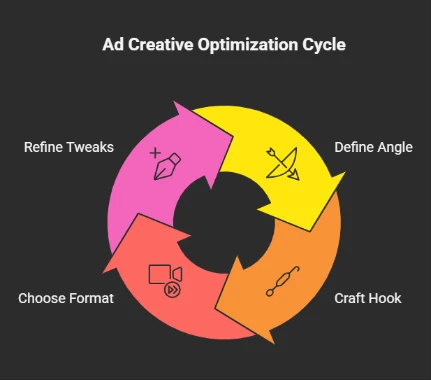
1. Angles (the Big Idea Behind Your Ad)
Angles decide what the ad is really about. They frame the promise and set the lens through which every benefit is interpreted, which is why They frame the promise and set the lens through which every benefit is interpreted. If the angle misses, strong editing won’t save it.SaaS messaging strategies often start with positioning before execution. If the angle misses, strong editing won’t save it.
High-performing angles usually fall into patterns like these:
Solving a specific pain point with a clear payoff.
Showing a transformation that feels believable.
Addressing objections directly and confidently.
Using social proof that feels current and concrete.
Comparing alternatives in a crowded category.
A practical rule: if the angle cannot be summarized in one clean sentence, it will be hard to scale.
2. Hooks (the First 3 Seconds)
Hooks catch attention, and attention is the entry point for everything else. This is where scroll-stopping creative becomes real, or it dies quietly.
Reliable hook styles include:
A direct pain statement that feels specific.
A bold claim that stays believable.
A surprising fact that reframes the problem.
A question that pulls the viewer into the next line.
A visual pattern interrupt that fits the platform.
Instant gratification hooks are also worth testing on purpose, especially if you’re chasing quick wins.
AppsFlyer also found that these hooks get double the spend in DSPs compared to social & search, while DSPs deliver 17% better Day 7 retention.
That’s a useful reminder that “scales fast” and “retains well” can be different outcomes, so your hook tests should match your actual goal.
3. Formats (How You Deliver the Message)
Format changes trust, clarity, and how quickly the offer lands. It also affects how easy it is to maintain creative velocity, especially if it’s lightweight and modular.
Formats that tend to perform well in paid social include:
UGC-style videos that feel native, not overproduced.
Founder-led videos when authority drives conversions.
Testimonial cuts for higher-consideration offers.
Product demos that show the “how” quickly.
Before-and-after when the transformation is visual.
Once you find a format that fits, iteration becomes faster because the structure stays consistent.
Tutorial-style UGC is a good example of format to test. In the AppsFlyer’s 2025 report, creative optimization data shows that testimonials take 88% of UGC spend, but users who engage with tutorial-style content show 37% better retention.
That’s a clear signal to test “show me how it works” creative, even if your account has been living on testimonials.
Remember: The real edge usually comes from structure. This is exactly why UGC hooks that scale on Meta and TikTok tend to follow repeatable patterns instead of random trends.
4. Small Tweaks (Only After You Find a Winner)
Small edits matter, but they matter most after you have your testing results. Otherwise, you risk optimizing a concept that is not strong enough to scale.
Save these for later:
CTA wording and offer framing.
Video length and pacing.
Thumbnail and first-frame choices.
Captions and on-screen text clarity.
If you want a clean order of operations, use this: angle first, hook second, format third, and micro-edits last. This is how structured creative testing stays efficient instead of chaotic.
What Mistakes Slow Down Your Ad Creative Testing?
Some “small” habits could feel efficient, but are, in fact, mistakes that slow down your ad creative. Let’s see which are the common ones:
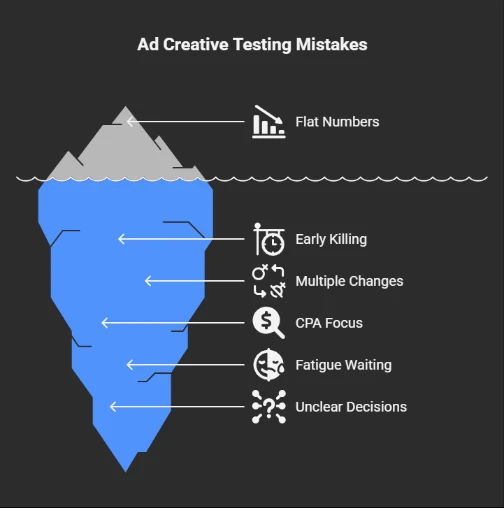
Killing Ads Too Early
It’s easy to pull the plug after a few days because the numbers look flat. The catch is that early delivery can be noisy, especially on paid social.
Give your test enough time to collect data, then decide with a steadier view of performance. You’ll avoid cutting creatives that would have stabilized with a bit more time.
For paid social, you generally want at least:
1,500–3,000 impressions to judge hook strength (CTR signal)
2–3x your target CPA worth of spend before judging conversion efficiency
Or ideally 20–30 conversion events if you’re evaluating CPA seriously
If you kill an ad after $50–$100 in spend with 1 conversion or none, you’re reacting to randomness.
Testing Too Many Changes at Once
Big changes are fine. Multiple big changes in the same ad are where things get messy. If you swap the hook, angle, and format at once, you can’t tell what caused the outcome.
Keep the test clean by changing one major variable, then stack improvements once you’ve found traction.
Only Looking at CPA
CPA matters, but it shows up late. If you wait for a CPA to diagnose the issue, you end up fixing problems after they’ve already cost you money.
Use earlier signals to spot what’s happening, then let CPA confirm the direction.
Waiting Until Fatigue Forces a Refresh
Fatigue usually presents as a slow, dragging sensation. People stop reacting, CPM inches up, and CPA starts creeping in the wrong direction.
If you wait until performance really hurts, you’ll end up rushing new creative out the door, and rushed creative is rarely your best work.
As Brian Bowman, a former Forbes Councils Member, puts it:
“Heavy, constant creative testing is necessary to uncover winning ads that significantly improve ROAS. Large direct-response advertisers are testing hundreds of creatives and must deliver a steady supply of new concepts to avoid ad fatigue and maintain a positive ROAS at scale. Top-performing ads often last fewer than 30 days, which means continued testing is necessary to offset natural performance decline.”
The move here is simple: refresh before you feel forced to. Keep a small bench of new concepts ready, rotate in variations regularly, and you’ll stay in control of performance instead of chasing it.
Running Tests Without a Clear Decision
A test should answer a question, not just add another asset to the account.
Before you launch, decide what you’re trying to discover and what you’ll do based on that. That keeps your testing engine focused and helps results compound over time.
P.S.: Creative testing only works when approval speed matches testing ambition. If launches slow down, your data slows down too, and performance plateaus.
How Do You Scale Winning Creatives Without Burning Them Out?
Scaling works best when you treat a winning creative as concept validation, not a single asset to squeeze dry. You want to keep the core idea intact while adding enough novelty to stay interesting.
AppsFlyer’s 2025 report also analyzed 1.1M video creative variations across $2.4B in ad spend, and the pattern is consistent: winners come from intentional volume and iteration.
That comes down to three moves you can apply every time:
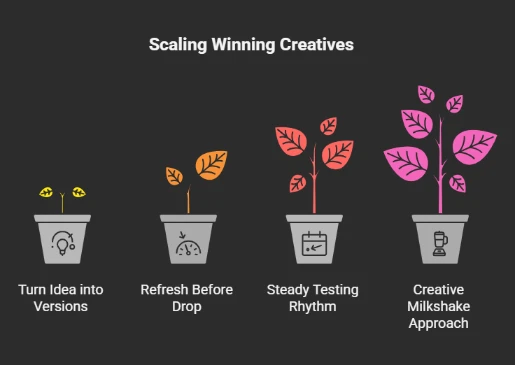
Turn One Winning Idea Into Multiple Versions
Start with the winning angle, then create variations that keep the message stable while changing the entry point:
New hooks that open the same idea in different ways.
New visuals that keep the promise but shift the pattern.
New intros that tighten the first seconds without rewriting the whole script.
This keeps the creative fresh while preserving what made it work.
Refresh Before Performance Drops
Once people feel like they’ve “seen it,” attention drops first, and your ad’s efficiency follows fast.
Refreshing earlier keeps you in control and protects the scaling window. It also prevents the familiar cycle where performance dips, then everyone scrambles.
Keep a Steady Testing Rhythm
A weekly cadence usually does the job. Keep one lane for experiments and one lane for proven winners, and keep feeding the account new creative assets so scaling stays predictable.
How Creative Milkshake Approaches This
Creative Milkshake builds performance creative around a simple operating rhythm: test, iterate, scale.
The focus stays on platform-native ads that can handle budget, paired with structured creative testing that turns winners into scalable variants.
That way, growth doesn’t depend on one “hero ad,” and performance stays predictable as spending increases.
Keep Your Best Ads Alive With Ad Creative Testing
If paid social has felt a bit unpredictable lately, you’re not imagining it. Ad creative testing is how you bring order back without overcomplicating things.
Keep it simple: test the big levers first, ship new variations on a steady weekly rhythm, and refresh before fatigue shows up.
If you want a hand building a testing engine that moves fast and stays clean on Meta and TikTok, reach out to us. We’ll help you turn creative into a reliable growth lever!
FAQs
What Is Ad Creative Testing, and Why Is It Important?
Ad creative testing compares creative variants to see what improves performance and why. It strengthens ad effectiveness by aligning creative decisions with real performance metrics.
How to Test an Ad Creative?
Start with a simple creative concept and test one major change at a time. Keep the offer consistent and run clean A/B tests so you can trust the result.
What Are the Best Practices for Ad Creative Testing to Improve Campaign Performance?
Focus on angles, hooks, and formats before micro-edits. Track performance metrics early, separate testing from scaling, and align every test with clear campaign goals.
Which Methods Are Commonly Used for Ad Creative Testing in Digital Marketing?
Brands rely on A/B tests, split testing, and iteration across ad variations. The goal is to compare ad variants cleanly and scale what performs across media platforms.
How Does A/B Testing Compare to Multivariate Testing in Ad Creative Evaluation?
A/B tests isolate one change, making results easier to read. Multivariate testing changes multiple creative elements at once and requires more budget to stay reliable.
How Does Ad Creative Testing Impact Overall Advertising ROI?
It improves ROI by reducing wasted ad exposure and focusing the budget on creatives that resonate with the target audience. As you reallocate spend toward proven creatives, performance improves incrementally across the entire ad campaign.
We’re Busy. How Can Creative Milkshake Get Involved Without Adding Work for Our Team?
We build and manage a structured advertising creative testing system, from creative strategy to scalable ad variants. Your team reviews direction while we handle execution.
We Have an In-House Media Buyer. What Does Creative Milkshake Do Then?
We focus on performance creative and creative automation to increase velocity, while your media buyer manages budgets and audience segments inside the ad campaign.