
Scaling paid social looks simple on paper. Increase the budget, reach more people, and conversions should follow. But in practice, the opposite can happen, too: spend rises, delivery expands, and suddenly CPA jumps.
And when that happens, the problem rarely sits in the budget itself.
More frequently, the issue sits in the system behind the campaign.
We’re talking about weak creative testing, rushed scaling decisions, or a fragile campaign structure.
So the real question is not whether you can spend more. It is whether the system behind your campaigns can support that spend.
This guide explains how to scale paid social without breaking performance, with great examples from experienced marketers.
Let’s dive in.
P.S. Want a team that builds paid social systems that scale? At Creative Milkshake, we help brands achieve predictable growth through creative testing and solid campaign structure. Contact us today if you want to scale without pushing CPA up.
TL;DR
Scaling paid social means either increasing your campaign budget (vertical scaling) or expanding on new markets, channels, or audience segments (horizontal scaling).
Many campaigns break because marketers increase budgets before optimizing creative, targeting, or campaign structure.
Scaling works best when three systems grow together: creative output, audience expansion, and budget optimization.
Gradual vertical scaling (≈20% every 48-72 hours) helps platforms adjust without resetting delivery.
Horizontal scaling expands reach through lookalikes, interests, or new markets.
Increasing creative volume prevents fatigue and keeps engagement signals strong.
Separate testing and scaling campaigns to protect performance during growth.
Use automation tools carefully, with guardrails that protect CPA.
Monitor early metrics like CTR, CPM, and frequency before CPA rises.
What Does Scaling Paid Social Actually Mean?
Scaling paid social means growing results from your ad campaigns without hurting efficiency.
There are two main ways to scale:
Vertical scaling increases budgets on campaigns that already perform well.
Horizontal scaling expands performance by testing new creatives, audiences, placements, or even new platforms.
The goal is to generate more revenue while keeping CPA stable and ROAS healthy.
Of course, spending more money is easy. Scaling profitably is harder.
Effective scaling depends on three elements growing together.
Creative volume: Paid social performance is largely creative-driven. Some studies estimate that creative can determine approximately half of incremental sales, which is why high-growth brands constantly test new concepts, formats, and hooks.
Audience expansion: Scaling requires reaching new potential buyers. This can include broader targeting, lookalike audiences, or new markets. Without expanding reach, delivery simply recycles the same users.
Budget increases: Budgets typically scale best through gradual increases. That way, the platform keeps optimizing toward recent conversions rather than restarting the learning process.
If you focus on these three elements, your campaigns can scale while maintaining stable performance.
Watch the video below for a quick breakdown of how scaling Meta Ads works and why these factors matter when increasing ad spend.
This leads us to why it breaks down.
Why CPA Typically Breaks When You Scale
Scaling paid social looks easy on paper: increase the budget and generate more conversions. In reality, costs often rise when spend increases too quickly.
Most campaigns struggle during scaling for four predictable reasons.
Sudden Budget Increases Reset Optimization
Ad platforms learn who is likely to convert based on recent conversion data. When you suddenly double or triple the budget, the platform must reach new users it hasn’t tested yet.
Until enough new conversions happen, performance becomes unstable.
Meta estimates that an ad set needs about 50 optimization events in seven days (such as purchases or leads) for delivery to stabilize. If your spend increases faster than those conversions appear, CPA usually fluctuates.
Creative Fatigue
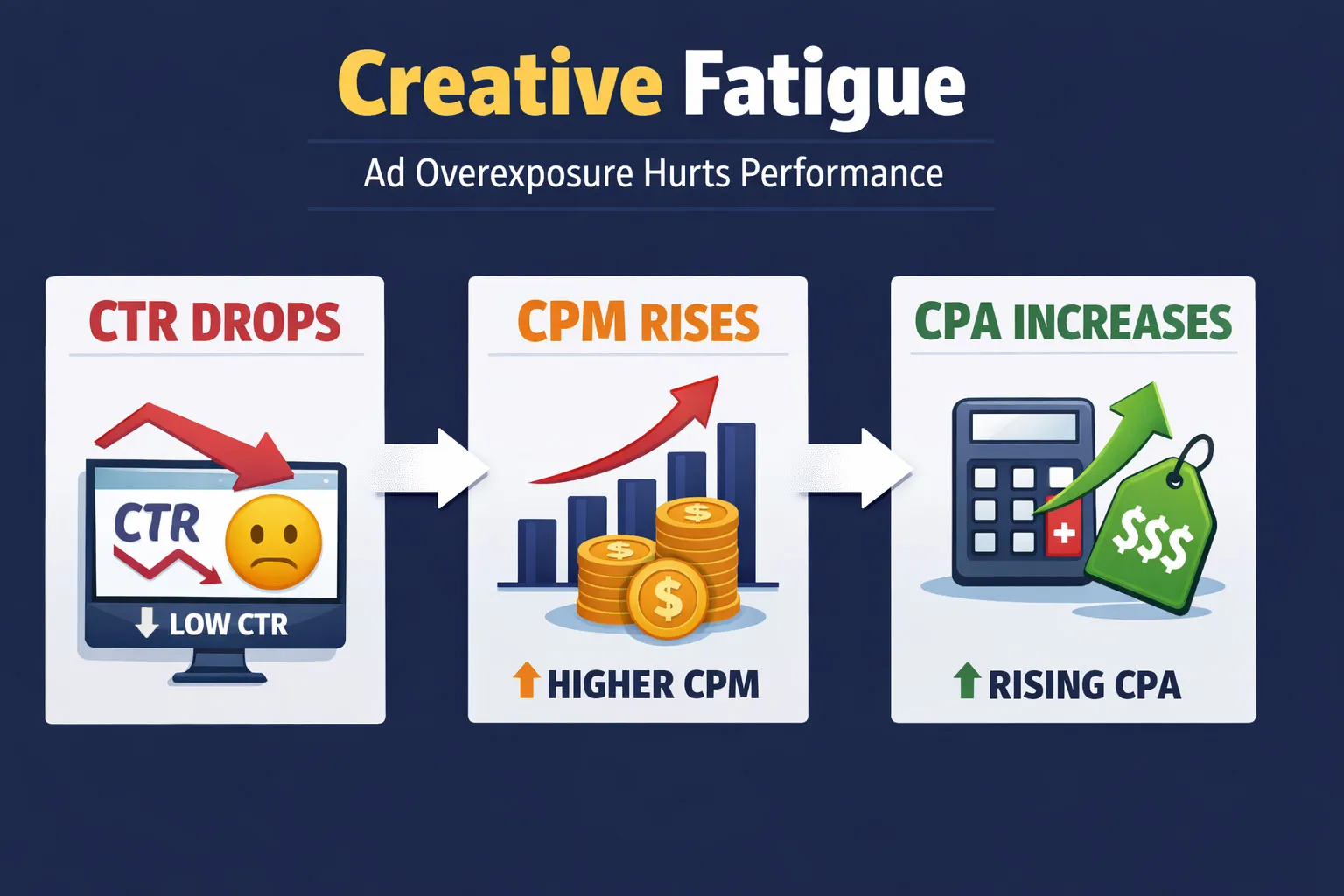
Scaling increases how often people see the same ads.
When exposure frequency rises, fewer users click or engage with the creative. Lower engagement then reduces your ad performance, which forces the platform to bid higher for impressions.
And as CPM rises, CPA typically increases as well.
That's how you experience creative fatigue in your campaigns.
Audience Saturation
If you scale spend without expanding your audience, the platform quickly runs out of new people to show ads to.
The same users see the ads repeatedly, engagement declines, and conversion rates fall. Expanding audiences through broader targeting or lookalikes can maintain efficiency during scaling.
Weak Creative Testing
Many teams try to scale using one successful ad. But paid social performance depends on continuous creative testing.
Without new creatives entering the campaign, performance eventually plateaus and costs increase. In many cases, the real scaling constraint is not targeting or bidding, but a lack of fresh creative concepts.
So the next step is understanding how to scale spend without triggering those cost increases.
The 7 Proven Ways to Scale Paid Social Without Killing CPA
Scaling spend safely requires structure behind every decision. Here are seven proven ways you can scale paid social while keeping performance under control.
1. Scale Budgets Gradually (Vertical Scaling)
Vertical scaling means increasing the budget on a campaign that already performs well, while keeping the same creatives and targeting.
The main risk is increasing spend too quickly.
When budgets jump sharply, the platform must deliver ads to many new users it hasn’t tested yet. Until enough conversions happen in those new segments, CPA often fluctuates.
A common rule is to increase budgets by about 20% every 48–72 hours. This gives the platform time to generate new conversion data before the next increase.
As you scale, watch the core performance indicators:
CTR: Falling CTR often means the creative is losing attention
CPM: Rising CPM can signal audience saturation or weaker engagement
CPA: Confirms whether the campaign is still acquiring customers efficiently
Pro tip: If CTR remains stable, CPM stays relatively consistent, and conversions continue to grow, the campaign is usually handling the additional spend well.
2. Expand Horizontally Into New Audiences
Horizontal scaling means reaching new potential buyers, not just increasing budgets on the same campaign.
If you only raise spend on one audience, the same users start seeing your ads more often. Frequency rises, engagement drops, and CPA usually increases.
That’s why we advise expanding the pool of people your ads can reach.
From our experience, the most effective ways to do this are:
Build lookalike audiences based on your best customers
Test new interest groups or broader targeting
Expand into new regions or countries
Launch campaigns on additional channels, such as TikTok, YouTube Shorts, or Pinterest if you started on Meta
Lookalike expansion is typically the fastest way to extend reach. In fact, one analysis of more than 200 e-commerce ad sets found that 1% lookalike audiences produced about 26% lower CPA than standard interest targeting.
Here’s a simple way to test new audiences without disrupting your existing campaigns:
Identify the audience generating the most conversions.
Create a 1-5% lookalike audience from those users.
Duplicate your top-performing ad set.
Apply the new audience while keeping the same creative.
Run both ad sets in parallel and compare CPA and conversion volume.
Once the new audience proves profitable, increase its budget.
This approach lets you expand reach without risking the performance of campaigns that are already working.
Side note: Watch the video below to see the difference between horizontal scaling and vertical scaling in paid social campaigns:
3. Increase Creative Volume (The Most Overlooked Lever)
Budget and targeting matter, but creative typically determines whether scaling works or breaks. And the main reason performance declines is creative fatigue.
As we explained above, when the same ads appear repeatedly, attention drops. CTR falls, the engagement rate weakens, and the platform raises CPM to win impressions. That chain reaction pushes CPA higher.
Creative volume helps prevent that cycle.
More ideas give the algorithm fresh signals and keep delivery competitive.
So the goal is to feed the system with new inputs regularly. These are the most effective ways to increase creative velocity:
Test new creative hooks that frame the offer differently and attract new attention.
Introduce different ad formats to reset user engagement patterns.
Launch UGC variations that feel more native to the feed.
Rotate messaging angles that show different product benefits.
Work with new creators to bring fresh perspectives and delivery styles.
Remember: More creative inputs mean more performance signals. And when the system receives those signals consistently, scaling becomes far more stable.
4. Separate Testing Campaigns From Scaling Campaigns
Mixing testing and scaling in the same campaign tends to lead to unstable performance. Early-stage ads still generate inconsistent signals, and when large budgets hit those ads too quickly, delivery typically becomes unpredictable.
From our perspective, the easiest solution is structural.
Instead of running everything in one place, separate testing from scaling. This structure keeps the system organized. Each campaign serves a different role in the account.
Here is a simple framework many experienced media buyers follow:
This structure helps you scale without hurting performance.
First, keep testing campaigns on smaller budgets. This gives new creatives time to generate reliable data before you put serious spend behind them.
Second, use separate scaling campaigns for ads that are already converting well. When you only scale proven creatives, the platform can optimize more consistently.
Finally, run dedicated retargeting campaigns to convert warm audiences. People who already visited your site, watched your videos, or interacted with your ads are much closer to buying. Retargeting keeps those prospects moving toward conversion while your prospecting campaigns bring new users into the funnel.
5. Use Platform Automation (But With Guardrails)
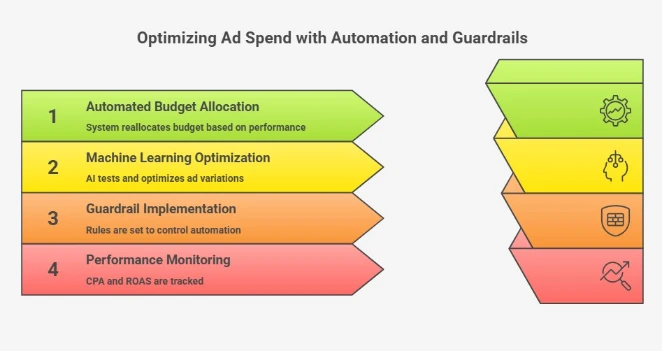
Automation can accelerate scaling when used correctly. Most modern ad platforms include tools that help distribute spend based on real performance signals.
For example, campaign budget optimization automatically reallocates budget toward the best-performing ad sets. Instead of manually allocating spend, the system itself increases budget where conversions are more likely.
And newer automation systems go even further.
Campaign types like Meta Advantage+ Creative rely on machine learning to test variations and optimize delivery across multiple audience signals. In fact, internal Meta studies show these campaigns can lower CPA by about 17% while increasing ROAS by roughly 32% compared with standard setups.
But automation still needs control. Without clear limits, systems may scale weak creatives or unstable audiences too quickly.
So experienced advertisers apply simple guardrails. These rules keep automation aligned with performance goals:
Pause campaigns automatically if CPA rises above a defined threshold using automated rules.
Increase spend only when ROAS remains stable over a set time window.
Maintain creative diversity so the algorithm receives multiple performance signals.
With the right controls in place, automation supports scaling while keeping performance predictable.
6. Monitor Early Warning Metrics
CPA rarely rises without warning. In most cases, you can see other signals first. Pay attention to them so you can react before performance declines.
The most important metrics include:
CTR, which shows whether creatives still attract attention.
CPM, which reflects competition and auction pressure.
Frequency, which reveals how frequently the same user sees an ad.
Conversion rate, which signals whether traffic still converts on the landing page.
For example, performance studies show that a 10-15% week-over-week drop in CTR typically signals early creative fatigue. And if you do experience creative fatigue, you can bet your acquisition costs will rise, too.
Audience exposure also plays a role. In fact, when ad frequency climbs above 3-4 impressions per user, then engagement typically begins to decline.
To interpret these signals more clearly, we use a simple diagnostic framework:
7. Build a Continuous Creative Testing Engine
Scaling paid social depends heavily on creative supply. When testing slows down, performance usually follows. So the most effective advertisers treat ad creative testing as an ongoing system.
And the key principle is simple: creative testing never stops.
New audiences, higher budgets, and changing platform behavior constantly create new performance conditions. Without fresh inputs, campaigns gradually lose momentum.
Because of this, strong teams build structured testing loops. The goal is to keep learning cycles active so the platform always receives new performance signals.
This is also how Creative Milkshake approaches scaling. Our strategy involves continuous testing, data analysis, and creative iteration. Instead of relying on one winning ad, new concepts are constantly introduced and refined as campaigns grow.
Testing systems also create compounding performance gains. In fact, research shows that even a 20% improvement in creative effectiveness can double campaign profitability, because improvements compound across impressions, clicks, and conversions.
Continuous creative systems follow a simple loop, and the process typically includes:
Research audience psychology to identify motivations, objections, and behavioral triggers.
Launch multiple creative concepts built around different hooks and messages.
Measure performance across engagement, conversion signals, and delivery stability.
Iterate winners by turning strong concepts into new variations and scaling them further.
With this system in place, creative supply keeps pace with growing budgets. And when new ideas constantly enter the system, then scaling becomes far more stable.

Real Examples of Scaling Paid Social Successfully
Scaling becomes much clearer when you look at real campaigns. So, here are a few examples that show how structured creative systems allowed brands to increase spend while keeping performance stable.
Example 1: UGC Diversification
Brand: N26
Strategy: Replace polished ads with UGC-style creative
Result: 65% lower cost per registration
N26 wanted to improve the efficiency of its paid social campaigns. When they first came to us, the brand relied heavily on polished brand ads. Those creatives looked professional but were starting to lose performance as audiences became familiar with them.
So, our Creative Milkshake team tested a different direction. Instead of traditional ads, we introduced user-generated style videos that felt more authentic in social feeds.
The goal was simple: match the native content style people already engage with.
This shift changed how their audiences reacted to the new N26 ads. Engagement increased, and the social platforms received stronger signals that the ads were relevant.
As a result, the campaign achieved 65% lower cost per registration while maintaining consistent delivery.
Example 2: Scaling Meta Spend
Brand: iwoca
Strategy: Structured creative testing
Result: 2x increase in Meta ad spend while maintaining efficiency
iwoca wanted to scale its paid social activity on Meta without losing acquisition efficiency. However, simply increasing spend would have pushed the campaign into unstable performance.
Instead, we built a structured testing framework before scaling budgets. The process entailed producing multiple creative concepts, running controlled tests, and iterating based on performance data.
Over time, this approach created a continuous pipeline of new creatives entering the campaign. Strong performers received additional spend, while weaker variations were replaced with new ideas.
Because fresh concepts kept feeding the campaign, scaling became safer.
The result was a 2x increase in Meta ad spend while maintaining performance efficiency.
Example 3: YouTube CPA Reduction
Brand: Jimmy Joy
Strategy: New creative production
Result: 25% lower CPA while increasing ad spend
Jimmy Joy wanted to grow acquisition through YouTube but needed stronger creative performance before scaling budgets.
Our Creative Milkshake team built new video concepts tailored for YouTube’s viewing behavior. We developed scripts, localized creatives, and produced multiple video variations designed to hold attention during the first seconds of the ad.
That change improved how viewers interacted with the Jimmy Joy ads. Stronger engagement signals helped the platform deliver ads to more qualified viewers.
As a result, the campaign achieved a 25% lower CPA while increasing ad spend.
Across all three examples, the pattern remains consistent. Scaling success did not come from budget increases alone. Instead, performance improved because creative diversification and systematic testing supported the growth.
But let's see if you are ready to scale paid social.
Signs You Are Ready to Scale Paid Social
Scaling works best when the campaign already shows stable performance signals. So before increasing your advertising budgets, check whether your campaign is ready to scale:
The campaign generates consistent conversions. This means the social platforms you’re disseminating your messages on receive steady optimization signals.
CPA stays stable for at least 1-2 weeks, which shows that delivery is predictable.
Multiple creatives perform well, which reduces the risk of creative fatigue when spend increases.
The audience size is large enough. This allows the channel(s) to find new users without overexposing the same group.
Conversion tracking is reliable, so budget and ad optimization decisions come from accurate data.
Pro tip: Many scaling problems actually start with weak creative testing systems. If you want to avoid that mistake, read our guide on why most brands fail at creative testing.
Ready to Scale Paid Social Without Breaking CPA?
If you read this article, you’ve seen us emphasize one point (because it’s actually the most important thing to remember):
Scaling paid social is rarely about spending more money. The real challenge is building systems that allow performance to grow as budgets rise.
When creative testing, audience expansion, and budget optimization work together, campaigns can scale without pushing CPA higher.
That is where Creative Milkshake can help.
We build creative systems that continuously test concepts, analyze performance signals, and introduce new variations that support campaign growth across Meta, TikTok, and YouTube. If you want to scale paid social while keeping acquisition costs under control, the next step is building the system behind it.
Contact Creative Milkshake today and start scaling your campaigns with performance-driven creative.