


Meta says it drove the sale. TikTok nods proudly. Google raises a hand as well. But your business only sees one purchase, which makes the victory lap a little awkward.
Today, digital advertising budgets are under the microscope, and US social media ad revenue reached $117.7 billion in 2025. So, this question matters more than ever: are your ads creating demand, or just claiming credit after the fact?
There is a big difference between someone who converted after seeing an ad and someone who converted because of an ad. So, what would happen if you paused your best-performing campaign? That’s what incrementality testing is all about.
On a side note, Creative Milkshake can be your partner for paid social advertising, backed by a measurement system that continuously optimizes spend.
TL;DR
Paid social dashboards are useful, but they do not always prove what your ads caused.
Incrementality testing compares exposed and unexposed groups to estimate net-new impact.
Retargeting typically looks beautiful in-platform because it reaches people close to buying.
Prospecting can look messy, even when it drives real future demand.
The best first test usually sits where spend is high, and certainty is low.
Use lift results to adjust budgets, targets, and creative direction.
The goal is not prettier reports but better decisions.
What Is Incrementality Testing in Marketing?
Incrementality testing in marketing is a way to measure the additional conversions, revenue, or business outcomes caused by a marketing activity compared to what would have happened without it.
The key phrase is “what would have happened anyway.” And that's where causal impact becomes the real question.
But that is also the tricky part. You cannot show the same person an ad and not show them the ad in the exact same moment. Unless your media team has discovered a portal to another universe, we need a practical workaround. Incrementality testing creates that workaround with test and control groups.
For example:
A paid social campaign reports 1,000 conversions.
A control group suggests 700 of those conversions would have happened anyway.
The incremental result is 300 conversions.
The platform did not necessarily lie, but it did measure touchpoints.
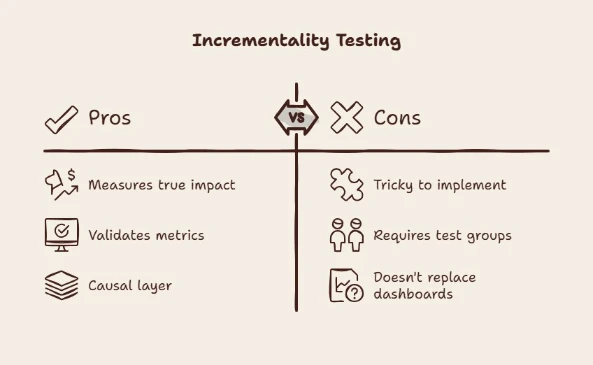
That is why incrementality is usually treated as the causal layer of marketing measurement. Of course, we don't think that it replaces every dashboard. But it can help validate whether performance metrics reflect actual business impact.
Incrementality Testing for Paid Social: Why This Matters Now
Incrementality testing is becoming increasingly relevant for understanding the impact of social media ads, as marketers divert more money toward them. Also, because paid social budgets are bigger, tracking is messier, and leadership wants proof that spend creates net-new growth.
Platform reporting helps you optimize inside Meta, TikTok, YouTube, and other channels, but it can still include conversions that would have happened anyway.
For website purchase campaigns, click attribution and conversion lift disagreed about 48% of the time, with an average CPA difference of 79% when they disagreed. And that is not a tiny footnote. That is the kind of gap that makes finance teams ask spicy questions.
But the pressure comes from three places:
Attribution inflation: Multiple platforms can claim the same customer.
Privacy and tracking gaps: Post-iOS measurement has made deterministic tracking harder.
Budget pressure: Marketing teams need to prove which spend creates net-new growth.
Prospecting, retargeting, creator ads, whitelisting, Spark Ads, broad audiences, Advantage+ campaigns, and UGC can all look strong in-platform. They just do not all create the same incremental value.
Don't get us wrong, we don't want to tell you to distrust every dashboard. But you might want to learn which numbers deserve budget decisions.
This podcast explains how Meta incrementality tests show whether strong paid social results reflect real business impact:
Incrementality Testing vs. A/B Testing, Attribution, Lift Studies, and MMM
These tools typically get tossed into the same measurement soup, but they answer different questions and carry different levels of proof. That distinction matters because not every measurement method is equally good at proving causality.
A Facebook field-experiment study used 15 US advertising experiments, 500 million user-experiment observations, and 1.6 billion ad impressions. It found that common observational methods failed to match randomized experiment results.
So, just because a model can assign credit does not mean it can prove what caused the sale. That is why multi-touch attribution can be useful for directional learning, but risky as the only source of truth.
Here are the main differences between different forms of measurement in advertising, including incrementality testing, geo-lift testing, platform-lift study, A/B testing, and Marketing Mix Modeling (MMM):
A/B testing and incrementality testing can work together across marketing campaigns. An A/B test might show that one UGC hook beats another. An incrementality test shows whether the full paid social push created net-new revenue.
We recommend using A/B testing to improve assets and use incrementality to decide whether a channel, campaign type, or audience deserves more budget.
Incrementality in Marketing: The Main Test Methods Paid Social Teams Can Use
Once you understand the “why,” the next question is usually, “Okay, how do we actually test this without breaking the business?” The good news is that you have options. But the bad news is that none of them are magic buttons.
Here are the main methods paid social teams use.
User Holdout Tests
A user holdout test keeps a portion of your target audience from seeing ads, while another portion continues to receive them. Then you compare outcomes between the two groups. This is the closest paid social gets to a clean randomized experiment when the setup allows it.
These tests are useful for platform lift studies, CRM audiences, app campaigns, and controlled audience-level experiments. They are especially helpful when you want to know whether a specific paid social tactic is doing more than following users around the internet with a tiny “remember us?” banner.
But the risk is access and trust.
Not every platform gives you clean user-level control. And native tools can raise the classic concern that the platform is grading its own homework. Still, when designed well, audience holdouts can give you a strong read on incremental impact.
Geo Lift Tests
Geo lift tests compare regions where spend changes against regions where spend stays stable. For example, you might increase Meta spend in several cities or states while keeping similar regions as your control.
This is practical for Meta prospecting, TikTok, YouTube, CTV, creator campaigns, and channels where user-level randomization is not realistic. It is also useful because it can measure effects that do not stay neatly inside one platform.
Paid social might lift branded search, direct visits, or search performance later in the customer journey.
Also, geo tests do not always require platform cooperation, which is a major advantage.
For example, a Snapchat geo-experiment meta-study across 7 brands, 2 markets, and 6 months found Snapchat contributed about 3% to 7% of total sales. That kind of read is helpful because it connects channel activity to business outcomes.
Matched Market and Synthetic Control Tests
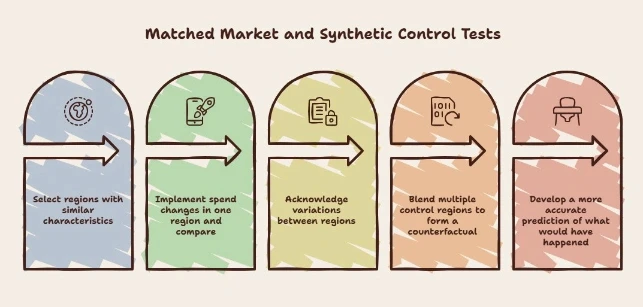
Matched market testing pairs similar regions. Think of it as a match market-style comparison. The idea for this is simple. Let's say if Austin and Portland normally behave similarly, you can change spend in Austin and use Portland as a comparison.
The challenge is that no two markets are perfect twins. Local competitors, buying patterns, weather, culture, and market changes can all get in the way.
Synthetic control tests solve part of that problem by creating a weighted blend of multiple control regions.
Instead of comparing Austin to one “similar” city, the model might blend Boston, Denver, and Nashville. This can help create a better version of what Austin would have done without the spend change.
It sounds fancy, but the idea is friendly: build a better counterfactual.
Platform Conversion Lift Studies
Meta, Google, TikTok, and other platforms offer lift-style tests inside their own ecosystems. Meta advertising is usually a practical starting point because many paid social teams already have enough volume there. These can be very useful because they are close to the ad delivery system and can randomize users more cleanly than many DIY setups.
Meta requires a campaign that started in the past year with $5,000 USD+ spend and 500+ optimized conversions to run a conversion lift test. That threshold alone tells you that these tests need enough volume to produce a useful read.
Platform tests are rigorous in structure, especially when randomization is clean. We still recommend reading the results with a balanced brain. Native lift studies are helpful, but you should avoid treating them as the only source of truth for budget decisions.
Scale Tests and Blackout Tests
A scale test increases spend in a controlled way to see whether incremental revenue rises proportionally.
If you double-spend and revenue barely moves, you may be hitting audience saturation. But if revenue climbs efficiently, there may be room to scale.
A blackout test, also called a go-dark test, pauses a channel or campaign and watches what happens.
These tests are easy to understand, which makes them tempting. But they are also risky. Seasonality, promotions, competitor activity, and creative fatigue can all muddy the read.
We recommend using blackout tests carefully, especially for larger marketing investments. The point is not to slash advertising spend blindly. They can reveal waste, but they can also cause panic if the test window is messy.
How To Set Up an Incrementality Test for Paid Social
A good test starts before anyone touches a campaign toggle. If the setup is sloppy, the result will be a very confident-looking shrug.
Here are the steps we recommend you follow.
Marketing Incrementality Starts With One Decision
Your test should begin with a decision rather than curiosity. “Is Meta working?” is too vague. “Should we move 20% more budget into Meta prospecting next month?” is much better.
A clear decision keeps everyone honest because the test has a job. It is not there to decorate a QBR deck but to guide campaign planning.
Example decisions include:
Increase or decrease the budget for a channel.
Shift budget from retargeting to prospecting.
Validate a new creative format before scaling.
Prove whether paid social is creating search or direct traffic lift.
Decide whether creator-led ads deserve more spend than brand-led ads.
Pro tip: Once you know which channels and audiences are driving incremental results, the next step is improving the creative behind them. Check out our guide on how to build a repeatable creative testing process to turn incrementality insights into better-performing ads.
Choose the Campaign With High Spend and High Uncertainty
You do not need to test everything at once. So, start where the potential upside is real, and the current answer is fuzzy. Usually, that means a campaign with meaningful spend and a suspiciously perfect dashboard.
These are the priority levels:
Common first tests include retargeting, branded search support from paid social, TikTok prospecting, Meta Advantage+ campaigns, creator ads, or a major new acquisition push. If leadership keeps asking about it, that is usually a clue.
Define the Test Group and Control Group
Once the decision is clear, define the structure. This is where the test becomes real.
You need:
Test group: The audience or region exposed to the change.
Control group: The audience or region where business continues as usual.
Baseline period: Historical data used to understand normal behavior.
Test period: The time when the change runs.
KPI: Revenue, purchases, app installs, registrations, qualified leads, subscriptions, or another business outcome.
The KPI should match the decision.
Also, do not use CTR to prove revenue incrementality. CTR can help with conversion rate optimization, but it will not tell you whether paid social created incremental sales.
In one Haus meta-analysis, the average test lasted 18.6 days, followed by an 8.8-day post-treatment observation window, for a total of about 27.4 days.
Your ideal timeline depends on volume and buying cycle, but this is a useful reality check. And keep in mind that most serious tests need more than a long weekend.
Keep the Test Clean
A test does not need to be perfect, but it does need to be controlled enough to be trusted. The goal is to avoid adding a dozen weird variables and then pretending the result is scientific.
Here are the basic rules:
Avoid launching major promos only in test regions.
Keep pricing, landing pages, and email calendars stable when possible.
Do not change multiple paid channels at once unless the test is designed for that.
Watch for spillover between geos or audiences.
Run long enough to capture buying cycles, but not so long that external factors dominate.
Also, get alignment before the test starts. If sales, finance, media, and creative teams all expect different answers, the post-test meeting will turn into a tiny courtroom drama.
This video shows how incrementality testing checks whether higher spend actually leads to more revenue:
How To Measure Incrementality (Formulas)
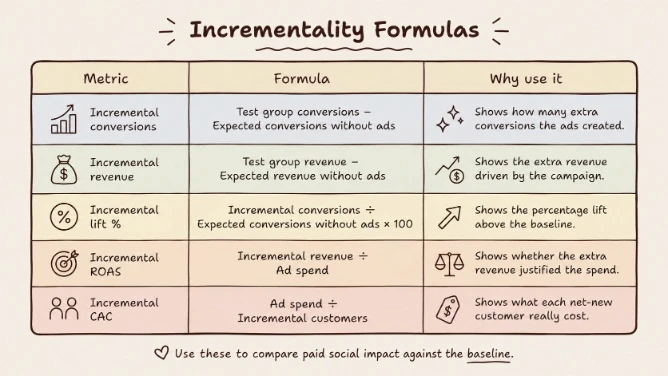
After the test, compare actual outcomes in the test group against the estimated baseline or control outcome. That gap is incremental lift. TikTok’s own help page says lift studies calculate incremental conversions, absolute lift, relative lift, CPIC, and iROAS.
These are the core formulas:
Incremental conversions = conversions in test group − expected conversions without ads
Incremental revenue = revenue in test group − expected revenue without ads
Incremental lift % = incremental conversions ÷ expected conversions without ads × 100
Incremental ROAS = incremental revenue ÷ ad spend
Incremental CAC = ad spend ÷ incremental customers (another way to express customer acquisition cost)
And here's a simple example:
Expected revenue without the test: $100,000
Actual revenue with increased paid social spend: $125,000
Incremental revenue: $25,000
Additional spend: $10,000
Incremental ROAS: 2.5x
The final read is a range. A confidence level helps you understand how much trust to place in that range. But statistical significance tells you whether the result is likely real enough to guide a decision.
If the point estimate is 2.5x iROAS but the confidence interval ranges from 0.8x to 4.2x, be cautious. And if the lower bound remains profitable, the decision becomes much easier.
Applying Incrementality Marketing to Budget and Creative Decisions
Incrementality is not just a way to prove a channel is “good” or “bad.” That framing is too small. The real value is changing what you do next.
Here are three ways to use the result.
1. Budget Allocation
If reach campaigns or Meta prospecting have stronger incremental ROAS than Google non-brand or TikTok, shift spend accordingly. But if retargeting looks profitable in-platform but weak incrementally, reduce the budget or tighten campaign targeting.
This is where attribution-based and contribution-based measurement can point in different directions. TikTok reported that one fashion retailer saw 2.4x more conversions than last-click attribution suggested. It improved overall ROI by 33% after reallocating the budget.
That is the kind of decision incrementality should unlock.
Source: TikTok for Business
2. Channel Targets
Incrementality factors help you set fairer goals by channel. If a channel’s reported ROAS is only 50% incremental, then a 4x platform ROAS behaves like a 2x incremental ROAS. Suddenly, the “winning” campaign needs a different target before it earns more budget.
This is where Media Mix Models can also help at a planning level. But for daily paid social management, you still need channel targets that reflect real incremental contribution.
3. Creative Strategy
Paid social creative should be treated as a hypothesis: a hook, persona, angle, format, or creator style that should create incremental demand. While creative variants are assets to feed the algorithm, they are also ideas to test against reality.
For example, when N26's product-focused ads began to plateau, Creative Milkshake helped diversify the brand’s creative mix with UGC built around real people and platform-native storytelling.
Through brand lift and conversion lift testing, the team identified which creative approaches generated stronger results. That contributed to a 65% lower cost per mobile complete registration.
Brainlabs also reported a -0.85 correlation between creative diversity and cost per incremental search lift. That means that more varied creatives can support stronger cross-channel performance when the strategy is built properly.
Incrementality Testing Marketing Mistakes That Ruin the Read
Incrementality tests can be powerful, but they are not immune to “oops.” A clean test gives you a decision, and a messy test gives you a debate with graphs.
Here are the mistakes you should avoid:
A study on latent stratification for incrementality experiments found that the method reduced variance by 30% to 60% across five catalog experiments. That is a good reminder that test design matters. A better structure can make the read cleaner.
Also, keep in mind that a “failed” incrementality test is not always bad. Sometimes it just tells you a campaign does not deserve more budget.
And sometimes it tells you the test design was not strong enough. But the important thing is to separate “no lift” from “no clear read,” because those are very different conversations.
Build the System Around the Signal
Incrementality testing can show whether paid social drives net-new outcomes, but the next step is to have enough creative variation to act on the learning. Otherwise, you discover what moved the business and then stare at the wall. And that's not ideal.
For brands that already have media spend but need stronger creative testing systems, Creative Milkshake can help. We can help you turn incrementality insights into new hypotheses, scripts, UGC formats, creator-led ads, and paid social iterations.
Our team will measure what worked and build the next batch of creative around what actually moved the business.
For example, iwoca worked with us to scale its Meta performance through structured creative testing, new ad concepts, UGC-style videos, and multiple creative iterations.
The work generated 15 new ad concepts, 5 creative iterations, and 60 ads in total, which gave the team a much larger testing pipeline. As a result, iwoca was able to double its Meta ad spend while maintaining CAC efficiency.
Ready to turn incrementality insights into smarter creative and media decisions? Contact Creative Milkshake today.
FAQs
How long should an incrementality test run?
An incrementality test should run long enough to capture the buying cycle and produce a reliable read. For many paid social teams, that means several weeks, plus enough post-test observation to understand delayed conversions.
What is a good first paid social incrementality test?
A good first paid social incrementality test is a high-spend, low-certainty campaign. We’d start with retargeting, Meta prospecting, TikTok Spark Ads, creator-led campaigns, or any channel leadership keeps questioning.
Can small brands run incrementality tests?
Yes, small brands can run incrementality tests, but they need to keep the setup simple. Use fewer segments, longer windows, and bigger effect sizes instead of slicing the data until nothing is readable.
Does incrementality replace attribution?
No, incrementality does not replace attribution. Attribution is still useful for day-to-day optimization, while incrementality is better for budget, channel, audience, and creative decisions.
What should you do if the incrementality test shows no lift?
If the test shows no lift, first check whether the setup was strong enough to trust. Then decide whether to reduce spend, change the audience, refresh creative, or rerun the test with cleaner conditions.