
If you're planning your next growth move and wondering whether to start with UGC or influencer marketing, you're not alone. Both promise engagement, trust, and sales. Both show up everywhere on your feed. And both can work exceptionally well when used correctly.
But they are not the same.
The confusion usually starts before brands even launch their first campaign. Should you hire creators to produce ads you own? Or partner with influencers who publish to their own audiences? Which one drives faster results? Which one scales better? And where should you invest first?
In this guide, we break down the real differences between UGC and influencer marketing, when each makes sense, and how to think about them strategically from day one.
You’ll also get access to our FREE decision-making quiz to help you choose the right starting point for your brand, plus real-world case studies from our work at Creative Milkshake showing how each approach performs in practice.
Let’s make this simple and actionable.
TL;DR
The real debate in UGC vs influencer marketing is allocation.
UGC builds owned, testable assets for performance and scale.
Influencer marketing borrows reach and credibility for awareness.
UGC excels in mid- and bottom-funnel conversion systems.
Influencers accelerate positioning in new or competitive markets.
Mixing both without role clarity inflates CPA and slows scale.
Cost, control, and usage rights define long-term leverage.
Creative variation drives performance more than polish alone.
Funnel mapping prevents misallocation across stages.
The strongest systems combine influencer-led discovery with UGC-powered conversion.
Creative Milkshake builds reusable creator asset libraries for paid ads instead of single campaign posts.
Sustainable growth comes from systems that compound over time, instead of short-term campaign spikes.
UGC vs Influencer Marketing: Side-by-Side Comparison
Before deciding where to allocate your budget, clarity on function matters more than format. So, try to focus on the role inside your system.
Here are the core structural differences that shape cost, control, and scale across paid media and owned channels.
With that foundation in place, let’s move into what UGC actually means in practice.
What Is User-Generated Content (UGC)?
User-generated content (UGC) is content created by customers, creators, or hired talent for your brand to use across its own channels. It lives inside your ad accounts, product pages, emails, and social feeds, where you control distribution, targeting, and optimization.
Aeva Beauty offers a great example of integrating UGC in email campaigns:

And unlike borrowed reach, this is asset-based content built for performance, clarity, and iteration. In practice, UGC supports your content strategy by giving you usable, rights-cleared assets you can plug directly into paid media.
The focus stays on usefulness and relatability.
That difference shapes how you test, scale, and map creative to funnel stages. After all, user-generated content drives about 28% higher engagement than branded posts.
Here’s also a short video that explains how UGC works in practice and how brands apply it across real campaigns:
Types of UGC
UGC can take several forms depending on your funnel goals. These are the most common formats you might work with:
Customer reviews and ratings.
Short-form video demos and testimonials.
Creator-style ads filmed to a brief.
Product-in-use clips and reactions.
Why UGC Works So Well in Paid Media
At a structural level, UGC functions as performance input. These are the reasons it converts inside ad platforms:
Feels peer-to-peer.
Answers real questions.
Blends into feeds.
Easy to test and iterate.
And the behavioral impact is measurable.
Research by Nosto shows that 79% of consumers say UGC strongly influences their purchasing decisions. This explains why objection-handling videos and product demos usually outperform polished brand spots in retargeting.
So when you deploy UGC inside mid- and bottom-funnel campaigns, you reduce skepticism and increase conversion intent without increasing spend.
Here's what an expert on this subject had to say:
“UGC can provide brands with a great vehicle to tell a story in an authentic, creative and relatable way, while still getting their own brand message across.” - Rob Newlan the Global President of Virtue Worldwide.
Now, let’s move on and see how influencer marketing operates differently.
What Is Influencer Marketing?
Influencer marketing is when your brand partners with a creator who already has an audience and publishes content on that creator’s channels first. Distribution starts on their profile, rather than your ad account.
The goal here is reach, trust, and cultural relevance tied to personality and positioning.
So, instead of building assets you fully control, you are borrowing attention and credibility from someone who already holds it.
Here’s a good example from Dashing Diva:
In practical terms, this is less about content volume and more about association. Your brand appears inside someone else’s voice, tone, and community. And that difference shapes how you plan amplification, measure lift, and protect brand credibility.
But brands don't seem to stop using this marketing channel anytime soon.
According to PR Newswire, 80% of brands either kept or increased their influencer marketing budget in 2025, with nearly half boosting spending by 11% or more.
Types of Influencer Marketing
Influencer activity can take different forms depending on your objectives. These are the most common structures you can work with:
Sponsored posts and videos on Instagram, TikTok, or YouTube.
Product reviews and tutorials shared with the creator’s audience.
Long-term brand ambassador partnerships.
Event collaborations and product launches.
Whitelisted ads where you amplify the creator’s content.
Why Influencer Marketing Works So Well for Awareness
At a structural level, influencer campaigns operate at the top of your funnel. These are the reasons they drive visibility:
Leverages built-in trust with an existing audience.
Provides direct access to niche communities.
Shapes brand perception through personality and voice.
Creates visible social proof through comments and shares.
Builds credibility faster than brand-owned content alone.
And the trust gap is real. Data from Matter Communications show that 69% of people trust recommendations from friends or influencers more than brand messages. This is why well-aligned influencer partnerships can speed up early-stage consideration.
Here's what another expert had to say about this in the MarketingMag:
"The continual rise of grassroots and micro ascendants who create relatable content and build real connections, and the ways that brands harness this in a scalable way, will have the biggest impact." - Sharyn Smith, Founder and CEO of Social Soup
Now, all of this leads us to the deeper distinction most teams overlook.
The Core Difference Most Brands Miss
At first glance, UGC and influencer content can look identical inside your feed. But functionally, they play very different roles in your system.
UGC creates signals. It helps you test hooks, angles, and objections inside Meta ads and other paid placements. Over time, patterns in performance metrics show what actually drives action.
Influencers create meaning. Their authority and voice shape perception across social media platforms, which influences how your brand is positioned before a click ever happens.
Pro tip: Treating them as interchangeable creates structural friction. For example, using influencer content in retargeting typically weakens conversion rate because the asset was built for reach.
The real lens is the role each asset plays inside your funnel, rather than how it looks on screen.

That leads us to when to use each.
When UGC Is the Better Choice
UGC becomes the better move when performance, control, and testing speed matter more than borrowed reach. In those moments, you need assets you can plug directly into paid systems and optimize without waiting on a creator’s calendar.
These are the scenarios where UGC earns its budget:
Paid social creative that blends naturally into feeds.
Faster testing cycles across hooks, angles, and formats.
Lower CPA or CAC through iteration.
Content for product pages and retargeting ads.
Assets you can reuse freely with clear content ownership.
This matters most when fresh ads are needed for Meta or TikTok, believable demos are required, PDP proof is missing, or testing velocity has slowed.
Performance data supports this approach. Ads built on UGC formats can drive about 42% lower CPA than traditional creative, which directly impacts paid efficiency and margin control. That cost gap compounds when you scale.
A clear example comes from our work with Wise.
At Creative Milkshake, we rebuilt their TikTok paid acquisition system around platform-native UGC formats.
Instead of leaning on authority or broad reach, we focused on creative research, localized scripting, and structured iteration across hooks, pacing, POV, and delivery styles. Every asset was designed for testing, rather than just publishing.
And the impact was measurable. US conversion rates increased by 43.75%, EU conversion rates increased by 100%, and customer acquisition costs dropped by 26.23%. That lift came from creative variation and disciplined optimization cycles, rather than borrowed audience trust.
Typical fits
UGC tends to perform best in these cases:
DTC and eCommerce.
Apps and subscriptions.
Products with a clear demo or habit loop.
In these environments, every asset strengthens testing velocity, supports retargeting, and compounds performance across your funnel.
Let’s now shift to when influencer marketing makes more strategic sense.
When Influencer Marketing Makes More Sense
Influencer marketing makes more sense when the goal is attention first and efficiency later. In certain moments, borrowing trust accelerates positioning faster than producing assets internally.
In practice, these are the scenarios where it earns its place in your mix:
Awareness fast.
Entry into a new market or niche.
Cultural relevance.
Social proof at scale.
When entering unfamiliar territory, association reduces friction. That shortcut to trust can compress the time it takes to gain legitimacy inside a niche, especially when credibility is tied to identity or expertise. In these cases, the creator’s existing relationship with their audience does the heavy lifting before your funnel logic even begins.
Unlike performance-driven content creation, influencer activation centers on borrowed authority across creator channels. The value sits in alignment and proximity, rather than just asset output.

Typical Fits
This approach tends to perform best in specific contexts. These are the common use cases:
Product launches.
Seasonal campaigns.
Categories where trust ties closely to identity, such as beauty, fitness, or finance tools.
In these cases, brand partnerships strengthen brand awareness quickly, especially when narrative fit matters more than testing velocity.
Moving on, let’s examine the practical trade-offs around cost, control, and risk.
Cost, Control, and Risk: The Practical Trade-Offs
Every allocation decision carries trade-offs. At scale, cost structure and control mechanisms shape performance more than format preference.
These are the practical tensions you might come across:
UGC is cheaper per asset, but it requires clear direction and creative guardrails.
Influencers command higher fees and limit message control.
Usage rights and whitelisting usually affect scale more than brands expect.
A poor influencer fit can damage positioning.
Weakly produced UGC can also hurt trust if it ignores brand guidelines.
On one hand, working with UGC creators gives you asset-level control. Scripts, iterations, and edits stay within your performance workflow, which protects margin and accelerates testing. But without clear briefs or brand guidelines, quality can slip and signal inconsistency.
On the other hand, influencer activations place distribution power outside your control. Creative tone, timing, and audience reaction sit in someone else’s ecosystem. And once published, the message is harder to recalibrate.
So the real question becomes: which risk profile fits your current objective?
Now, let’s map how both tactics work across your funnel.
Funnel Mapping You Can Copy
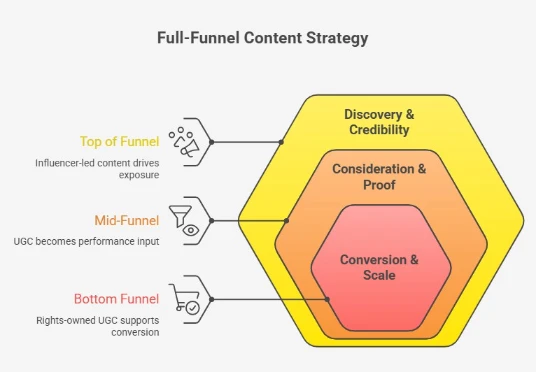
If allocation has felt inconsistent, the issue is usually structural. What matters is how each content type functions inside your full-funnel strategy, rather than how it looks on screen. Here is a simple system you can apply immediately.
Top of Funnel: Discovery & Credibility
At this stage, influencer-led content drives exposure and positions your brand inside relevant communities. Association builds initial trust before performance logic takes over. Reach and narrative alignment matter more than testing volume.
Mid-Funnel: Consideration & Proof
Now the role shifts. UGC becomes performance input. Relatable demos, testimonials, and comparison angles power retargeting ads by answering objections and validating interest. This is where structured iteration compounds.
Bottom Funnel: Conversion & Scale
Finally, rights-owned UGC supports PDPs, email, and paid conversion campaigns. Because you control the assets, you can optimize, refresh, and expand without relying on creator availability.
A simple flow might look like this:
Influencer TikTok activation for awareness.
UGC clips deployed in Meta retargeting.
UGC placed on PDP and email to close.
At Creative Milkshake, we build a content library that spans these stages, so performance does not hinge on one post or one creator.
And when mapping breaks, so does efficiency. Influencer content pushed too deep into the funnel typically inflates CPA. UGC used too early can lack authority. Mixing both without role clarity creates signal noise and slows scaling.
How We at Creative Milkshake Turned UGC Into a Performance Engine
When performance plateaus, creative usually becomes the constraint. That was the case with N26. Standard product-led ads had delivered in the past, but efficiency began to flatten across Meta.
So we rebuilt the system.
At Creative Milkshake, we shifted from polished branded visuals to diversified, creator-led UGC built for testing. Real people spoke directly to the camera, explained the benefits in simple language, and drove clear app-store CTAs.
And we validated the shift through structured brand lift and conversion lift testing. At the same time, Meta’s Advantage+ automation handled placements and budget allocation.
The outcome made the trade-off clear.
Diversified UGC drove a 65% lower cost per complete mobile registration, alongside 40% lower cost per ad recall and 19% lower cost per action intent. Performance improved because variation increased and messaging aligned with how people actually scroll.
The takeaway is practical. Authenticity alone is not enough, and polish alone does not scale. Structured testing combined with relatable creative is what compounds over time.
Common Mistakes Brands Keep Making with UGC and Influencer Marketing
Even experienced teams misallocate roles, and when roles blur, efficiency drops. These are the patterns that quietly erode performance:
Asking influencers to drive direct conversions.
Using influencer content deep in retargeting.
Treating UGC as a random output instead of a testing system.
Ignoring usage rights and amplification limits.
Chasing polish instead of message clarity.
Assuming UGC is “free.”
Choosing influencers misaligned with the brand.
Running one-off influencer posts with no follow-up.
Overlooking fake followers or engagement fraud.
Buying content without defined rights.
Follower count typically distorts judgment. In fact, around 25% of Instagram influencers may rely on artificial growth tactics. This means that a meaningful share of audiences can be inactive or fake. That risk compounds when budget decisions rely on surface metrics instead of validation.
So before allocating spend, clarify role, ownership, and downstream use.
A Simple Decision Tool (Quick Quiz)
Not sure whether to go with UGC, influencer marketing, or both? Try this quick decision tool. Answer a few simple questions and get a clear recommendation based on your goals, budget, and growth stage.
Build a System That Scales, Not Just Campaigns
UGC and influencer marketing are not competing tactics. They serve different roles inside your funnel. One builds owned assets you can test, scale, and optimize. The other builds reach, trust, and positioning through association. And when you assign each to the right stage, performance becomes predictable instead of reactive.
At Creative Milkshake, we turn creator content into structured performance systems. Instead of chasing one-off wins, we build reusable creator libraries designed for testing, iteration, and scale across paid media. That shift moves brands from campaign thinking to compounding growth.
If you want a clearer allocation plan and a creative system that drives measurable lift, contact us and let’s build it together.
FAQs
What is the difference between UGC marketing and influencer marketing?
UGC marketing focuses on content created by customers or hired creators for your brand to use across paid ads, product pages, and email. Influencer marketing focuses on creators publishing content to their own audience first to drive reach and credibility.
What are the 5 types of social media marketing?
In practice, most teams operate across five buckets: paid social, influencer partnerships, UGC programs, organic brand content, and community-led distribution. Each serves a different funnel role. Mixing them without a clear allocation logic is where inefficiency begins.
Does UGC include influencers?
Sometimes. Influencers can produce UGC-style assets, but the intent matters. If the content is built for your paid amplification and owned use, it functions as UGC. If it relies on its audience, it functions as influencer marketing.
Does UGC usually cost less than working with influencers?
Typically, yes. UGC usually costs less per asset because you pay for the content itself and not for access to a creator’s audience. Influencer partnerships tend to be more expensive since the price includes reach and visibility.