
Imagine this scenario:
Your ad costs keep rising, but results don’t improve at the same pace. In fact, when you scale spend, CPA typically climbs with it. At this point, targeting and bidding are mostly handled by platform algorithms.
And that leaves one variable you still control: your ad creatives.
Yet most teams test them without any structure. Ideas are launched, results come in, but the reason behind those results stays unclear.
But a good creative testing framework increases your chances for growth. That’s because you follow a system that shows what works and why.
In this article, you’ll see exactly how to structure testing and scale without damaging ad performance. You’ll learn what to test, how to read results, and what to do next.
P.S. We help teams build and run these systems at Creative Milkshake, with 2,000+ ads delivered monthly and a 30% average drop in CPA for our clients. If you want to improve performance, contact us today to see how we can help.
TL;DR
Ad costs keep rising, so performance depends more on the quality of your creative than targeting.
Most teams test creatives randomly, which leads to unclear insights and wasted budget.
A structured framework helps you test, learn, and scale what actually works.
Focus on three layers: concept, message, and execution.
Start with concept testing, then refine with variations like hooks and visuals.
Align KPIs with funnel stages to understand performance across the journey.
Control test setup, budget, and variables to get reliable results.
Analyze data carefully and scale only proven winners.
Turn every result into a system that improves future performance.
Strong creative systems lead to lower CPA, higher ROAS, and faster growth.
What Is Creative Testing for Performance Ads?
Creative testing for performance ads means testing different creative ideas to identify which ones drive measurable results, such as good conversion rates and higher return on ad spend.
Remember: the focus here is not how an ad looks, but what it does.
If a creative does not improve performance, it does not matter how polished it is. In fact, Nielsen found that creative drives 47% of an ad’s effectiveness, so it’s extremely important to zero in on what makes your ads even more effective and optimize those features.
Basically, you need good creative testing.
How can you get good creative testing, you ask? Well, you need to break it into three layers:
Concept (big idea): The core angle you test, such as problem-led vs. benefit-led messaging. This is where most performance gains come from.
Message (how it’s framed): The way the idea is communicated, which shapes how users interpret your value props.
Execution (visuals, format, copy): The final delivery, including visuals, hooks, and structure.
Now, this goes beyond basic A/B testing. Instead of comparing small changes, you test structured ideas across these layers to find repeatable winners.
Here's a good explanation of this:
To understand why this matters, you need to look at what actually drives performance today.
Why Creative Testing Is the #1 Growth Lever in 2026
Targeting and bidding have become more automated, which limits how much control you actually have there. So when your performance falters, the cause is rarely your audience setup. More frequently, it comes down to your creative assets.
And this is where things typically start to fall apart.
Without structure, you rely on trial and error, which makes results unstable. On top of that, creative fatigue sets in quickly, so even strong ads lose impact over time.
Now, this is not just a theory. According to Nielsen and Google, creative accounts for 56% of sales impact and can influence up to 70% of campaign success. This shows how much weight sits on what users actually see.
When you approach ad creative testing with structure, you start to see clear outcomes.
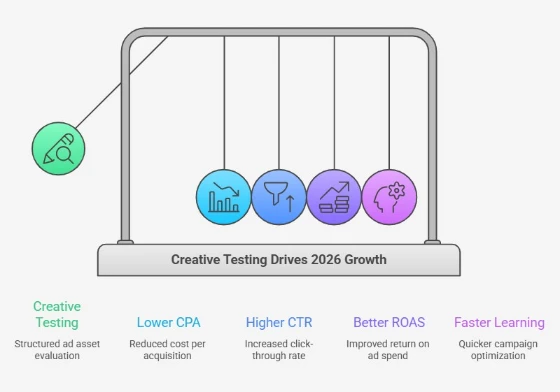
Here are the results you can expect:
Lower CPA
Higher CTR
Better ROAS
Faster learning cycles
So if these are the outcomes you want, you need a clear framework that shows what to test, how to test it, and how to scale what works.
The Ultimate Creative Testing Framework in 2026
To make results predictable, you need a system. Scattered tests won’t do you much good because you can’t infer anything long-term if you don’t follow a clear process.
Here are the steps that turn testing into a repeatable system you can scale with confidence.
Step 1: Define Clear Goals and KPIs
Every test needs to connect to a business outcome. Without that link, results may look positive, but won’t move return on ad spend or growth.
But here’s the issue: not every user converts right away.
And that’s exactly why relying only on bottom-funnel data leads to wrong decisions.
Most users don’t convert on the first visit (in fact, cart abandonment sits around 77%), so conversion metrics alone tell you what happened, not why it happened. Early signals like click-through rate and engagement show whether your creative is actually driving intent.
To keep this structured, align KPIs with funnel stages. Here’s how to map them:
This way, each test reveals what’s working at each stage, which gives you a more complete picture than relying only on final conversion data.
Step 2: Build Strong Hypotheses
Random testing slows you down because it gives results without clear answers. So instead, every test should start with a simple hypothesis: “We believe X will improve Y because Z.” This forces you to define what you are testing, what you expect to change, and why it should work.
And this approach works.
That’s why successful companies like Booking.com run over 25,000 experiments each year, but remember:
The value comes from how those tests are designed, rather than just from volume.
To decide what to test first, you need clear priorities. Here are the key factors to focus on:
Impact: Will this change meaningfully shift results such as CTR or conversions?
Effort: How fast can this be tested using existing creative assets?
Learning value: Will this test give insights you can reuse across future ad variations?
Step 3: Test Concepts First (Big Ideas)
Before testing small changes, you need to validate the big idea behind the creative. This is where most performance gains come from. So instead of jumping into details, start by comparing core directions.
Here are the key concept angles to test:
Emotional vs. rational: Tests whether feelings or logic drive action for your audience.
UGC vs. polished: Compares raw, trust-based content with high-production visuals. Some studies show that UGC can drive up to 8.7x higher engagement, which typically leads to stronger early signals. However, raw UGC doesn’t work for every company; some brands benefit from more polished ads.
Problem vs. benefit: Identifies whether users respond more to pain points or desired outcomes.
Each concept gives you a clear direction to build on. That’s also why strong teams treat this as a concept iteration framework.
Pro tip: From our experience, testing broad concepts first works best. Then narrow down into variations once you see what actually drives response.
Step 4: Move to Variation Testing
Once a concept proves it can drive results, the next step is to improve how it performs even more.
This is where variation testing comes in.
Instead of changing the idea, you refine how it is delivered across hooks, headlines, CTAs, and ad formats.
And this is where small changes start to compound.
In fact, structured copy optimization systems have shown lifts of up to 12.5% in CTR and 8.3% in conversion rate. This shows how much execution details can impact performance once the concept is validated.
To do this effectively, focus on controlled changes. Here are the key areas to test:
Hook variations: Test different openings to improve scroll-stopping power and early engagement.
Visual changes: Adjust scenes, pacing, or framing to improve clarity and retention.
Copy tweaks: Refine wording to strengthen clarity, urgency, or value communication.
This is how you turn one winning idea into multiple high-performing conversion-focused creatives.
Step 5: Structure Your Tests Properly
How you structure tests directly affects how reliable your results are. If you change and test multiple variables simultaneously, you can’t pinpoint what actually drove the outcome.
That’s why you need a clear testing approach based on your goal.
And this is, indeed, how most teams operate in practice.
Data shows that 67.6% of experiments rely on A/B testing, while multivariate testing is used far less, mainly because it is harder to control and interpret.
But it’s up to you to decide what testing method works in your case. Here are the three main ones:
Step 6: Control Budget and Test Size
Test size and budget directly affect how reliable your results are.
As we said above, if too many variables run at once, performance becomes hard to interpret. And if the budget is too low, results never reach statistical significance, which leads to false conclusions.
So instead, keep tests focused and controlled. Limit each test to 2-4 variations to isolate what actually drives change.
At the same time, allocate enough budget to generate stable performance metrics. Otherwise, you’ll only get untrustworthy early signals that can change quickly.
But most importantly, avoid testing too many ideas at once. A smaller, structured setup gives clearer answers and faster decisions, which helps you scale paid social with confidence.
Step 7: Analyze Results Correctly
Results and numbers only matter if you can trust them.
Without the right checks, you risk scaling something that worked by chance. So instead of reacting to early info, you need to validate what the data is actually telling you.
And this is where proper analysis comes in.
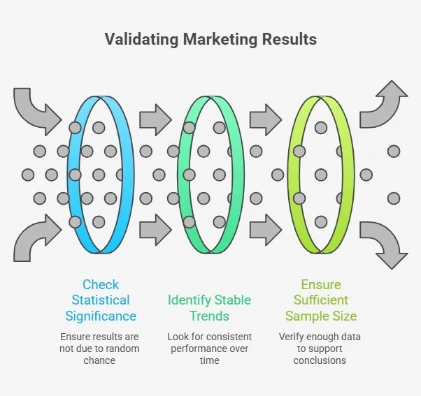
To make confident decisions, these are the signals to focus on:
Statistical significance: Confirms that the result is not driven by random variation.
Stable trends: Look for consistent performance over time, instead of short-term spikes.
Enough sample size: Make sure the test has enough data to support reliable conclusions.
This approach will offer performance marketers like you more confidence levels to act on concrete data.
Step 8: Scale Winners the Right Way
Once a creative proves it works, scaling it correctly becomes the next challenge.
But scaling goes beyond increasing the budget. It requires managing performance as conditions change.
So:
Add winning creatives into your main campaigns and monitor how they behave at higher spend.
Don’t turn off older winners too quickly, as they typically stabilize results across paid social campaigns.
Unfortunately, this is where scaling can have the opposite effect.
Once you increase your budget, your ad frequency rises as a direct consequence. And when people start seeing your creatives more and more, ad fatigue starts to impact results.
In fact, repeated exposure can reduce CTR by up to 50-70%, which means even proven creatives lose efficiency if left unchanged.
The solution is simple, though.
Instead of relying on a single winner, refresh creatives regularly and track performance trends to decide when to iterate.
Step 9: Turn Learning Into a System
Running tests isn’t enough if you only apply the insights to a single campaign.
To make progress repeatable, each result needs to feed into your next decision. That’s how testing turns into a system.
So:
Start by documenting what worked and why.
Then tag your creative assets based on patterns such as hooks, messages, and formats. This makes it easier to reuse insights across future campaigns.
Next, feed those learnings into your next round of tests. Over time, this builds a structured testing library that improves decision speed.
Check out this video if you want to learn more methods:
Concept vs. Variation Testing
To structure testing properly, you need to separate what you are testing. Mixing concepts and variations leads to unclear results and slows down decision-making. So instead, treat them as two distinct steps.
Here’s how they differ:
Concept testing sets the direction. Variation testing improves execution once that direction is clear. So, always test concepts first, then move to variations.
What to Test in Your Creatives (With Examples)
To improve results, you need to know what to test and why it matters. As we kept insisting throughout this article, focus on the key elements that directly influence performance.
Here are the main areas to prioritize:
1. Hooks
Hooks decide whether someone pays attention or scrolls past, so these are the first elements to test:
The first 3 seconds determine if users keep watching.
Test different opening angles, such as problem, curiosity, or bold claim.
Try multiple hooks for the same concept.
This is critical because early engagement compounds.
Meta data shows that 65% of users who watch the first 3 seconds continue to watch for at least 10 seconds, and 45% keep watching for 30 seconds. This directly impacts retention and downstream performance.
That’s why, at Creative Milkshake, we test multiple hooks for each concept to identify what actually drives response. This approach allows us to scale winners faster and build a structured creative engine that improves performance over time.
2. Messaging
Messaging shapes how your offer is understood, which is why how you frame it needs to be tested:
Benefits vs. features
Emotional vs. logical angles
Pain points vs. outcomes
That is why strong teams build a message-matrix framework to test how positioning impacts response.
3. Visual Style
Visuals influence trust and engagement, and small changes here can shift performance:
UGC vs. studio
Product-focused vs. lifestyle
Talking head vs. hands-on demo
4. Format
Format affects how content is consumed, which directly shapes how users engage with your ad:
Video vs. static
Short-form vs. long-form
Native platform formats vs. polished ads
Pro tip: Short-form content typically drives a 2.5x stronger engagement rate, especially in fast-scrolling environments.
How to Launch and Manage Creative Tests
Execution matters as much as strategy. Even strong ideas fail when the setup is unclear. And when tests are not structured properly, then results become hard to trust. So you need a simple system that keeps everything controlled and measurable.
Key Rules to Follow
To keep your tests reliable, follow these rules:
Don’t overlap audiences, as this mixes signals and makes results harder to interpret.
Separate platforms, since Meta Ads and TikTok behave differently and require their own setup.
Keep testing campaigns separate from scaling campaigns to avoid bias in results.
Avoid changing variables mid-test, because it breaks your testing architecture and resets learning.
Quick Checklist Before You Launch
Before launching, make sure everything is set up correctly:
Clear KPI defined, so success is measurable from the start.
Limited variables, with only one change per test.
Enough budget allocated to generate reliable data.
Clean naming and tracking structure, so results are easy to analyze across campaigns.
This structure helps you move faster while keeping decisions grounded in clear data.
Common Creative Testing Mistakes (and How to Fix Them)
Even with a solid plan, brands can fail at creative testing. And once that happens, decisions become harder to trust. Here are the most common issues and how to fix them:
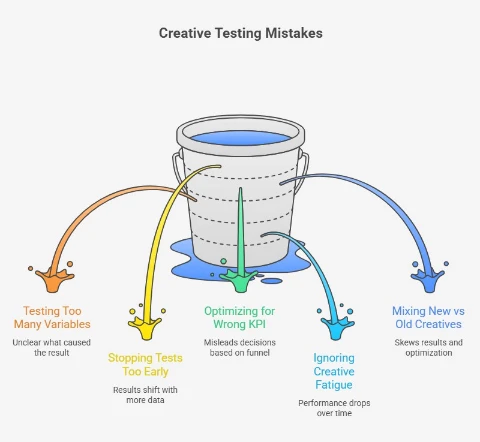
Testing too many variables: We’ve said this before, but it’s that important to reiterate: running multiple changes at once makes it unclear what actually caused a certain result. In fact, testing many variations at the same time increases the risk of false positives, which leads to wrong decisions. Instead, isolate one variable per test to keep learnings clean.
Stopping tests too early: Early results can look promising, but they can change once more data feeds into the campaign. That’s why we advise you to let tests run long enough to reach stable outcomes before making changes.
Optimizing for the wrong KPI: Focusing only on top-level metrics can mislead decisions. Align each test with the right goal based on the funnel stage.
Ignoring creative fatigue: Performance drops over time, even for strong creatives. Track fatigue timelines and refresh before results decline.
Mixing new vs old creatives unfairly: Comparing fresh assets with already scaled ones skews results. Keep testing conditions consistent to protect your ad campaign optimization decisions.
Real Case Studies: How Creative Milkshake Drives Performance
To see how this works in practice, it helps to look at real outcomes. So here are a few examples of how we apply this system and what it delivers.
N26: Reducing Acquisition Costs with UGC
Problem: At N26, performance plateaued with traditional product-focused ads, which limit further growth.
What we did:
We shifted the creative direction completely:
Replaced polished ads with UGC built around real user experiences.
Tested multiple creative concepts. Note that we didn’t just focus on variations.
Focused on simple, direct storytelling tied to real benefits.
Result: The cost per registration dropped by 65%, with stronger engagement and higher conversion performance.
Key takeaway: Concept-level testing has the biggest impact on performance.
iwoca: Scaling Spend Without Losing Efficiency
Problem: At iwoca, the goal was to scale paid social, but without breaking efficiency or increasing risk.
What we did:
We built a structured system to control scaling:
Developed a pipeline of new creative concepts.
Tested and validated each concept before increasing spend.
Separated testing pipelines from scaling to protect performance.
Result: This allowed spend to scale by 2x while maintaining strong efficiency across campaigns.
Key takeaway: Structured testing makes scaling both safe and repeatable.
Body&Fit: Scaling Creative Output Efficiently
Problem: At Body&Fit, the high demand for TikTok content made constant new production inefficient and hard to sustain.
What we did:
Instead of producing more different assets, we increased output through iteration:
Reused core assets across multiple variations.
Tested hooks, voiceovers, and formats.
Focused on structured variation.
Result: This approach increased creative output while improving performance across campaigns
Key takeaway: Variation testing unlocks scale without increasing production cost.
Turn Creative Testing Into a Scalable Growth System
Look at creative testing as a system that drives performance.
Without structure, results stay inconsistent, which leads to wasted spend and slow growth. But with the right approach, every test gives clear insight and builds on the last.
At Creative Milkshake, we help you build the right repeatable system.
That means a clear marketing strategy, fast iteration, and decisions based on real data. This is how brands like N26, iwoca, and Body&Fit improved performance and scaled with confidence.
In this article, we took you through our 9-step testing framework for performance ads.
Now, the next step is to turn this approach into a system that works inside your team.
And if you want to do that faster, with the right structure in place, contact Creative Milkshake and start scaling with confidence.