Most paid social problems do not start inside Ads Manager. They start earlier, when the brief sounds clear in a meeting but gets vague the moment someone has to turn it into hooks, angles, scripts, creator notes, and ad variations.
That gap gets expensive fast. According to a BetterBriefs Project, around 33% of marketing budgets are estimated to be wasted because of poor briefs and misdirected work.
A strong creative brief for paid social should help your team decide what to test, which audience tension to lead with, what format to produce, and what the ad needs to prove once it goes live.
In this guide, we’ll walk through what to include, how to structure each section, and how to turn a brief into a better paid social creative. You’ll also get a free downloadable PDF template to use before your next shoot, edit, or creator handoff.
Sidenote: Need help turning briefs into scalable ads? Check out our guide to the best performance creative agencies.
TL;DR
Paid social problems usually start when vague briefs turn into unclear hooks, scripts, creator notes, and ad variations.
A strong brief should define the goal, audience, offer, platform, format, creative hypothesis, and success metrics.
Paid social briefs need sharper testing direction than generic creative, marketing, social media, or creator briefs.
The brief should connect campaign KPIs with the creative decisions needed for Meta, TikTok, Reels, YouTube, statics, or video ads.
Strong briefs turn audience insight into hooks, angles, proof points, deliverables, and feedback loops.
Clearer briefs reduce rebriefs, avoid production confusion, and help teams make better creative decisions.
What Is a Paid Social Creative Brief?
A paid social creative brief is a short strategic document created before ads go into production. It helps marketers, creative strategists, designers, editors, creators, media buyers, and other stakeholders align on the campaign's direction.
This is more specific than a general campaign brief because it connects the ad idea to the platform, placement, audience, test plan, and performance goal.
A good brief should explain what the ad needs to achieve, who it needs to speak to, and what message it needs to test. It should also clarify the platform, required creative assets, and how results will be judged.
We believe that most briefs can be one to three pages, depending on campaign complexity. But the goal is clarity rather than length.
Check out this video to learn more:
Download the Free Paid Social Creative Brief Template
Download our free creative brief template as a PDF to help plan your next paid social campaign. You can use it for creator-led ads, UGC, Meta and TikTok creatives, Reels, static ads, and video ads. The template is built to help you organize the strategy before production starts, and the next sections show how to fill it out.
Free Paid Social Creative Brief Template
Creative Brief vs. Marketing Brief vs. Social Media Brief vs. Creator Brief
Different briefs get mixed up all the time, and that is where messy handoffs begin. Each one has a different job, even when they overlap. A marketing lead, creator, editor, and media buyer should not have to guess which document owns which decision.
Here are the main differences:
Why Generic Creative Briefs Usually Fail Paid Social
Generic creative briefs usually fail paid social because they focus on brand message, deliverables, and timelines, while paid social needs sharper testing direction.
A clean-looking brief can still leave the team unsure about the hook, format, offer, or angle. And when the brief stays vague, the ad usually looks fine in a deck and struggles in the feed.
A stronger brief should answer:
What is the hook?
What problem are we leading with?
What audience segment are we testing?
What format fits the platform?
What offer or CTA is the ad driving toward?
What will we measure?
What will we change in the next iteration if this does or does not work?
And this gap is more common than most teams think. The BetterBriefs Project also shows that 80% of marketers think they write good briefs, while only 10% of creative agencies agree. At the same time, 89% of marketers and 86% of agencies agree that producing good creative work is difficult without a strong marketing brief.
Paid social ads are part of an ongoing testing system. A vague brief can produce something on brand, but it may fail to create something testable, scalable, or useful for media buyers.
Pro tip: Once your brief defines what to test, use our guide on ad creative testing methods. It can help you decide how to structure the test, read the results, and turn early learnings into stronger ad iterations.
How to Write a Creative Brief for Paid Social in 9 Steps
A strong brief turns scattered context into decisions the creative team can actually use. It should help people move from a campaign idea to a set of ads with a clear reason to exist. And because paid social moves fast, the brief needs to balance structure with room for smart creative thinking.
Here are the nine steps you need to follow.
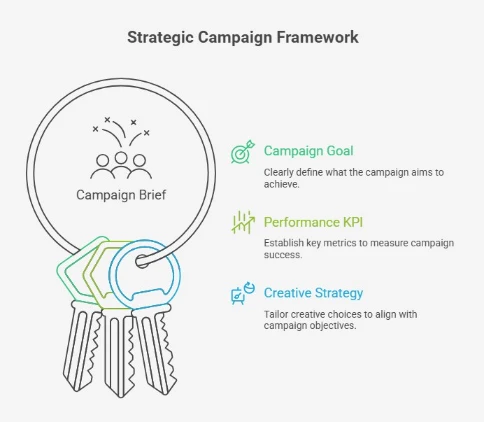
1. Start With the Campaign Goal and Performance KPI
A brief should start with what the campaign needs to achieve. That sounds obvious, but many briefs begin with a production request like three videos, two statics, and five hooks. That skips the most important part: why those assets need to exist.
So, we recommend starting with campaign objectives. Determine if you are trying to reduce CPA, increase ROAS, improve CTR, drive installs, improve trial signups, increase landing page traffic, or test a new audience.
Once the goal is clear, connect it to the right metrics.
For example:
Awareness: Thumb-stop rate, reach, ad recall, video views.
Traffic: CTR, CPC, landing page views.
Conversion: CPA, ROAS, CVR, CAC.
App growth: CPI, install-to-registration rate, activation rate.
This is especially important for growth marketing teams because the creative request should match the metric that matters. An awareness ad and a conversion ad can feature the same product, but they need very different creative choices.
2. Define the Audience Beyond Demographics
Audience inputs should go deeper than age, location, and gender. A brief that says ‘women 25-40’ or ‘busy founders’ gives the team a starting point, but it does not explain why someone would stop scrolling.
So, describe the audience’s pain point, buying trigger, hesitation, desired outcome, and level of awareness. This helps the team write ads that sound specific rather than generic.
Useful audience inputs include:
What do they already believe?
What are they tired of?
What have they tried before?
What objection stops them from converting?
What language do they use in reviews, comments, Reddit threads, TikTok comments, or customer surveys?
You can also include user personas when different segments need different messages. For example, target audiences for a sleep app could include exhausted new parents, shift workers, and anxious light sleepers. Each group needs a different hook because each one has a different emotional trigger.
3. Clarify the Offer and the One Message the Ad Must Land
Paid social ads need one clear promise. The brief should define the product, offer, promo, trial, bundle, download, demo, or lead magnet. It should also explain why someone should care right now.
The easiest way to make this useful is to separate the message into layers:
Core promise
Supporting proof
Objections to handle
CTA
Landing page or destination
For example, a SaaS app could lead with ‘save three hours per week,’ support the claim with customer proof, handle the objection around setup time, and send users to a free trial page. That gives the creative team enough information to build ads with a clear message and a clear next step.
4. Choose the Platform, Placement, and Format
A Meta ads creative brief should never read exactly like a TikTok creative brief. Meta feed, Instagram Reels, TikTok, YouTube Shorts, Stories, and static placements all need different creative decisions because people use each environment differently.
TikTok calls for faster pacing, creator delivery, rawer framing, trends, and conversational hooks. Meta may need stronger offer clarity, proof points, UGC-style variety, statics, Reels, and feed-friendly formats. And YouTube typically performs better with stronger story structure and higher retention because the viewing context can be more deliberate.
This is also where you should define aspect ratio, length, captions, subtitles, overlays, product shots, CTA cards, and any placement-specific rules.
A brief that says short-form video is too loose. But a brief that says ‘9:16 creator-led Reels with three hook variants’ gives the team a real production target.
5. Turn Strategy Into Creative Hypotheses
This is the biggest difference between a generic brief and a performance brief. Instead of briefing one finished idea, brief testable hypotheses. That gives your creative team direction and gives your media buyers something useful to learn from.
Examples:
Hook hypothesis: Leading with the pain point will outperform leading with the product.
Persona hypothesis: New parents will respond better to reassurance than urgency.
Format hypothesis: Creator-led product demo will outperform polished brand video.
Angle hypothesis: Saving time will outperform saving money.
Proof hypothesis: Review-led creative will outperform founder-led creative.
Creative Milkshake’s creative strategy treats every ad creative as a hypothesis. We test formats, personas, angles, visuals, and execution styles before performance data guides the next creative batch.
That approach matters because Meta says hypothesis-driven, audience-centric creative briefs can improve campaigns. Compared with vertical and regional norms, they can drive 1.5x higher ad recall lift and 1.3x higher message association lift.
The brief should make those hypotheses easy to understand before anyone starts writing or filming.
6. Write Hook, Angle, and Messaging Direction
The brief does not always need finished scripts. In many cases, it should clearly define direction for writers, creators, and editors to explore better ideas.
These are some useful hook types you can use:
Problem-first hook
Contrarian hook
I tried X hook
Mistake hook
Comparison hook
Review-led hook
Before/after hook
Demo hook
Each hook should connect back to the audience insight and campaign goal. For instance, a problem-first hook can work for a pain-aware audience, while a demo hook may work better for someone who needs to understand the product quickly.
This is also where visual direction helps. Tell the team whether the ad should feel like a creator selfie, a product demo, a testimonial, a founder explainer, a skit, a comparison, or a polished studio cut.
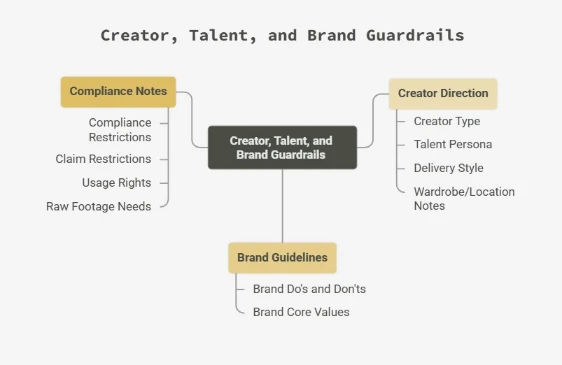
7. Add Creator, Talent, and Brand Guardrails
Creator direction is different from scripting every word. The brief should explain who should deliver the message, what tone they should use, what they must avoid, and where they have the freedom to vary.
Include:
Creator type
Talent persona
Delivery style
Wardrobe/location notes
Brand do’s and don’ts
Compliance or claim restrictions
Usage rights and raw footage needs
This matters even more when a creator program feeds paid acquisition. The creator needs enough freedom to sound natural, while the brand still needs control over claims, tone, and product accuracy.
Add brand guidelines here, plus any rules around the brand's core values. If the product operates in finance, healthcare, beauty, wellness, or apps, also include compliance notes so the edit does not create problems later.
8. List Deliverables, Specs, Timeline, and Approval Flow
A good brief removes production ambiguity. So, make sure to include formats, lengths, aspect ratios, number of variants, hooks, statics, edits, captions, subtitles, deadlines, review rounds, and stakeholders.
Be specific about what counts as a deliverable and what counts as an iteration. For example, one raw creator video cut into three opening hooks is different from three net-new concepts. And a static ad resized for Stories is different from a new design.
This is where teams typically create avoidable rework. If the brief asks for ad designs without size, copy, format, and approval owner, someone will have to fill in the blanks later. And those blanks usually show up right before launch.
9. Define the Test Plan and Feedback Loop
The brief should not end at delivery. It should explain how the ads will be tested, who will review performance, and what happens after results come in.
Include:
Which variables are being tested
What will stay constant
How long will the test run
Which KPI determines the next step
What happens if the ad wins
What happens if it underperforms
How are learnings documented for the next batch
This step turns the brief into part of the creative lifecycle. Without it, the team may launch ads and move on without learning enough to improve the next round.
AppsFlyer’s 2024 report said marketers typically need to test upward of 50 variations to find a creative winner. That does not mean every campaign needs 50 assets at once, but it does show why a creative testing plan belongs inside the brief.
Example: A Paid Social Creative Brief for a Meta or TikTok Campaign
Sometimes the easiest way to understand a brief is to see one filled out. The example below is simple on purpose. You can adapt the same structure for DTC, SaaS, apps, beauty, wellness, finance, or eCommerce.
Here are the core inputs:
This example is stronger than a vague brief because it gives the creative team a direction without locking them into one rigid script. It says what the ad needs to prove, who it needs to reach, and how it will be judged.
Creative Milkshake’s Jimmy Joy work is a strong adjacent example of why research and strategy documents matter before production starts. For Jimmy Joy, our data-led strategy helped reduce YouTube CPA by 33% and increase ad spend by 25%.
But the bigger lesson for this section is what happened after the assets were delivered.
The client said they frequently revisited the “inside your consumers’ minds” section to think of new concepts and describe their creative direction or target audience. That is exactly what a strong paid social creative brief should do. It should give the team reusable audience insight, clearer creative direction, and a sharper starting point for future ad tests.
Common Paid Social Creative Brief Mistakes to Avoid
Even smart teams write messy briefs when speed takes over. The problem usually starts small, then shows up as unclear scripts, mismatched edits, slow approvals, or ads that no one knows how to evaluate. And once production has started, every missing detail costs more energy to fix.
These are the mistakes to watch for:
Briefing deliverables before defining the performance goal.
Writing for brand approval instead of platform behavior.
Using generic audience descriptions.
Giving creators too much script and too little strategy.
Forgetting the offer or CTA.
Skipping the difference between hook, angle, and format.
Treating Meta, TikTok, Reels, and YouTube Shorts the same.
Asking for authentic UGC without defining what authentic means.
Skipping proof points and objections.
Leaving out the testing or iteration plan.
Letting too many stakeholders add conflicting feedback.
These mistakes seem small on paper, but they usually create the same problem. The problem is that the team has to pause, clarify, rewrite, re-edit, or re-approve work that could have been aligned before production started.
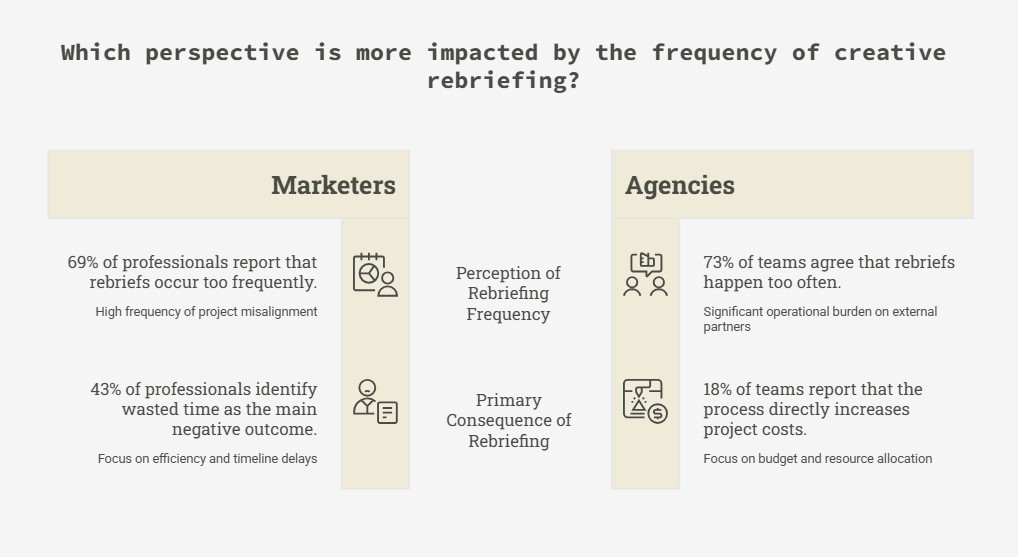
That is why rebriefing becomes such a drag on paid social teams. According to the BetterBriefs Project, 69% of marketers and 73% of agencies agree that rebriefs happen too frequently. And when the brief has to be rewritten midstream, the cost is not just creative frustration. 43% of marketers say rebriefing wastes time, while 18% say it adds cost.
A clearer brief will not remove every revision, but it can stop the avoidable ones before they turn into missed launch dates, messy feedback threads, and ads that never had a fair shot.
Conclusion: A Creative Brief Is Only Useful If It Leads to Better Creative Decisions
Many teams treat the brief like a document to approve. The better approach is to treat it as a tool that helps decide which ideas deserve production, which angles deserve testing, and which learnings should shape the next batch.
This matters because a 2026 analysis of $1.29B in Meta ad spend found winning creatives represented only 4% to 8% of total output, depending on advertiser size. So the brief has to support better bets.
At Creative Milkshake, we integrate research, scripting, production, paid media feedback, and iteration into a single system. Our process shows what a brief needs to enable, and that's better hypotheses, better production inputs, and better testing loops.
If you want help turning your next brief into a platform-native paid social creative, contact Creative Milkshake and let’s build the next batch together.
FAQs
What is the difference between a creative brief and a marketing brief?
A creative brief translates strategy into direction for creative execution, while a marketing brief defines the broader campaign plan. Paid social usually needs both. The marketing brief explains the business goal, while the creative brief outlines which ads to produce and test.
You can watch this video to learn more:
How long should a creative brief be?
A creative brief should usually be a few pages. It can be shorter for one asset or longer for multiple platforms, creators, markets, or test variables. The goal is clarity, though.
Who writes the creative brief?
The creative brief is usually written by the marketer, brand lead, agency strategist, or whoever owns the campaign direction. For marketing campaigns, it should also include input from media buyers, creative teams, production leads, and approval owners.