
When ad performance declines you may start to refresh creative, adjust budgets, or test new audiences.
If results barely improve, that’s when the real question appears: what should you fix first?
Here’s the truth:
Most ad optimization efforts stall because testing lacks order.
Teams change too many variables at once, scale before stability, or optimize based on incomplete signals. The result is wasted spend and unstable performance.
In this guide, you’ll get a clear ad optimization cheat sheet.
You’ll learn what to audit first, what to pause, and what to formalize so performance improves without constant resets.
TL;DR
Ad performance slows when signal, structure, and scale fall out of order.
Follow the execution sequence: signal → structure → creative → scale.
Fix tracking before touching hooks, bids, or budgets.
Separate testing campaigns from scaling campaigns to protect stability.
Use ABO for controlled validation and CBO after signal density is proven.
Run 6-10 creatives in parallel and plan creative velocity weekly.
Allocate budget by function: testing, scaling, and retargeting.
Improve CTR without weakening intent or post-click performance.
Align landing pages with ads to protect conversion efficiency.
Scale gradually and expand only when creative depth supports it.
Optimize for LTV, instead of short-term ROAS optics.
Treat optimization as a documented system, rather than reactive edits.
What Is Ad Optimization?
Ad optimization is the process of improving your ads step by step to get better results from the same budget. It means testing creatives, adjusting targeting, refining offers, and shifting budget to the highest-performing creatives based on real data.
And this matters more than ever.
Global ad spend is expected to reach around $1.23 trillion by the end of 2026, which means your competitors are investing more and more in ads. If you do not optimize your strategy fast, costs climb and performance drops.
Here's what you can track at the start:
This leads us to our next point.
The Only Framework You Need to Optimize Ads
Before adjusting budgets or refreshing creatives, you need a clear execution order. Without structure, optimization turns reactive and unstable.
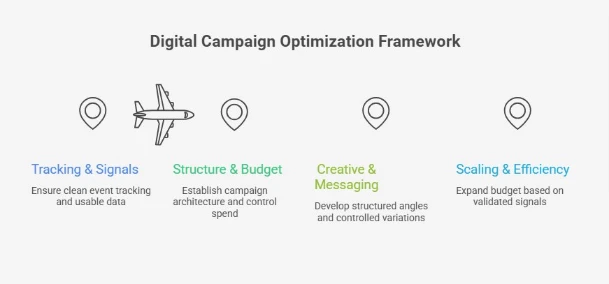
So here are the four parts that keep your digital campaigns predictable and aligned with your campaign goals:
Tracking & signals: Clean event tracking, prioritized conversions, and usable LTV data that support real data-driven decisions.
Structure & budget: Campaign architecture that separates testing from scaling and controls spend allocation.
Creative & messaging: Structured angles, controlled variation, and disciplined iteration.
Scaling & efficiency: Budget expansion based on validated data, separating high from low performers.
Most brands optimize in reverse. They tweak creative first, scale second, and audit tracking last. As a result, unstable inputs lead to unstable outputs.
With this foundation in place, let’s break it into a tactical cheat sheet you can apply immediately.
The Ultimate Ad Optimization Cheat Sheet
Once the framework is clear, execution comes next. Start with tracking because creative and budget decisions mean nothing if your data is wrong.
1. Fix Tracking Before You Touch Creative
Before changing hooks or angles, audit your signal. Performance volatility typically starts with broken attribution, so here are the non-negotiables you validate first:
Meta Pixel and CAPI are firing with event_id deduplication confirmed in Events Manager.
Conversion events are prioritized based on actual revenue contribution or LTV, rather than just the highest volume.
Cross-domain tracking has been validated across checkout flows, subdomains, and payment redirects.
LTV or contribution margin data is mapped back into platform reporting to guide budget allocation.
Remember: Flawed data distorts allocation. Unfortunately, 45% of marketing data used for decisions is incomplete or inaccurate, which directly impacts informed decisions.
When event match quality improves, efficiency follows.
For example, adding advanced matching increased match rates from 57% to 84% and lowered CPA by 22%. This proves that stronger signals improve optimization stability.
The point is to fix attribution before scaling marketing efforts. Otherwise, you’re just scaling error.
2. Structure Campaigns for Testing Velocity
Campaign structure determines how quickly you can test and how reliably you can scale. Budget control and algorithm control serve different purposes.
When to Use ABO
ABO (Ad Set Budget Optimization) lets you control spend at the ad set level. This is useful during testing because each audience or angle receives equal budget and isn’t starved by early performance swings.
Use ABO when:
You want controlled audience testing
You’re validating new offers or messaging
You need consistent data per variation
When to Use CBO
CBO (Campaign Budget Optimization) centralizes the budget at the campaign level and lets the algorithm redistribute spend. This works better once performance is stable and conversion volume is consistent.
Use CBO when:
You are scaling proven creatives
You have sufficient conversion data
You want automated budget redistribution
Industry testing (e.g., Lebesgue data) shows that manual budget control can outperform algorithmic allocation during early-stage prospecting. But once performance stabilizes, algorithm-driven scaling often becomes more efficient.
So, structure according to intent:
Pro tip: If you want to see how UGC and influencer content perform differently inside paid campaigns, check out our UGC vs Influencer guide.
3. Optimize Creative like a Performance Asset, Rather than a Branding Asset
Creative should operate as a measurable input to revenue. So instead of merely chasing aesthetics, structure your creatives around performance logic.
Here are the core elements that drive stability:
Hook in the first 3 seconds.
Clear Problem → Solution flow.
Direct offer.
Visual pattern interrupt.
Single CTA.
Attention is the gatekeeper.
According to research, 47% of viewers decide within the first three seconds whether to keep watching the video, and strong hooks can lift retention by roughly 60%. In other words, a good start directly influences engagement rates and delivery.
Once viewers get past that first moment, about 65% keep watching for at least 10 more seconds, which gives your message real time to drive action.
Structure alone is not enough.
Multiple variations must run in parallel, with A/B testing as the default, and at least 6-10 creatives live at all times.
Proper A/B testing can detect performance differences in the 5-15% range, which means you can make precise improvements before scaling. That discipline protects your conversion rate from volatility.
Creative Milkshake’s work with Jimmy Joy illustrates this clearly.
By restructuring YouTube ads around performance-led scripting and iterative testing, CPA dropped by 33% while ad spend increased by 25%. Performance held over longer periods and turned creative into a controlled growth lever.
4. Your Budget Allocation Rule of Thumb
Budget allocation affects how predictable your results are week to week. When you constantly move spend between testing and scaling, CPAs swing, learning phases reset, and performance becomes harder to forecast.
Use a functional split instead:
20-30% → Testing: Run new creative angles, hooks, and formats without disrupting revenue from proven campaigns.
50-60% → Scaling: Increase spend behind validated winners with stable CPAs and predictable volume.
10-20% → Retargeting: Convert high-intent visitors who have already interacted with your brand or products.

This model keeps exploratory spend from disrupting proven revenue drivers. Testing can fluctuate. Scaling must stay reliable.
Pro tip: If increasing budget causes CPA to spike, pull back until efficiency returns. Scale only what remains stable under higher spend.
5. Improve CTR Without Killing Conversion Rate
More clicks don’t help if those clicks don’t convert. The goal isn’t just a higher CTR; it’s attracting the right traffic.
Here’s how to increase CTR without lowering conversion quality:
Group keywords by clear, shared intent.
Remove broad or mixed-intent keyword clusters.
Write headlines that match exactly what the user is searching for.
Use ad extensions to clarify pricing, features, or limitations so low-intent users self-filter.
Here’s how it works:
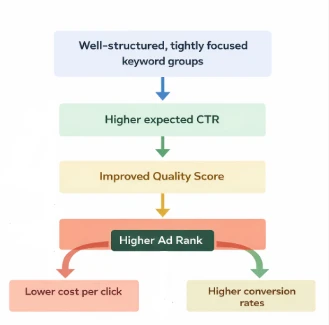
Campaign structure directly affects how Google evaluates your ads in the auction. When keyword groups are tightly organized around a single intent, your ads match searches more precisely, which improves expected click-through rate.
Remember: Google calculates Ad Rank using your bid, expected CTR, and landing page experience.
A higher expected CTR improves Quality Score, which lowers the cost required to win placements. More importantly, tight keyword control filters out low-intent searches, so you spend budget on users who are more likely to convert.
6. Landing Page Optimization That Supports Paid Traffic
Paid traffic underperforms when the landing page does not match the ad. If the message changes after the click, conversion rate drops.
Focus on these fundamentals:
Keep the headline consistent with the ad’s promise.
Present one clear value proposition above the fold.
Place social proof near the primary CTA.
Remove friction from forms, navigation, and load speed.
When the ad and landing page reinforce the same offer, users move faster from click to action.
Landing pages that closely mirror ad copy can increase conversion rates by up to 25%, yet 65% of advertisers fail to maintain consistent message match. That gap explains why many campaigns generate clicks but struggle to convert.
In our work with Spoke London, we aligned platform-native ads with landing page messaging.
This helped shift 32% of total spend into Reels, increase overall ad spend by 20%, and drive a 43% higher click-through rate compared to business-as-usual creatives.
That consistency reduced drop-off after the click and improved paid efficiency without diluting brand positioning. This gave the marketing teams both scale and control.
7. Broad Targeting + AI Signals Done Correctly
Broad targeting means running campaigns without tightly defined audience filters. Basically, the platform’s algorithm decides who sees your ads based on conversion data.
This approach can work, but only if the inputs are strong. You need:
Sufficient conversion volume to train the model.
Clear creative segmentation by angle or intent.
LTV data strong enough to guide value-based bidding.
Remember: Automation does not “find winners” on its own. It reallocates based on probability.
When creative angles are mixed inside one ad set, AI can’t interpret signals as well. In contrast, when signals stay consistent and creatives are grouped by angle, then allocation becomes more predictable and stable.
8. Scaling Without Breaking Performance
Scaling fails when you focus on speed and neglect stability. And most volatility appears not during testing, but during aggressive expansion. So here are the controlled ways to grow:
Vertical scaling:
Increase budgets gradually, typically 15-20% per day, once performance is validated and stable.
Horizontal scaling:
Duplicate into new audiences only after the creative proves durable.
Expand creatives to avoid overloading a single asset.
Creative fatigue is predictable.
As frequency rises, engagement drops, and CPAs climb because the same users see the same message repeatedly. That cycle forces the algorithm to search for performance in narrower pockets, which increases volatility.
That’s why we advise you to scale in phases.
Grow the budget only when creative depth and signal density can support it. Otherwise, expansion simply accelerates decline.
9. Shift from ROAS Optimization to LTV Allocation
Short-term ROAS can come from cheap conversions; it doesn’t necessarily mean you have durable customers. So if you base your bidding only on day-one revenue, you may not make the best scaling decisions.
Instead, we advise you to anchor your ad budget to lifetime value.
Once you start to consider LTV and contribution margin, your bidding logic shifts from lowest CPA to highest long-term return. In practice, that changes who wins auctions and how aggressively you scale.
Unfortunately, only about 50% of companies track the CLTV-to-CAC ratio. So, the companies that don’t track it allocate capital with poorer long-term visibility.
In finance, this difference matters more.
In Creative Milkshake’s work with regulated finance brands, clear and compliant creatives increased CTR by 17.35% and helped raise platform forecasts by 322% in key markets. That kind of improvement supports stronger deposit growth and steady customer acquisition.
10. Weekly Optimization Routine
Your performance stabilizes when you create a system for optimization. Here is a weekly structure that protects efficiency and prevents silent budget leaks.
Every Monday:
Check CPA trends across testing and scaling separately.
Identify creative fatigue through rising frequency and declining CTR.
Kill the bottom 20% based on predefined thresholds.
Launch 2-4 new creatives into the testing pool.
This cadence matters because 40-60% of ad spend usually sits in underperforming creatives that should have been removed earlier. That’s why we recommend weekly pruning to directly protect your margin and scale.
Consistency also requires monthly resets. Here are the higher-level reviews that prevent strategic drift.
Every Month:
Refresh hooks while keeping winning angles intact.
Review the attribution model against actual revenue signals.
Re-evaluate whether campaigns are in testing, scaling, or maintenance mode.
Routine creates control, and control creates durable growth.
Pro tip: Want to refresh your current hooks more effectively? Check out our guide on the best UGC hooks for social media.
Common Ad Optimization Mistakes That Kill Scale
Scaling becomes difficult when testing and budget decisions lack structure. These patterns quietly reduce performance and make results harder to interpret:
Testing too many variables at once. When hooks, offers, audiences, and landing pages change together, you can’t tell what caused performance to move.
Scaling too early. If you increase budget before an ad proves it can convert consistently, cost per acquisition usually rises.
Over-segmenting audiences. Splitting spend across too many small audiences slows learning and limits data per variation.
Ignoring placement performance. When placements are blended in reporting, underperforming ones stay active because stronger placements hide them.
Relying only on last-click ROAS. Budget shifts toward bottom-funnel ads while prospecting gets undervalued.
Attribution is often the hidden constraint behind stalled growth.
If performance is judged only by last-click results, you’ll naturally favor retargeting and cut the campaigns that generate new demand.
As Alan C. Moore noted:
"If your paid ads are judged only by last-click attribution, you are losing money every day without realizing it." - Alan C. Moore, Founder of Paton Digital
When last-click becomes the only lens, you scale the ads that close existing demand and reduce spend on the ads that create it. Over time, that shrinks your pipeline.
Looking at contribution across the funnel — not just the final click — gives a more accurate picture of what actually drives growth.
What High-Performing Teams Do Differently When Optimizing Ads
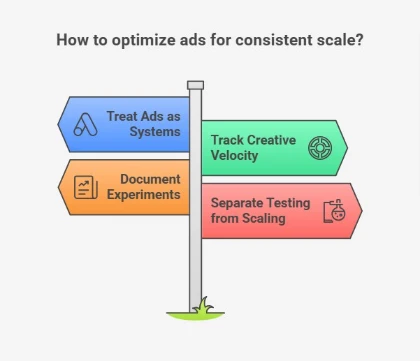
Consistent scale comes from structure. Here’s how teams that scale profitably operate:
They fix tracking before changing ads. Attribution is verified before creative or budget decisions are made. This prevents scaling based on incomplete data.
They plan creative production in advance. New hooks and formats are scheduled before performance drops, so fatigue doesn’t cause sudden revenue dips.
They test one variable at a time. Each experiment has a defined hypothesis and controlled change. Results are documented so future tests build on real learnings.
They scale only proven assets. Ads move to higher budgets only after holding CPA at stable volume. Testing and scaling are kept separate to avoid distorting results.
Creative Milkshake follows this same principle.
We build structured creative libraries and repeatable testing workflows instead of one-off launches, which allows brands to scale predictably.
Turn Ad Optimization into Predictable Growth
Ad optimization follows a clear order: signal first, then structure, then creative, and only then scale. When that sequence breaks, volatility follows.
So, take a step back and audit your current setup. Validate tracking, clarify campaign structure, and separate testing from scaling. Then review whether creative output matches the level of spend.
And if controlled growth is the goal, Creative Milkshake supports brands with structured creative systems built for predictable scaling. Apply this cheat sheet internally, or partner with a team that runs this process daily.
Contact us when you are ready to scale with discipline.
FAQs
What is ad optimization?
Ad optimization is the structured process of improving performance without breaking stability. It starts with signal accuracy, then campaign structure, then creative validation, and only after that, budget expansion.
How often should I optimize my ads?
Review performance weekly to remove underperforming creatives and introduce new tests, but avoid daily changes that reset learning. A deeper structural review should happen monthly, focusing on attribution, scaling phase, and budget allocation.
How to optimize an ad?
Begin with tracking integrity and event prioritization. Next, isolate variables in controlled tests. Move validated creatives into scaling campaigns only after consistent results. That sequence protects margin and reduces volatility.
Is broad targeting better than interest targeting?
Broad targeting works when signals are clean, creative angles are clear, and value data informs bidding. Interest targeting may help during early testing, but scale depends on structured signal consolidation.