


User-generated content (UGC) works well in paid social because it feels closer to the content people already consume, while giving brands room to test different hooks, messages, creators, and formats.
The challenge starts when you find something that performs.
Scaling requires more than producing more videos. You need a creative system that can turn a promising concept into new scripts, hooks, voiceovers, visuals, testimonials, and platform-specific variations without losing the qualities that made the original ad work.
The performance case is strong too. TikTok reports that Spark Ads, which amplify creator or user-generated content, deliver a 43% higher conversion rate than standard in-feed ads, along with higher completion and engagement rates.
This guide shows you how to build that UGC system, increase testing velocity, use performance data to shape the next round of creative, and keep successful campaigns running as creative fatigue starts to appear.
TL;DR
UGC works because it feels native, credible, and easy to understand. Strong UGC ads combine a relevant hook, clear problem or desire, convincing demonstration, proof, and a direct CTA.
Scaling UGC requires a creative system. Start with audience research, build messaging angles, develop multiple concepts, match the right creators, capture modular footage, and run structured tests.
Use performance data to turn winners into creative families. Expand successful concepts with new hooks, creators, formats, visuals, CTAs, and platform-specific versions while watching for creative fatigue.
Match UGC to the customer journey. Use broader education and storytelling for prospecting, demonstrations and comparisons for consideration, and testimonials, offers, FAQs, and stronger proof for retargeting.
Secure usage rights at the start. Clarify paid usage, licensing, whitelisting, exclusivity, geographic limits, and raw footage rights so successful creative can scale without legal delays.
What Is UGC-Based Performance Creative?
UGC-based performance creative is ad creative designed to look and feel like user-generated content while being built specifically to drive measurable results.
It can include creators or customers speaking directly to camera, product demonstrations, testimonials, voiceovers, green-screen videos, reviews, and other formats that feel natural within social feeds. That’s why UGC comes off as more authentic (9.8x more than influencer content).
The main difference from traditional influencer marketing comes down to the creator's role.
Influencer campaigns usually depend heavily on the creator’s audience and organic distribution. However, with UGC ads, you may hire a creator mainly to produce content your brand can test, edit, and run as paid ads.
This gives performance teams more control over hooks, messaging, offers, formats, and creative variations while still keeping the content familiar to the platform.
Why UGC Works So Well for Paid Social
UGC fits paid social because it matches how people consume content on platforms like Meta, TikTok, and YouTube. It can capture attention without feeling overly produced, make product benefits easier to understand, and give performance teams more creative angles to test.
Let’s look at the reasons UGC works so well for paid social performance.
1. Looks Native to the Feed
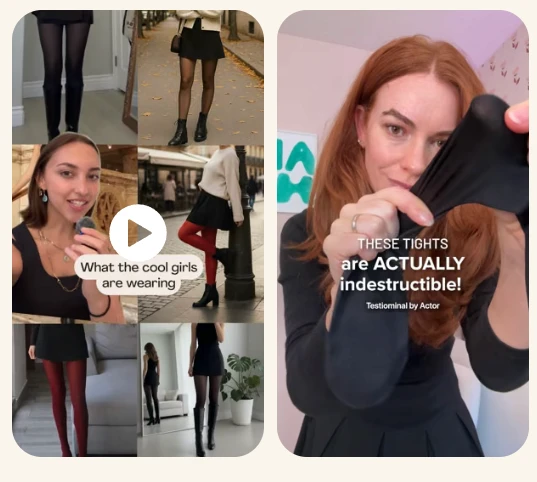
Traditional video ads can stand out for the wrong reason. Highly polished lighting, scripted brand language, and commercial-style visuals featuring celebrities immediately signal to viewers that they are watching an advertisement as they scroll.
UGC blends naturally into the scroll feed. These ads typically use the same vertical framing, direct-to-camera delivery, subtitles, and platform-native editing conventions that help make the ad appear like another piece of content.
For that very reason, TikTok explicitly recommends a DIY, ‘not overly polished’ aesthetic for performance creative because it helps ads fit naturally alongside user-generated content on the platform.
2. Builds Trust Quickly
UGC also lets brands borrow some of the credibility associated with recommendations from real people.
A creator or user speaking naturally about an experience can feel more believable than the same benefits being presented through branded copy. Testimonials, product demonstrations, before-and-after results, and other forms of social proof can make that message feel more credible.
In an Entribe survey, 82% of respondents said they’d be more willing to buy from a brand that features UGC in their marketing.
3. Makes Benefits Easier to Demonstrate
UGC gives you a practical way to show how a product works instead of relying on copy alone. Creators can demonstrate key features, walk through how the product is used, and make benefits easier to understand within a short video.
This works well when the value of a product becomes clearer once people see it in use.
This was one reason our team at Creative Milkshake used UGC to help Spoke London scale with Meta Ads. Creators could show how the pants looked and fit on a real person while also explaining how customers could choose the right size.
4. Gives Performance Teams More Creative Variables to Test
One of the biggest advantages of UGC for performance marketers is its modularity. One underlying concept doesn’t have to produce only one ad.
Your team can test different hook variants, creators, scripts, opening visuals, testimonials, calls to action, voiceovers, product demonstrations, offers, subtitles, and editing styles while keeping the core proposition consistent.
And all of this can be done in a relatively short time because you can work with different creators without managing the same level of production you would for traditional brand content.
What Makes a Good UGC Ad
An effective, well-performing UGC ad doesn’t need complicated production. It needs a clear structure that earns attention, communicates value quickly, and gives the viewer a reason to act.
For paid social, that usually comes down to four core elements:
A hook that attracts the right viewer: The hook should stop the right person. Strong hooks call out a specific pain point, desire, audience, misconception, or outcome in the first few seconds.
A clear problem, desire, or use case: The viewer should quickly understand why the product matters. Good scripting connects the product to a recognizable problem, goal, or real-world situation before moving into features.
Credible proof: Creator experience, product demonstrations, customer results, or other visible evidence can support the main claim and make it easier to believe.
A clear CTA and offer: Tell the viewer what to do next and, when relevant, give them a reason to act now.
And, by the way, video UGC ads do way better than other formats.

How to Build a UGC Creative Engine That Can Support Scale
When we talk about scaling paid social with UGC, we mean building a creative system that can generate new ideas, turn them into ads, learn from performance data, and use those insights to shape what we produce next.
In other words, keep testing new angles while building stronger variations from concepts that are already showing promise.
Let’s walk through how we build that system.
1. Start With Customer and Audience Research
Strong UGC starts before scriptwriting or video production. The first step is to understand what your customers actually care about, what problems they are trying to solve, and the language they use to describe those problems. This information then guides everything from creator selection to what they say to the style and format of the content.
The best audience research sources can include:
Customer reviews and testimonials
Sales calls and customer interviews
Support tickets and FAQs
Comments on organic social content
Competitor reviews
Reddit, TikTok, YouTube, and other community discussions
Search queries and site-search data
Social listening and sentiment analysis
Paid social comments
Existing content marketing analytics
We suggest looking for repeated pain points, objections, desired outcomes, purchase triggers, misconceptions, and product use cases. These insights can become the foundation for hooks, scripts, testimonials, product demonstrations, and broader creative concepts.
Research should also help you identify the differences between audience segments.
2. Build a Library of Messaging Angles
Once you understand the audience, organize those insights into a pattern library of messaging angles. An angle is the central reason someone should care about the product.
Take a running shoe as an example.
One ad might focus on the frustration of foot pain during longer runs.
Another could focus on staying comfortable for more miles.
A third could challenge the idea that extra cushioning always makes a shoe feel heavy.
The product stays the same, but each angle gives the viewer a different reason to care.
Keep these angles in a documented, shared creative library alongside the audience insight to guide creative strategists. This makes ideation much more systematic.
3. Turn Strong Angles Into Creative Concepts
An angle explains what you want to communicate. A creative concept determines how you will communicate it.
Take the running shoe example from above. If one messaging angle focuses on staying comfortable during longer runs, you could turn that same angle into several UGC concepts:
Creator testimonial: A runner explains how the shoes feel during longer sessions.
Product demonstration: A creator shows the shoes in action during a run and talks through the comfort features.
Podcast-style clip: A creator discusses why they changed running shoes and what they noticed after switching.
Comparison concept: A runner compares the shoe with another option based on cushioning, weight, fit, or comfort.
The angle stays consistent, but the way you present it changes. This gives you several ways to test how the same message performs.
You can see this approach in our work with Jimmy Joy. We tested several creative concepts for the meal replacement brand, including street interviews, routine showcases, and testimonials. That UGC campaign helped reduce YouTube CPA by 33%.
4. Match Creators to the Concept
Choose creators based on the concept, target customer, and message they need to deliver. For paid UGC, follower count matters far less than how believable that creator feels in the ad.
A creator demonstrating a beauty product may need a different personality, communication style, and level of product knowledge from someone explaining a financial app. You want someone who feels like a natural fit for both the customer you’re speaking to and the story you’re trying to tell.
To make sure of that, consider factors like:
Some concepts benefit from highly polished creators, while others work better with a less rehearsed delivery.
Creator involvement can also vary. Some creators may follow detailed scripting, while others perform better when given talking points and freedom to use their own language.
Important note: Keep platform policies, disclosure requirements, brand safety, and compliance in mind when briefing creators. They should understand which claims are approved, how sponsorships need to be disclosed when content appears on their own account, and which brand guidelines they need to follow.
5. Capture Modular Assets During Production
Scaling UGC becomes much easier when one creator shoot gives you enough footage to build several ads. And this needs to be planned before filming starts.
Instead of filming a single script from beginning to end, capture modular assets such as multiple hooks, different calls to action, several product demo angles, short reaction clips, separate voiceovers, b-roll, and product shots.
These modular assets give you enough material to develop multiple creative variations from the same production cycle. This approach increases test volume while keeping content production manageable. It also reduces the need for constant revisions because editors have more material to work with after the shoot.
Insider tip: At Creative Milkshake, we make these requirements explicit in our creative briefs. We identify which hooks, shots, calls to action, and delivery styles need alternatives before filming starts, so our editors have enough material to build and test multiple variations.
6. Run Structured Creative Tests
Remember, more creative doesn’t automatically mean better testing. If every ad changes the hook, creator, offer, format, length, visuals, and CTA at the same time, it becomes hard to understand what actually drove the result.
Instead, use a structured approach to model creative testing. For example, you might test:
Several messaging angles against one another.
Different creative concepts for the strongest angle.
Different creators using the winning concept.
Multiple hook variants for the strongest creator-concept combination.
Different CTAs, proof points, lengths, or editing styles.
The structure will vary based on your budget, platform, and how much data the campaign can generate. What matters is creating enough variation to learn from performance without changing so many elements that the findings become difficult to interpret.
7. Build a Creative Analytics System
Creative testing becomes much more valuable when the learnings are stored in a structured way.
Instead of analyzing ads only at the campaign or ad set level, tag each piece of ad creative by its major components. These tags might include creator, messaging angle, concept, platform, CTA, format, offer, and product (if different products are used in the same ad campaign).
Those tags let you connect performance back to specific creative decisions. Over time, patterns start to emerge. Certain hooks may produce stronger view-through rates, one creator may convert more efficiently, or product demonstrations may consistently outperform testimonial-led concepts for a particular audience.
At Creative Milkshake, we build custom dashboards that connect platform performance with these creative variables. This helps us compare concepts, creators, hooks, and formats without relying on individual ad names or scattered campaign reports.
When UGC runs alongside other paid channels, broader measurement can add useful context too. Multi-touch attribution can show where UGC appears in the customer journey, while incrementality testing can help measure its contribution to conversions.
For campaigns with broader awareness goals, brand lift studies can also show how the creative affects awareness, consideration, or purchase intent.
8. Turn Winning Concepts Into Creative Families
When an ad performs well, don't leave it running until creative fatigue destroys its performance. Use it as the starting point for a creative family.
A creative family is a group of ads built around the same core insight, message, or concept that made the original creative successful.
For example, if a creator-led product demonstration performs strongly, you could develop:
Three new hook variants
A shorter version
A longer testimonial version
A new creator using the same script
A creator voiceover version
New proof points
Different product visuals
A new CTA or offer
A version adapted for another platform
Each variation should keep the strongest part of the original concept while changing enough of the execution to give you something meaningful to test.
This keeps the creative system moving in a continuous cycle:
Audience research → messaging angles → concepts → production → testing → analytics → winning creative families → new testing
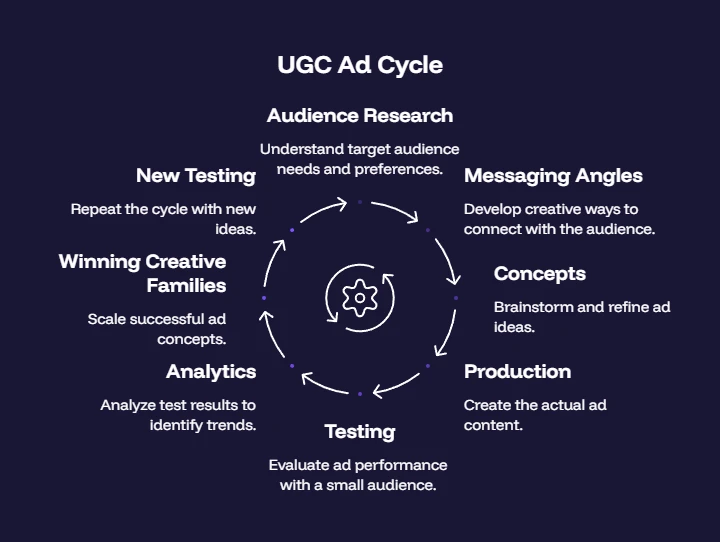
That loop is what turns UGC from occasional creator content into a scalable performance creative engine.
How to Scale Winning UGC Ads
Once a UGC ad proves it can convert, you can put more budget behind it, but carefully and strategically. But before scaling, confirm that the ad:
Converts at an acceptable CPA
Supports the campaign's revenue or acquisition goals
Has enough performance data to justify more budget
If all these signals are strong, this is what we’d do:
Increase spend gradually: Scale the budget while monitoring CPA, ROAS, conversion rate, and frequency to ensure performance holds as reach expands.
Adapt the concept across platforms: Rework the winning idea for Meta, TikTok, YouTube, or other channels rather than pushing the exact same asset everywhere.
Watch for performance decay: Rising frequency, weaker click-through rates, or worsening CPA can signal that the creative is losing efficiency.
Keep fresh creative in rotation: Continue introducing new concepts so the campaign does not become dependent on one winner.
Read Next: How to Scale Paid Social Without Killing Your CPA: 7 Proven Ways
How to Manage UGC Creative Fatigue
Creative fatigue appears when an ad starts losing its ability to hold attention or drive efficient results after repeated delivery. This means even the winning UGC creative can eventually lose momentum.
And if you’re running UGC ads on TikTok, that fatigue may kick in as early as 48 hours, according to Influee.
Common warning signs include:
Rising frequency and CPA
Falling CTR or conversion rate
Weaker engagement rate
Declining view-through rate
When these signals start moving in the wrong direction, avoid replacing a proven concept immediately. Test fresh hooks, creators, openings, visuals, or edits around the same core idea first. If the underlying concept continues to perform across those variations, it may still have room to scale.
You should also prepare replacement creative before the current winner starts declining. This gives you fresh ads ready to launch without interrupting campaign momentum.
How to Use UGC Across the Paid Social Funnel
The message in a UGC ad should change as someone becomes more familiar with the brand. A first-time viewer may need a reason to care, while someone who has already visited the site may need more proof, clarity, or motivation to purchase.
This means using different creative angles at each stage rather than showing every audience the same message.
Prospecting
Prospecting creative should help the right viewer recognize a problem, desire, or situation that feels relevant to them before the brand becomes the focus.
Insider tip: Lead with the customer’s situation first. Hooks based on familiar frustrations, desires, mistakes, or everyday use cases can give viewers a stronger reason to keep watching.
Consideration
At this stage, the viewer needs more detail. Use UGC to answer product questions, show how it works, compare alternatives, and address concerns around price, quality, setup, or expected results.
Retargeting
Retargeting can become more specific to what the viewer has already done. Someone who visited a product page, watched previous ads, or added an item to their cart may need stronger proof, a clearer offer, or an answer to the objection still holding them back.
Secure UGC Usage Rights Before You Find a Winner
UGC can become significantly more valuable once it proves it can drive conversions, so usage terms should be clear before the asset starts scaling.
Make sure the agreement covers:
Paid usage rights: Confirm whether the brand can use the content in paid advertising.
Duration and geographic restrictions: Define how long the content can run and which markets or countries it can be used in.
Creator licensing fees: Establish whether paid usage requires additional fees beyond the original content production rate.
Partnership ads and whitelisting: Clarify whether the brand can run ads through the creator’s account or identity on platforms such as Meta and TikTok.
Exclusivity: Specify whether the creator may work with competing brands and, if restrictions apply, how long those restrictions last.
Raw footage rights: Determine whether the brand receives the original footage and whether it can create new edits, cutdowns, voiceovers, or other content variations from it.
Negotiate these terms before production. Once an asset is generating strong ROAS, the brand may want to increase spend, expand into new markets, create more video ad variations, or use the creator in Partnership Ads.
If these rights were never secured, scaling can be delayed by renegotiations, unexpected licensing costs, or limits on how the creative can be reused.
This is where working with an expert UGC agency can help. For example, at Creative Milkshake, our team builds usage rights into creator agreements from the start. We negotiate compensation based on how the content will be used and handle the creator coordination, so you can scale strong assets without reopening those conversations later.
What Metrics Matter When Scaling UGC Ads?
Performance data helps you decide which UGC ads have room to scale and what needs to change in the next creative round. The key is to look at attention, engagement, traffic quality, and conversion efficiency together rather than judging an ad from one metric.
No single metric can tell you that a UGC ad is ready to scale. Read the signals together. For example, a strong hook rate means little if viewers drop off quickly, while a high CTR can still lead to poor economics if conversion rate and CPA deteriorate.
The strongest scaling candidates usually maintain healthy attention, qualified traffic, conversion efficiency, and revenue performance as spend increases.
Build a Scalable UGC System With Creative Milkshake
Scaling UGC requires a steady flow of creators, strong concepts, structured testing, and enough production capacity to keep new creative moving into the account.
At Creative Milkshake, we manage that process from audience research and messaging angles through creator sourcing, production, testing, and iteration. We also handle usage rights and creator coordination, so strong assets can keep moving without unnecessary delays.
Our team uses performance data to understand which messages, concepts, creators, and formats deserve another round of testing. That gives you a more consistent way to produce UGC around what is already working rather than starting from scratch every time.
Ready to build a stronger UGC creative system? Talk to our UGC experts!
FAQ
How much does UGC cost?
UGC costs depend on the creator’s rates, the scope of work, and usage rights. The method of engagement will also affect costs:
Typical direct free-market engagement UGC rates range between $150-$500 per video. But creators may factor in costs for using their generated assets for ads and/or the website. The duration of ownership may also impact the creator fee.
Using a UGC Content partner like Creative Milkshake ensures everything is done for you end-to-end: sourcing, managing, briefing, strategy & concept, product placement, filming & all post-production. This method is a higher cost for higher value, more intentionally performance-driven content & convenience.
Is UGC still effective for paid social ads?
Yes. Creator-led UGC remains widely used across paid social, with formats such as TikTok Spark Ads and Meta Partnership Ads giving brands more ways to run creator content as advertising. Performance still depends on the concept, message, creator, offer, and how well the creative fits the platform.
What paid social platforms are best for UGC ads?
TikTok, Instagram, Facebook, and YouTube Shorts can all support UGC-style advertising. The right platform depends on where your audience spends time and how they consume content. Creative should also be adapted to each platform rather than running the exact same asset everywhere.
How does Creative Milkshake scale UGC ad assets?
We track creative-level signals such as hook rate, watch time, CTR, conversion rate, CPA, and ROAS to identify concepts with room to scale. When a concept performs strongly, we develop new hooks, creators, edits, and other variations while monitoring how performance responds to additional spend.
Does Creative Milkshake help with UGC creative briefs and production?
Yes. Creative Milkshake manages the UGC production process from concept development and creator sourcing through contracts, creative briefs, production support, and post-production editing. We also plan the variations needed for testing before filming starts, so each production cycle can generate multiple usable assets.