

Paid social campaigns are not always about clicks or conversions. Many also depend on upper-funnel activity that shapes discovery, awareness, consideration, and brand perception.
For campaigns focused on these outcomes, marketers need a way to understand whether their advertising influences audiences, even when that impact doesn't show up immediately in direct-response metrics.
That’s what a brand lift study does.
This guide covers everything paid social marketers need to know about brand lift studies, including:
How brand lift works
What it measures
How to interpret the results
When it makes sense to run one and when it does not
Looking for help with paid social measurement? Creative Milkshake offers paid media measurement services to help you better understand campaign performance and make more informed media decisions.
TL;DR
Brand lift studies measure changes in awareness, recall, consideration, favorability, purchase intent, and other brand perceptions.
They compare exposed and control groups to estimate the incremental impact of advertising.
Brand lift complements attribution and conversion reporting by measuring changes that happen before a purchase or conversion.
Results can include absolute lift, relative lift, lifted users, cost per lifted person, and statistical certainty.
Meta, TikTok, and YouTube offer native brand lift tools, but access, setup, budgets, and study requirements differ.
Brand lift works best for larger awareness campaigns, product launches, messaging tests, and campaigns with enough reach and budget.
Smaller or highly direct-response campaigns may be better measured through attribution, conversion tracking, and creative testing.
Brand lift findings become more useful when combined with creative, audience, media, and conversion data.
What Is a Brand Lift Study?
A brand lift study measures whether an advertising campaign changed what people know, remember, think, or feel about a brand.
In marketing terms, it estimates the incremental effect of advertising on brand perception by comparing people who were exposed to the ads with a similar group who were not (control group).
Depending on the study, marketers can measure lift in metrics such as brand awareness, ad recall, consideration, favorability, or purchase intent after running campaigns. The difference between the exposed and control groups indicates how much of that change can reasonably be attributed to the campaign.
This makes brand lift different from standard paid media reporting, which focuses on metrics like impressions, click-through rate (CTR), video views, and conversions. It also differs from attribution, which attempts to connect ads to actions such as purchases or leads.
Brand lift instead answers a different question: Did the advertising actually change audience perception, even if the person did not immediately convert?
How Does a Brand Lift Study Work?
A brand lift study typically works by splitting the target audience into two comparable groups:
Exposed group: People who are eligible to see, or actually see, the advertising campaign.
Control group: Similar people who are intentionally withheld from seeing the campaign.
Both groups are then surveyed with questions related to metrics the study is intended to measure. For example, if the goal is to measure ad recall, the question may ask both the exposed and control group if they remember seeing an ad from the brand.
Because the main difference between the groups is ad exposure, marketers can compare their responses to estimate the campaign’s incremental impact.
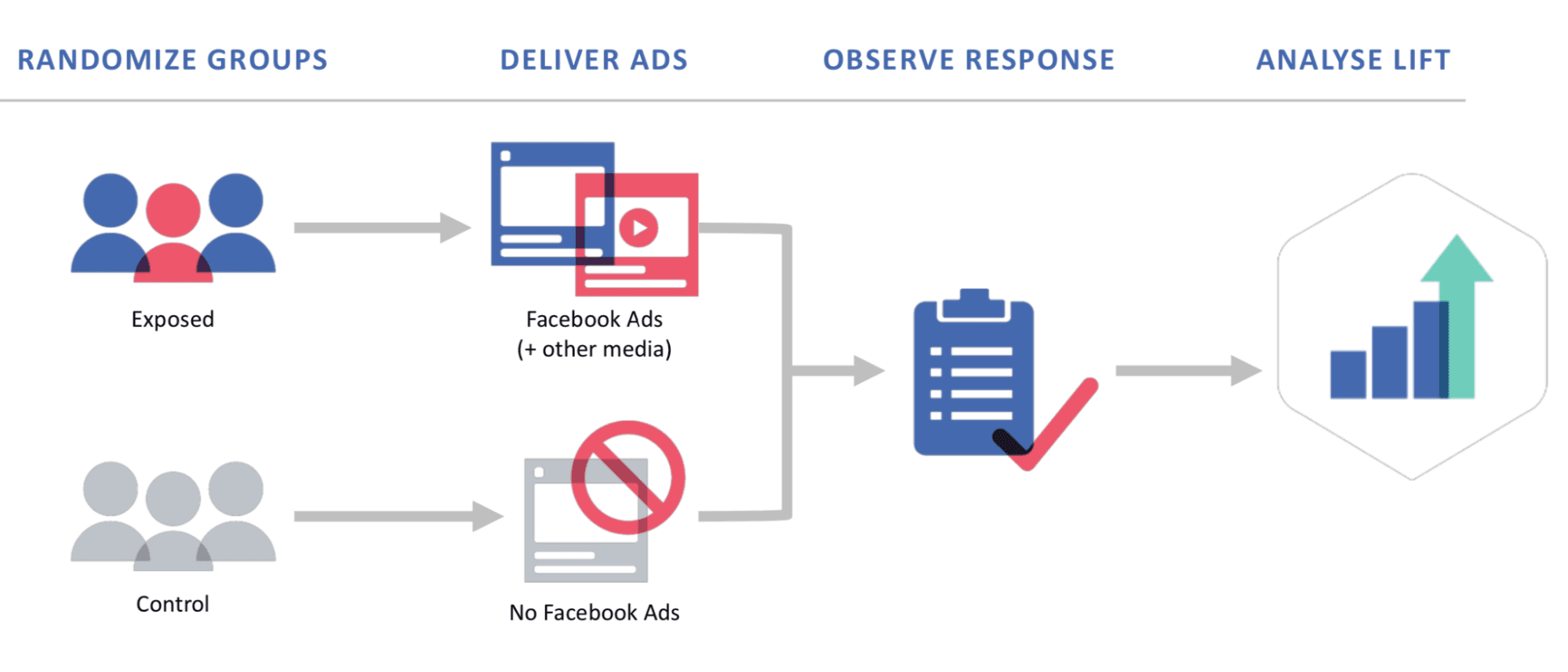
For example, if 35% of the exposed group says they would consider buying from the brand compared with 30% of the control group, the campaign generated at least a 5 percentage-point lift in consideration. (We’ll cover how to interpret results later on in more detail.)
Many major advertising platforms automate much of this process. Depending on the platform, this can include creating the control group, serving surveys, calculating lift, and determining whether the difference is statistically significant.
What Are the Benefits of a Brand Lift Study?
A brand lift study focuses on outcomes such as awareness, perception, and consideration, which are different from sales or conversions. Because these are essentially part of the upper and middle of the funnel, a brand lift study helps you judge campaign impact at these stages.
The following are the benefits of running a brand lift study:

1. Measure Campaign Impact
Awareness campaigns can be difficult to evaluate through metrics like cost per acquisition (CPA) or return on ad spend (ROAS) because many people will not take immediate action after seeing an ad. Those metrics also reflect performance across more of the customer journey rather than isolating changes in brand perception.
A brand lift study helps quantify whether the campaign increased awareness, recall, consideration, or another intended brand outcome.
For example, Hormel Foods used a TikTok Brand Lift Study in 2026 to measure a campaign that combined broad-reach advertising with commerce-focused activity. They found a 10.9% lift in ad recall, 5.0% lift in awareness, and 4.0% lift in purchase intent. These findings showed that the campaign was influencing audiences across several stages of the funnel.
2. Understand Audience Perceptions
Brand lift studies can also reveal how advertising changes what people think about your brand. For example, you can measure whether an audience is more familiar with your brand, more likely to consider it, or more favorable toward it after exposure to a campaign.
This can be useful when you want to understand how audiences respond to new messaging, positioning, creative concepts, or broader brand activity.
3. Make Better Budget Allocation Decisions
Lift results can help marketers compare campaigns, audiences, creatives, or platforms to see where brand-building spend is having the strongest effect. This gives you another signal when deciding where to increase, reduce, or redirect media investment, particularly when direct-response metrics do not tell the full story.
4. Justify Brand and Awareness Spend
Brand campaigns can be harder to defend when leadership focuses mainly on revenue, conversions, or other direct-response metrics.
Statistically meaningful increases in awareness, consideration, purchase intent, or other brand metrics can provide stronger evidence that paid media is creating measurable value before a conversion takes place.
What Can You Measure with a Brand Lift Study?
Brand lift studies measure upper- and mid-funnel metrics:
Brand awareness: Measures whether campaign exposure increased the percentage of people who recognize or are familiar with the brand.
Brand consideration: Measures whether people who saw the ads are more likely to consider the brand when making a future purchase decision.
Brand favorability: Measures whether advertising improved the audience’s overall opinion or perception of the brand.
Brand message/value association: Measures whether audiences are more likely to associate the brand with a specific message, benefit, attribute, or value proposition communicated in the campaign.
Ad recall: Measures whether people who were exposed to the campaign are more likely to remember seeing the brand’s advertising.
Consumer purchase intent: Measures whether ad exposure increased the likelihood that someone intends to purchase the brand’s product or service.
Depending on the platform and the survey content, you can measure more than one of these metrics in a single study.
How Brand Lift Results Are Reported
Brand lift results are usually reported using several related metrics. Together, they show the size of the measured effect, how efficiently the campaign produced it, and how confident you can be that the difference was caused by the advertising rather than chance.
Once the study has collected enough survey responses, you may see metrics such as:
Let’s consider a hypothetical campaign where 30% of the control group says they would consider buying from the brand, compared with 36% of the exposed group.
The results could be interpreted like this:
Absolute lift or percentage-point lift: Consideration increased from 30% to 36%, producing a 6 percentage-point lift.
Relative lift: A rise from 30% to 36% represents a 20% relative lift because the 6-point increase is 20% of the original 30%.
Incremental people lifted: If the campaign reached 1 million people and the measured lift was 6 percentage points, that could translate to roughly 60,000 incremental people lifted, depending on the platform's methodology.
Cost per lifted person/user: If the campaign cost $120,000 and lifted 60,000 people, the cost per lifted person would be $2.
These metrics should be viewed together. A campaign can produce a positive lift, for example, but if the sample size is too small or statistical confidence is low, the result may be unreliable. Higher certainty gives you stronger evidence that the measured difference came from the campaign rather than random variation.
How Do Brand Lift Studies Work on Meta, TikTok, and YouTube?
Advertisers can run brand lift studies using the tools offered by ad platforms like Meta, TikTok, and YouTube. You can run the study yourself or take a managed approach where the platform runs it for you.
Here’s a simple comparison of brand lift studies on Meta, TikTok, and YouTube:
Requirements can change and may differ by market, currency, account, and study design, so make sure to check the eligibility information displayed in your ad account before finalizing a media plan.
Now, let’s take a more detailed look at each of these platforms and their brand lift study tools:
Meta Brand Lift
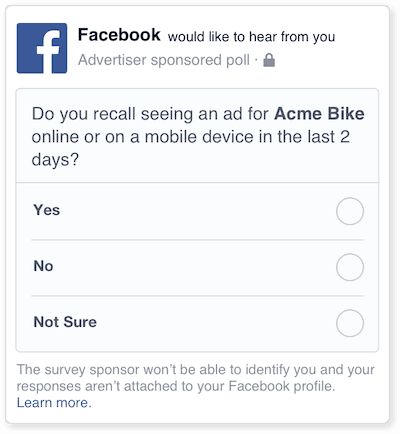
Meta Brand Lift measures the incremental effect of advertising on Facebook and Instagram. Meta randomizes the audience into an advertising group and a holdout group, then delivers polling questions to compare metrics (ad recall, awareness, familiarity, favorability, recommendation, or intent).
Eligible advertisers can access Brand Lift through Experiments in Ads Manager, while some managed studies may still involve a Meta representative.
Current Meta measurement materials indicate that advertisers can use up to 3 survey questions, with each eligible person receiving only 1 question. Meta also requires enough responses for reliable reporting. Current guidance states that at least 250 responses to a survey question are needed before results can be shown.
Meta does not use one universal minimum spend requirement across every study. Requirements can vary based on factors such as the market, audience size, reach, and study setup.
You should also give the study enough time to collect a meaningful number of survey responses, with roughly two weeks or more serving as a practical planning window.
TikTok Brand Lift Study
TikTok's Brand Lift Study also creates randomized exposed and control groups and uses in-feed polling to determine whether sponsored content generated incremental changes in metrics. A study can evaluate an individual campaign or a broader collection of promoted TikTok content.
Unlike Meta's increasingly self-serve option, TikTok Brand Lift Studies must currently be set up by an account manager.
Pro Tip: Struggling on TikTok? Check out the best TikTok agencies for brand growth.
YouTube Brand Lift
YouTube Brand Lift is managed through Google Ads and offers the clearest published eligibility requirements of the three.
Brand Lift is available for eligible Video, audio, and Demand Gen campaigns. For Demand Gen campaigns, Google recommends prioritizing video ads on YouTube because Brand Lift measurement does not capture results from other Demand Gen channels such as Gmail or Discover.
Advertisers also need access through a Google account representative. If you do not have one, Google currently does not allow you to use Brand Lift in your account.
Advertisers can measure up to three brand lift questions, and the required budget depends on both the target country and the number of questions.
Google currently groups markets into three budget tiers:
One question: $5,000, $10,000, or $15,000 over 10 days.
Two questions: $10,000, $20,000, or $30,000.
Three questions: $20,000 or as much as $60,000.
Google's Standard Brand Lift studies generally complete within 3 to 14 days, depending on how quickly enough survey responses are collected. Google also offers Enhanced Lift, which runs for roughly 9 to 14 days, gathers about 3 times as many surveys, and consequently requires approximately three times the standard minimum budget.
Once enough data is available, Google reports metrics such as absolute lift, relative lift, lifted users, and cost per lifted user. A study may complete after collecting roughly 4,100 responses per lift metric, although the number of responses needed can vary. Campaigns generating larger lift may require fewer responses to produce reportable findings.
When Is a Brand Lift Study Worth Running?
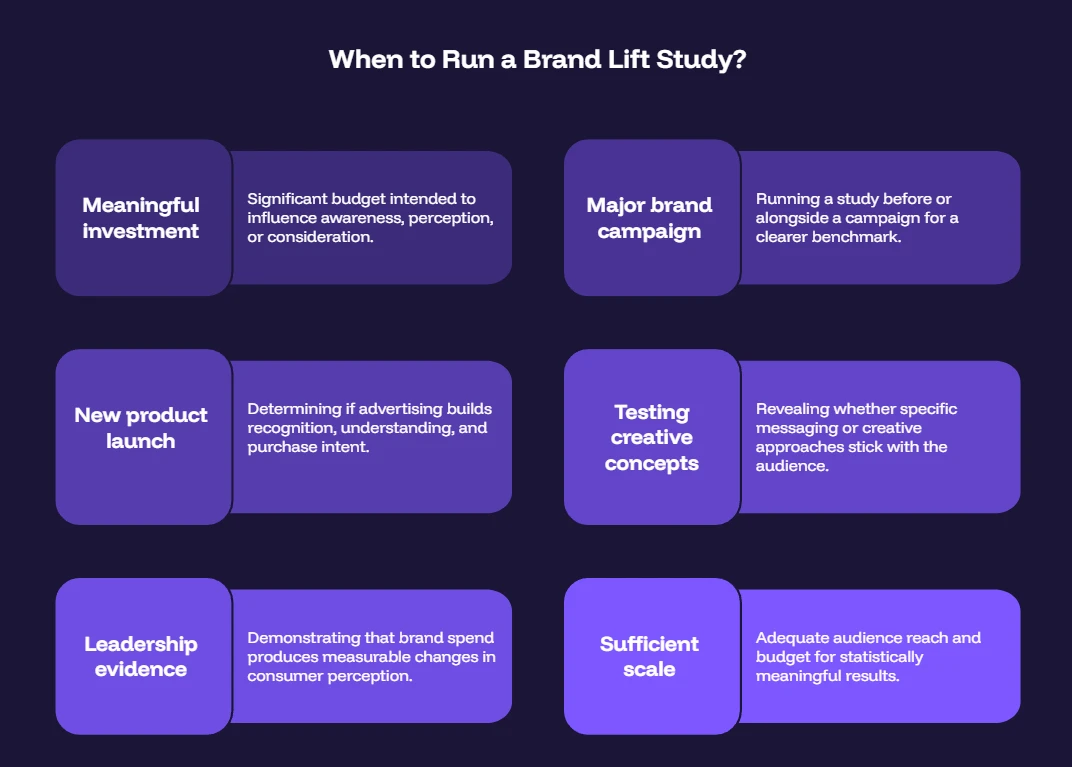
We recommend running a brand lift study when the campaign is large enough, strategic enough, or difficult enough to evaluate with standard performance metrics alone. But here are more specific conditions:
When you're making a meaningful investment in awareness or consideration: If a significant portion of your budget is intended to influence awareness, perception, or consideration, a lift study may help measure the impact.
Before or alongside a major brand campaign: A lift study can help you evaluate whether a large campaign is creating measurable incremental brand impact while it is in market.
During a new product or brand launch: Brand lift can help determine whether advertising is successfully building recognition, understanding, and purchase intent among the intended audience.
When testing positioning, creative concepts, or messaging: A lift study can help you see whether a particular message, value proposition, or creative approach is changing how audiences respond to the brand.
When leadership needs stronger evidence for brand investment: Lift results can provide measurable evidence that brand advertising is influencing awareness, perception, or consideration, which can make upper-funnel spend easier to defend.
When you have enough reach and budget to support reliable measurement: Brand lift requires sufficient exposure and control-group responses to produce meaningful findings. Campaigns without enough scale may struggle to generate reliable results.
When Is a Brand Lift Study Probably Not Worth It?
A brand lift study may not be worth running when the campaign lacks the reach, budget, duration, or audience size needed to generate reliable survey results.
It may also add limited value when the primary objective is direct-response performance and success can already be measured clearly through conversions, revenue, CPA, or ROAS.
In these cases, it usually makes more sense to strengthen attribution, conversion tracking, creative testing, or other performance measurement before investing in brand lift research.
How to Turn Brand Lift Findings Into Better Paid Social Decisions
At Creative Milkshake, we treat brand lift as one part of a broader paid social measurement system. It tells you how advertising affects outcomes such as awareness, perception, and consideration, while conversion and revenue data show what happens further down the funnel.
The real value comes from connecting those signals. Different combinations of lift metrics can point to creative, messaging, audience, or media issues that deserve closer attention.
Here are several common scenarios and what they may indicate:
1. High Ad Recall + Low Consideration
What it suggests: The creative is getting attention and sticking in memory, but the value proposition isn’t persuasive enough.
What to do: Review the message, product benefit, proof points, and reasons to choose the brand.
2. Strong Awareness + Weak Purchase Intent
What it suggests: The campaign is successfully introducing the brand, but it’s not creating enough motivation to act.
What to do: Reassess the offer, positioning, differentiation, and lower-funnel messaging.
3. One Audience Shows Stronger Lift
What it suggests: One segment responds significantly better than another.
What to do: Consider allocating more budget toward that audience or using its response to inform future targeting and creative development.
4. Strong Lift + High Cost Per Lifted Person
What it suggests: The advertising is influencing the intended brand metric, but the media investment may be inefficient.
What to do: Look for opportunities to improve CPMs, targeting, placements, frequency, or reach without weakening the creative.
5. Strong Message Association + Weak Brand Recall
What it suggests: People remember the idea communicated in the ad but do not clearly connect it to the advertiser.
What to do: Introduce branding earlier, strengthen visual brand cues, or make the brand more consistent throughout the creative.
6. No Statistically Significant Lift
What it suggests: The study did not produce strong enough evidence of measurable lift, but that does not automatically mean the campaign had no effect.
What to do: Check whether the study had enough responses, reach, campaign duration, and statistical power before drawing conclusions. If the study design was sound, review the creative, audience, messaging, and media strategy to identify where performance may have fallen short.
Make Your Brand Lift Data Actionable with Creative Milkshake
When a brand lift study shows weaker-than-expected results, the next step is identifying what is holding performance back. Creative can be one of those factors, particularly when ad recall, message association, or consideration falls short.
Strong paid social creative needs to capture attention, communicate the value clearly, and make the brand easy to remember. These elements can have a direct influence on how audiences respond to the campaign.
That is where Creative Milkshake can help. We develop and test static and video creative for paid social, then use performance data to refine the messages, formats, and concepts that resonate most strongly with the audience.
If your brand lift findings point to a creative issue, let’s talk about how stronger paid social creative can support awareness, consideration, and broader campaign performance.
FAQs
How much does a brand lift study cost?
Brand lift study costs vary by platform, market, audience size, and study setup. Some platforms require minimum media spend rather than charging a separate study fee. For example, Google’s published minimums start at $5,000 over 10 days for one Brand Lift metric in lower-cost markets, while requirements for Meta and TikTok can vary by account and market.
Which ad platforms offer native brand lift study capability?
Major platforms with native or first-party brand lift capabilities include Meta, TikTok, Google Ads/YouTube, LinkedIn, and Amazon Ads. Availability, eligibility, study setup, and minimum spend differ by platform and market.
What is the difference between brand lift and conversion lift?
Brand lift measures incremental changes in awareness, perceptions, or attitudes. Conversion lift uses a similar exposed-versus-control methodology but measures incremental business actions, like purchases, leads, app installs, or other conversions that would not have occurred without the advertising.
Can a brand lift study measure sales or conversions?
No, brand lift studies aren’t for measuring conversions. They measure metrics like brand awareness, consideration, favorability, purchase intent, and ad recall via survey questions.
What is considered a good brand lift?
There is no universal percentage that qualifies as ‘good’ because expected lift varies by metric, category, baseline brand awareness, audience, and campaign scale. However, the lift has to be statistically reliable to even be considered.
What questions are used in a Meta brand lift study?
Meta Brand Lift can include up to three survey questions covering ad recall, brand awareness, familiarity, favorability, and recommendation. They offer pre-populated customization options to make questions relevant to your business and study goal.
How does Creative Milkshake go about creating ads that perform?
We start by researching your audience and competitors and analyzing your existing ads. From there, our in-house team develops platform-native creative for Meta, TikTok, and YouTube, with each ad built to test a specific hook, angle, format, or persona.
Once campaigns are live, we review performance with the media buying team, identify what is working, and use those insights to shape the next round of creative. Each testing cycle helps make future ads more informed and effective.