


Advertising on Meta is getting more competitive. CPMs, CPCs, and customer acquisition costs have risen as competition increases and more advertisers fight for the same audience attention. Meta’s own 2026 Q2 results show average price per ad rose 12% year-on-year.
At the same time, Meta has made significant changes to its advertising system, particularly in AI, automation, targeting, and creative optimization. These updates are changing everything from how the ad auction evaluates campaigns to how advertisers approach audience targeting and ad creative testing.
All of this makes efficiency super important. Basic targeting and a handful of ad creatives are no longer enough to carry a campaign. You need higher-quality creative, smarter campaign structures, stronger conversion tracking, and a much more deliberate approach to testing and optimization.
As a leading Meta Ads agency, we’re sharing the Meta Ads best practices we’ve seen working across campaigns over the past several months.
TL;DR
Meta Ads in 2026 are becoming more automated, with AI playing a larger role in creative production, targeting, delivery, and optimization.
Simpler campaign structures and Advantage+ tools give Meta more room to learn and allocate budget efficiently.
Broad targeting is becoming more viable as Meta relies more on behavioral, creative, and conversion signals.
Creative quality and diversity matter more, with stronger performance coming from varied concepts, formats, messages, and creators.
Reels and mobile-first placements favor vertical, social-native creative that communicates the core message quickly.
AI is useful for creative production and iteration, but human judgment still matters for strategy, originality, brand fit, and quality control.
Strong campaigns need reliable conversion tracking and a clear connection between the ad, landing page, and final conversion.
Performance should be judged beyond clicks and attributed ROAS, with post-click behavior and incrementality providing a fuller view of impact.
What’s Changed with Meta Ads in 2026?
Meta has continued to push its advertising platform deeper into AI, with changes focused on creative production, ad ranking, localization, campaign optimization, and creator marketing.
Meta announced many of these updates at Cannes Lions 2026.
Some of the biggest updates in 2026 include:
Brand Memory: Meta introduced Brand Memory, an AI capability that learns a company's identity, tone, and existing creative patterns from its ad library. It can then apply those characteristics when generating new Meta ad creatives.
End-to-end AI creative workspace: Meta is bringing creative generation, performance insights, and testing closer together inside Ads Manager. Creative and media teams can analyze what's working, generate new variations from those insights, and test them within a shared workflow.
Meta Creator Marketing Hub: Meta is combining the Creator Marketplace and the Partnership Ads Hub into a unified creator marketing platform, primarily for Instagram for now. But the new hub will also bring Facebook creators alongside Instagram's existing creator ecosystem.
Better in-image text generation: Meta has improved its ability to generate text overlays directly within AI-created image ads (another automation win).
More multilingual creative tools: Meta expanded text-on-image translation to Portuguese, French, German, Italian, and Indonesian. It also added video voiceover translation support across 11 languages, including Hindi, Arabic, Chinese, German, and French.
Muse Image in Advantage+ Creative: Meta's Muse Image model is being integrated into Advantage+ Creative. That’s supposed to give advertisers more advanced AI-generated creative production and iterative image editing capabilities. Advertisers can provide a brief, change visual styles, replace elements, and continue refining the creative using AI.
AI video voiceovers and dubbing: Advertisers can use AI-powered voiceovers and dubbing in nine or more languages, with more to come.
GEM ad ranking: Meta's Generative Ads Recommendation Model, or GEM, is becoming increasingly important to its ad ranking and recommendation infrastructure. Meta doubled GEM's GPU training capacity in Q4 2025 and introduced a new sequence-learning architecture designed to better match ads with people likely to respond.
Meta AI business assistant: Meta introduced a conversational AI assistant for advertisers. The assistant can remember campaign goals and provide personalized recommendations around Meta ads performance and optimization.
Live Video Ads: Brands can promote live video and shopping streams through paid ad placements on Facebook and Instagram, supported by integrations with third-party live-commerce platforms.
10 Meta Ads Best Practices for 2026 And Beyond
Meta advertising has become increasingly automated, which means many tactics that worked when advertisers had to micromanage audiences, placements, bids, and ad sets are less useful.
These are the Meta Ads best practices we recommend prioritizing in 2026.
1. Simplify Your Meta Ads Account Structure
Meta's advertising system relies increasingly on automation and signal-based optimization, so an overly complicated account structure can work against you.
If you're splitting budget across too many campaigns, ad sets, audience segments, placements, and conversion events, each ad set may end up with too little data for Meta's AI to learn effectively.
We generally recommend consolidating campaigns and ad sets when they share the same objective, offer, geography, and conversion goal. Instead of creating separate prospecting campaigns for every interest, lookalike audience, or placement, broader structures can give Meta more conversion volume and more freedom to find the people most likely to act.
That doesn't mean every account should be reduced to a single Advantage+ Campaign. Separate campaigns can still make sense for different markets, objectives, products, retargeting audiences, or conversion events. But make sure every layer of account structure has a clear reason to exist.
A useful rule is: don't create another campaign or ad set just because you can segment something. Create it only when the separation will meaningfully change how you manage budget, messaging, or optimization.
2. Lean Into Advantage+ Campaign Automation
Meta is automating more of the delivery decisions that advertisers previously managed manually. In most accounts, we recommend testing where that automation can improve performance without giving up controls that matter to the business.
Use Advantage+ campaign budget where it fits: Meta can distribute a campaign-level budget across ad sets in real time based on where its system identifies stronger opportunities. This can work well when your ad sets share the same overall objective, and you don't need strict control over how much each one spends.
Give Advantage+ Audience useful signals: Customer lists, interests, Custom Audiences, and Lookalike Audiences can help guide Meta's delivery system. Treat audience suggestions as starting signals rather than rigid targeting boundaries. Use audience controls when Meta needs to respect specific restrictions.
Test Advantage+ Placements: This gives Meta access to eligible placements across its technologies and lets the delivery system allocate impressions based on where it expects to get more value from your budget. Make sure your creative works across those placements. Reels, for example, usually deserve a vertical 9:16 version designed for the format.
The idea is to give Meta enough room to optimize while keeping control over the decisions that directly affect your business. Define the right conversion event, budget, geography, exclusions, creative, and business objective, then allow the delivery system to work within those parameters.
You can also test more controlled campaign structures against Advantage+ setups and compare which approach produces stronger ROAS for your account.
Pro tip: If you’re using Advantage+ Creative, manually control allowed enhancements like brightness or music addition to ensure any changes don’t significantly alter the creative’s message or branding.
3. Use Broad Targeting and Let Creative Signal the Audience
Detailed interest targeting is becoming less important as Meta's recommendation systems improve at identifying likely responders using behavioral, creative, and conversion signals.
Meta's latest ads ranking models analyze sequences of user interactions across content and ads to build a richer understanding of people's interests and intent. Meta reported that recent sequence-learning improvements contributed to a 6% lift in conversions on Instagram and 3% on Facebook.
For that reason, we'd recommend testing broad targeting or Meta's Advantage+ Audience instead of building dozens of tightly defined interest groups.
Give Meta the essential parameters, like location, age requirements, exclusions, and valuable first-party signals, then allow the system to find additional people likely to convert.
But with this approach, your ad creative becomes an important filtering mechanism.
Elements like hooks, visuals, ad copy, offer, and social proof help generate response patterns that Meta can use alongside behavioral and conversion data to improve delivery.
Here’s an example of a simple image ad on Facebook from Slack that would provide enough targeting context to Meta’s AI even with broad targeting.

4. Prioritize Meaningful Creative Diversity
Creative diversity becomes increasingly important when campaigns run for longer periods, and the same ads start losing their ability to attract attention. But diversification doesn't simply mean producing more ads or making minor changes to the same concept.
Small iterations still have a place in testing, but they shouldn't make up your entire creative pipeline. You also need meaningful differences across concepts, messages, visual styles, formats, and the people delivering the message. Meta itself recommends varying formats, visuals, and messages so its delivery system has more relevant creative options to match with interested people.
Mirella, Founder of Creative Milkshake, explains how we approach meaningful creative diversity in practice:
"Meta decides who sees the ad now, so the only place you can still influence targeting is the creative itself. The brands that do the most research win. Your goal is to get inside the mind of your consumer and truly understand them. Ten people buy the same product for ten different reasons, and if you write one ad for the average of those ten, it lands with none of them. So we build creative concepts for micro personas. Each one gets its own hook, and usually its own creator, because the person on screen is part of the message. Someone either recognizes themselves in the first two seconds, or they scroll.
Most of that work happens before anyone shoots anything. For each micro persona, we want to know who they are, why they buy, what happened in their life that made them start looking, what they already tried that didn't work for them, and what's still holding them back. Answer that for five different people and you get five genuinely different ads instead of five versions of the same one. That level of true creative diversity is what unlocks performance at scale."
Depending on your product and audience, your creative mix could include:
Creator-led ads
UGC-style creatives
Carousel ads
Customer testimonials
Product demonstrations
Founder-led content
Statics
2D and 3D animation
Partnership Ads (influencer whitelisting)
Each format gives Meta a different type of signal and gives your audience more ways to engage with the same offer.
Keep this diversity in mind at the planning stage, so you can get more out of brand and creator shoots. For instance, we include various creative angles, hooks, and calls to action in creator briefs, so we can get more variations to work with from the start. That’s exactly what we did to scale Meta Ads for Napper, an app for new moms.
5. Build Meta Ads for Reels and Mobile-First Consumption
Reels are now a core ad placement across both Instagram and Facebook, so your creative should be designed for mobile viewing from the start.
And that means prioritizing 9:16 vertical video, fast hooks, large readable text overlays, strong visual movement, and framing that works naturally in Instagram Reels and other full-screen placements.
We'd avoid treating Reels as an afterthought where a horizontal Facebook video ad is simply cropped into a new aspect ratio.
Instead, create social-native content, placement-specific variants, and communicate the core message within the first few seconds. Organic-style videos, creator-led content, captions, and music can all help the ad feel less like a traditional commercial.
For LOLA, we took a Reels-first approach with new creatives and repurposed content. The resulting ad creatives were mobile-ready, delivered UGC trust signals, and worked for both Instagram and Facebook consumption. And these ads even led to a 40% reduction in CPA.

6. Experiment with the CTAs
Your CTA can have a bigger impact on Meta ads performance than it gets credit for. Small wording changes can affect how much commitment a user feels they're making, so we recommend testing different CTAs. Meta recommends this, too.
More direct CTAs such as Buy Now, Get Quote, Book Demo, Start Free Trial, or Sign Up can work when the offer and intended action are already clear.
Softer options such as Learn More, See How It Works, Watch Demo, or Explore Plans may feel like a smaller commitment when someone is still learning about the product.
It's also worth testing the CTA inside the ad copy and creative itself, besides the button selected in Facebook Ads Manager. A video that ends with “See how much you could save” creates a very different motivation than one that simply says “Click to save money,” even if both use the same platform button.
Insider tip: Treat CTA testing as part of a broader Conversion Rate Optimization (CRO) strategy. Test meaningful differences in intent and friction, then measure what happens after the click. You want a CTA that generates stronger conversion rates, lower CPA, or better campaign ROI.
7. Avoid Overly AI-Generated Meta Creatives
AI can speed up ad creative production, but that doesn't mean every asset should look or sound AI-generated.
Meta is adding more generative AI tools across its advertising platform, and these capabilities can be useful for producing and adapting creative. The risk comes when speed and volume start taking priority over originality, accuracy, and creative quality.
Overly AI-generated ads can feel generic and may even backfire. IAB found that while advertisers are keen on using AI in ad creatives, consumers aren’t as receptive to them. 30% of consumers had a negative opinion of them compared to just 7% of advertisers.
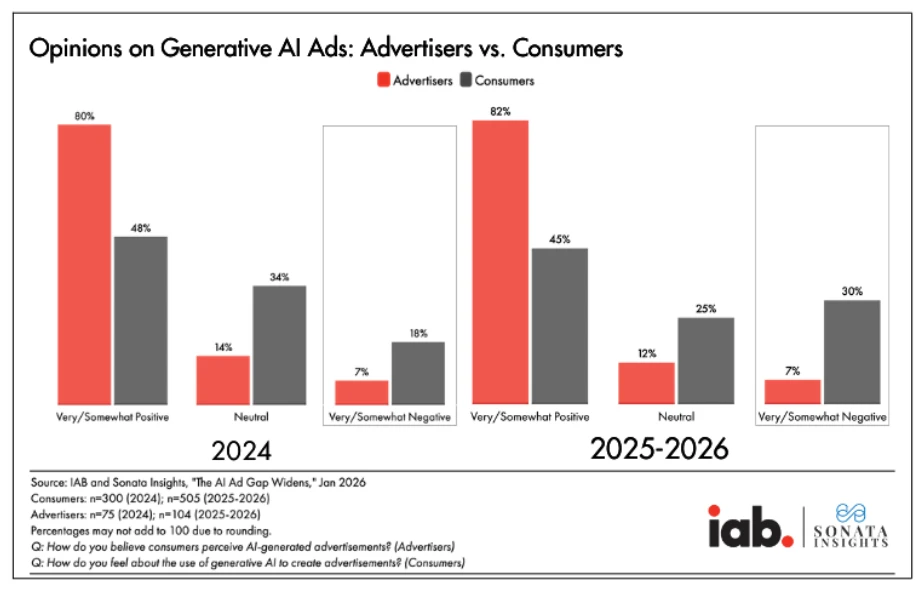
Source: IAB
That doesn’t mean AI use in creative is bad. It can be incredibly helpful in several ways, particularly for ad creative testing. So, here’s our take:
Where AI is great:
Ideation
Creative variations
Visual adjustments like resizing and adaptation
Translation and localization
Background and visual edits
Iterating proven concepts
Where human judgment still matters:
Original concepts
Brand positioning
Emotional nuance
Cultural context
Authentic creator content
Product accuracy
Quality control
8. Diagnose the Gap Between Clicks and Conversions
A strong CTR in Meta Ads Manager doesn't necessarily mean your campaign is sending valuable traffic to the website. Look beyond clicks and follow what happens as people move from the ad to the landing page and then to your conversion event.
Compare link clicks, landing page views, and the conversion event you're optimizing for. If link clicks are strong but landing page views fall sharply, check page speed, redirects, broken URLs, and the mobile experience.
If landing page views are healthy but purchases, leads, or sign-ups remain weak, the problem is likely further down the funnel. Review whether the page carries through the offer from the ad, makes the next action clear, and removes unnecessary friction from the conversion path.
For example, the core promise that earns the click should remain immediately recognizable once someone reaches the landing page.
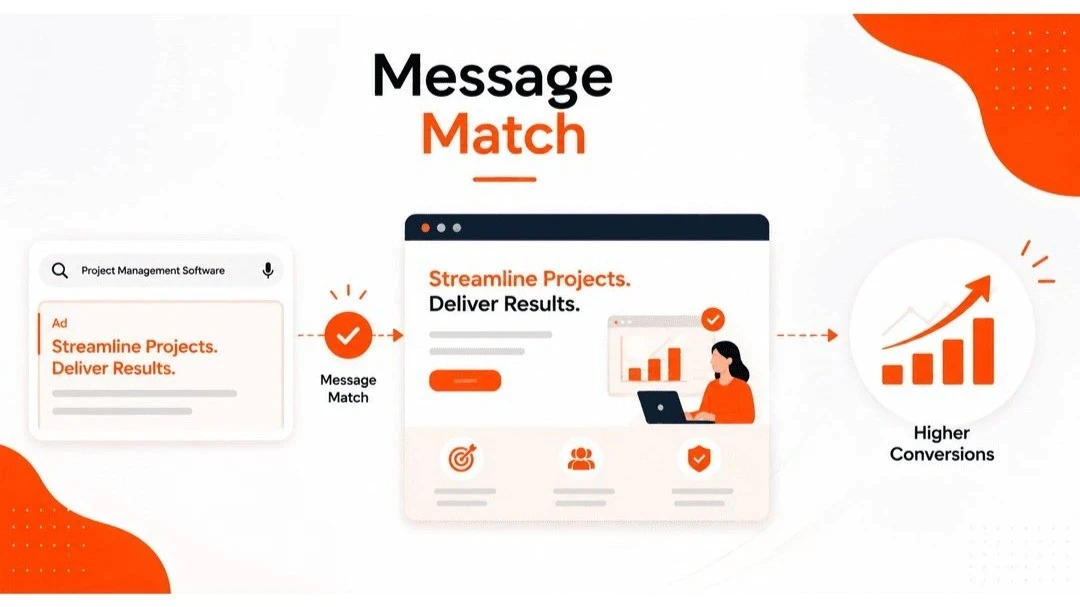
For Sales or Leads campaigns, don't judge performance from CTR or CPC alone. Use Meta's post-click metrics to identify where the drop-off starts, then optimize around the business outcome you're actually paying for.
9. Feed Meta Better Conversion Signals
Meta's optimization is only as good as the conversion data you send back to the platform. If your tracking is incomplete, delayed, or inaccurate, you're giving Meta's AI weaker signals about which users are actually valuable.
At a minimum, we recommend using the Meta Pixel alongside the Conversions API so browser-side and server-side events can work together. This can improve tracking accuracy in an environment shaped by cookie restrictions, ad blockers, browser limitations, and stricter privacy regulations.
In Meta Events Manager, you should also monitor Event Match Quality, use Enhanced Matching where appropriate, and ensure deduplication is configured correctly so the same conversion isn't counted twice.
The quality of the conversion event matters too. Don't optimize for shallow actions just because they're easier to generate. If purchases, qualified leads, booked demos, or subscription starts are what create business value, work toward giving Meta enough volume around those events.
For longer sales cycles such as B2B SaaS, feeding back offline conversions or CRM outcomes can help Meta distinguish a real opportunity from a low-quality lead ads form fill.
10. Measure Incrementality, Along with Attributed Conversions
ROAS and attributed conversions are important, but they don't always tell you whether Meta actually caused the conversion. Some customers may have purchased after seeing organic content, via Google Ads, receiving an email, or interacting with another channel.
That's why we recommend measuring incrementality alongside standard attribution.
Meta now gives advertisers several ways to do that. Incremental Attribution in Ads Manager uses models trained on Conversion Lift data to estimate which conversions were caused by an ad rather than simply occurring after an eligible interaction. You can compare these results with standard attribution reporting to get another view of campaign performance.
For a more rigorous test, Meta Conversion Lift uses randomized test and control groups to estimate how many additional conversions your advertising generated. Meta considers incrementality experiments such as Conversion Lift its strongest approach for answering the question: How many conversions happened because we ran Meta ads?
Where your account has enough scale, use Conversion Lift periodically to validate what your attributed ROAS is telling you. For ongoing campaign decisions, Incremental Attribution can provide a more frequent view of whether Meta is generating additional conversions rather than simply receiving credit for them.
Build a Stronger Meta Ads Creative Engine with Creative Milkshake
Meta is giving its delivery system more control over targeting, placements, budgets, and optimization. That puts more pressure on the areas advertisers still shape directly, and creative is one of the biggest.
Your ads need enough variety to give Meta different concepts to work with, while still communicating the offer clearly and giving the right audience a reason to act. This takes more than producing a high volume of assets. You need a creative system built around strategy, testing, iteration, and what the performance data is telling you.
At Creative Milkshake, we help brands build that system across Meta. Our team handles creative strategy, production, testing, and iteration so your campaigns have a steady pipeline of performance-focused creative rather than relying on the same few ads until they wear out.
Want to strengthen the creative side of your Meta campaigns? Book a call with Creative Milkshake and let’s talk.
FAQs
What is the best Meta ads strategy in 2026?
The best Meta ads strategy in 2026 is to keep campaign structures relatively simple, test broad or Advantage+ audiences, maintain real creative diversity, and feed Meta high-quality conversion data. Strong campaigns also rely on mobile-first creative, meaningful testing, and measurement that goes beyond attributed conversions alone.
Does broad targeting still work on Facebook?
Yes, broad targeting still works on Facebook because Meta's advertising system can use conversion signals to find likely customers within large audiences. But it works best when campaigns have reliable conversion data, effective creative, and accurate tracking.
What are the best practices for Instagram ads?
Create mobile-first visuals, communicate the offer quickly, test multiple creative formats, and optimize for measurable conversions. Use vertical 9:16 creative for Stories and Reels, add captions for dialogues, and design ads that communicate their main message within the opening seconds.
How long should you let a Meta campaign run before optimizing?
Let a Meta campaign collect enough conversion data before making major optimizations. Meta ad sets generally need about 50 optimization events within 7 days to exit the learning phase. Avoid frequent major edits during learning, and evaluate performance using conversion volume, cost, and profitability.
How is Creative Milkshake adopting the changes to Meta Ads?
We’ve been closely watching the roll-out of AI capabilities as well as Meta's new Andromeda update and how it treats ads in auctions. We’re also testing the benefits of Meta Advantage Plus features. All learnings from different campaigns feed our internal knowledge repository that strategists and creative teams lean on.
How does Creative Milkshake measure Meta Ads impact?
We base performance on the intended business outcome, which, in our experience running Meta Ads, is typically conversions, CPA, and ROAS. But we measure Meta’s impact in the context of overall brand performance to help our clients make smarter media decisions.