


Paid social can put your brand in front of thousands of potential customers quickly. But getting them to take action is a different battle.
Consider WordStream's 2025 Facebook Ads benchmarks. Across more than 1,000 campaigns, Facebook lead campaigns had an average conversion rate of 7.72%, down from 8.67% the previous year. At the same time, the average cost per lead increased 20.94% to $27.66.
This makes one thing clear: simply spending more on social media advertising doesn't guarantee better results.
Successful paid social media campaigns require the right combination of audience targeting, compelling ad creative, strong offers, accurate conversion tracking, and continuous optimization.
And that's what we'll cover in this step-by-step guide to running paid social ads centered around conversions.
TL;DR
Paid social conversions depend on the right mix of audience targeting, creative, offer, landing experience, and tracking.
Audience messaging and offers should reflect how familiar people are with the brand and how ready they are to convert.
Strong paid social creative combines an attention-grabbing hook, clear value proposition, credible proof, and relevant CTA.
Creative testing should cover different hooks, messages, formats, and concepts to identify what resonates with the target audience.
Landing pages should continue the ad's message and offer while making the desired action easy to complete.
Reliable conversion tracking helps measure performance and gives advertising platforms better signals for campaign optimization.
Campaign structure, budget, bidding, and platform choice should align with the conversion goal and target audience.
Performance issues can be diagnosed across the funnel using metrics such as CTR, conversion rate, CPA, ROAS, and landing-page performance.
What Makes a Paid Social Ad Convert?
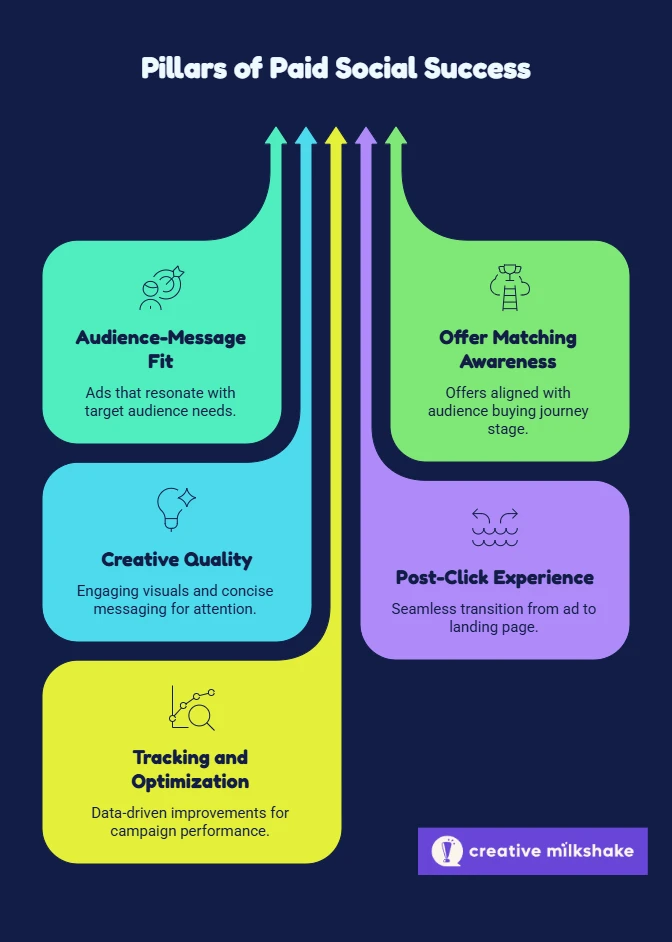
High-converting paid social ads combine relevant creative, accurate audience targeting, a compelling offer, and a smooth post-click experience.
While every platform works differently, the same core factors influence how effectively paid social traffic turns into leads or customers.
1. Strong Audience-Message Fit
Your ad copy and visuals should speak directly to the target audience's needs, priorities, or pain points. Precise audience targeting helps reduce wasted ad spend by showing ads to people who are more likely to care about the message.
The creative should then make that relevance immediately clear. When people recognize that an ad speaks to a problem, goal, or need they already have, they have a stronger reason to pay attention and take action.
2. An Offer That Matches Audience Intent
Someone discovering your brand for the first time may respond better to educational content or a low-commitment offer. A retargeting audience, on the other hand, may be ready for a demo, free trial, discount, or purchase.
Basically, your offer should match where the audience is in the buying journey. Major paid social platforms also support retargeting, which gives you the opportunity to tailor offers to people who have already interacted with your brand or campaigns.
A colder audience may need more information before taking action, while people who have already shown interest can usually be presented with a more direct conversion-focused offer.
3. Creative That Captures Attention and Communicates Value
Paid social ads compete with organic posts, creator content, entertainment, and updates from friends for attention. Your creative needs to give people a reason to stop scrolling and understand the value of your offer within a few seconds.
For conversions, creative is one of the most influential factors, provided your targeting was right in the first place. That's why 80% of marketers view creative quality as crucial for marketing success.
Strong ad creative uses clear visual branding, engaging video content, concise messaging, and an immediate value proposition, whether it appears as a carousel, Story, Reel, TikTok, static image, or another ad format.
4. A Smooth Post-Click Experience
The post-click experience should feel like a natural continuation of the ad. Your landing page should deliver the same message and offer, load quickly on mobile, remove unnecessary friction, and make the desired action easy to understand.
Sending people to a generic page can weaken that experience. Research from Unbounce and Ascend found that 62% of marketers who send paid traffic to their homepage fail to meet their ROI goals.
Remember, the stronger the connection between the ad and the landing page, the easier it is for people to understand what you want them to do next.
5. Reliable Tracking and Continuous Optimization
Accurate conversion tracking is essential for understanding which audiences, creative variations, placements, and campaigns actually produce results. Tools such as the Meta Pixel, Conversions API (CAPI), and platform analytics can help connect campaign activity with what people do after seeing or clicking an ad.
But tracking alone is not enough. Use the data to test creative variations, adjust targeting, reallocate budget, and refine underperforming campaigns. Conversion rate is useful, but you should also monitor metrics such as cost per acquisition and return on ad spend to understand how efficiently your campaigns are turning paid traffic into business results.
How to Run High-Converting Paid Social Ads (With Examples)
High-converting paid social campaigns start with a clear objective and improve through deliberate targeting, creative testing, measurement, and optimization. The following steps take you through that process, with real campaign examples along the way.

Step 1: Define the Conversion Goal
Start by deciding exactly what action you want the campaign to generate. Depending on your business and campaign, that action could be:
Purchases
Demo requests
Lead form submissions
Free trials
App installs
Registrations
A precise goal makes it easier to choose the right campaign objectives, call to action, audience targeting, landing experience, KPIs, and bidding strategy. It also gives platforms a clearer conversion signal to optimize against.
Your goal should also reflect where the campaign sits in the funnel. A brand awareness campaign might optimize for reach or video engagement, while a bottom-of-funnel campaign should usually optimize toward a meaningful conversion.
For example, HR, payroll, and finance software provider MHR used LinkedIn differently across funnel stages. The company first ran a brand awareness campaign and then followed it with a more targeted lead-generation campaign aimed at HR, payroll, and finance decision-makers.
For the lead-generation stage, MHR used Conversation Ads and Single Image Ads paired with LinkedIn Lead Gen Forms. LinkedIn reports that the campaign increased lead volume by 68% while reducing cost per lead by 74%.
Step 2: Understand the Audience and Buying Context
Good audience targeting is contextual. Demographics, interests, and platform behaviors create a strong targeting base, but understanding buying context is what drives results.
This means understanding:
What problem is the audience trying to solve?
What might stop them from taking action?
How familiar are they with your brand or solution?
And how much intent have they already shown?
These details help you decide who to target, what message to use, and how direct your offer should be.
In short, for paid social ads to drive higher conversions, build audience segments based on both who the person is and what they need to know to make the purchase.
Once you understand the core audience, avoid splitting it into so many narrow segments that each campaign has too little room to learn. Instead, organize audiences around meaningful differences in their relationship with your brand.
For example, you might separate:
Prospecting audiences: People who fit your target profile but have not meaningfully interacted with your brand yet.
Retargeting audiences: People who have visited your site, engaged with content, viewed products, or taken another relevant action.
Retention audiences: Existing customers you want to reach with repeat-purchase, cross-sell, upsell, or loyalty campaigns.
Use available data from your social platforms, CRM, website analytics, and other first-party sources to refine these audiences over time.
Step 3: Develop an Offer People Actually Want
Your product or service may have several benefits, but a paid social offer should focus on the one that matters most to the audience you are targeting. Make it immediately clear what they get, why it is valuable, and what action you want them to take.
The level of commitment should also match audience intent. Cold audiences may respond better to lower-friction offers, while warmer retargeting audiences may be ready for a more direct conversion offer.
When RéVive Skincare came to us to improve its Meta and TikTok campaigns, our experts at Creative Milkshake used both branded and user-generated content (UGC) to highlight specific benefits and make the offer more compelling.
In one UGC asset, for example, the creator focused on how quickly the product worked and the ingredients behind that benefit. The campaign saw 43% lower CAC and 25% higher ROAS.
Step 4: Create Paid Social Creatives That Earn Attention and Drive Action
Strong ad creative has two jobs: stop the scroll and give people a compelling reason to act. The best-performing paid social ads usually combine an attention-grabbing opening, a clear value proposition, platform-native creative, credible proof, focused ad copy, and an obvious next step.
Start With a Strong Hook
The opening seconds matter in fast-moving formats such as TikTok, Instagram Stories, and Reels. Lead with a problem, benefit, question, statement, or insight that quickly tells the right audience why the ad is relevant to them.
TikTok recommends introducing the proposition within the first three seconds and prioritizing the hook within the first six.
For more ideas, see our guide to UGC hooks for Meta and TikTok.
Make the Value Proposition Obvious
Once you have someone's attention, make the value clear quickly. Focus on the outcome or benefit that matters most to the audience instead of trying to squeeze every product feature into the ad.
The viewer should be able to understand what you are offering and why it matters without having to work through several layers of messaging.
Use Platform-Native Creative
Avoid simply resizing the same polished commercial for every social media platform. Build creative variations that resemble the content people naturally consume on each channel.
Marks & Spencer provides a useful example. For a TikTok campaign, the retailer moved away from repurposed, highly produced assets and created TikTok-first, creator-led content. Its creative included try-on hauls, outfit-of-the-day videos, styling tips, UGC, and fashion influencer content.
M&S paired this creative approach with TikTok's Smart+ automation and dynamic Catalog Ads, which connected relevant products and pricing with shoppers. The broader campaign increased conversion rate by 44% and reduced purchase CPA by 94%.
Add Credible Proof
Support important claims with evidence your audience can evaluate. Depending on the product and campaign, that might include customer testimonials, ratings, reviews, creator recommendations, case study results, recognizable clients, awards, or product demonstrations.
Choose proof that strengthens the specific claim you are making rather than adding social proof simply because it is available.
Write Conversion-Focused Ad Copy
Keep the messaging clear, specific, and closely connected to the creative. Address the audience's main pain point, explain the offer's benefits, and remove obvious objections wherever possible.
For video ads, add captions so the message remains easy to follow without sound and is more accessible.
Avoid trying to fit every selling point into one ad. Give each creative a focused message that leads naturally toward the offer.
Include a Clear Call to Action
Tell people exactly what you want them to do next, such as Shop Now, Book a Demo, Start a Free Trial, Download the Guide, or Learn More. The call to action should match the offer and the level of commitment you are asking from that audience.
Step 5: Build Multiple Creative Variations
Don't build a paid social campaign around one ad creative and assume you will know whether the underlying idea works. Create multiple creative variations to learn which hooks, messages, visual approaches, and ad formats resonate most strongly with the target audience.
Make the differences meaningful enough to produce useful insights. You might test:
Different hooks or opening lines
Problem-led versus benefit-led messaging
Customer testimonials versus product demonstrations
UGC-style video versus polished brand creative
Static images versus video or carousel ads
Short-form versus more explanatory ad copy
For iwoca's paid social campaigns, we built a structured creative testing system rather than relying on a small number of assets. Our work included 15 new ad concepts, five iterations, and 60 ads, giving the team a broader range of ideas to test and refine.
Step 6: Build a Landing Page That Matches the Ad
A strong click-through rate means little if the landing page breaks the experience. Once someone leaves Facebook, Instagram, LinkedIn, TikTok, or another social platform, the destination page should continue the same conversation the ad started.
Keep the core promise, offer, and visual cues consistent. If the ad promotes a specific product benefit, discount, creator testimonial, or use case, the landing page should reinforce that same message rather than forcing the visitor to search for it.
For example, an ad featuring an influencer demonstration could lead to a page that includes the same creator, product imagery, or supporting proof. The wording does not need to be identical, but the visitor should immediately recognize that they landed in the right place.
You can use this checklist:
A headline that reinforces the ad's core promise
A clear explanation of the benefit or offer
Relevant product imagery or video content
Social proof such as reviews, testimonials, customer logos, or results
A prominent call to action
Fast loading and a mobile-friendly layout
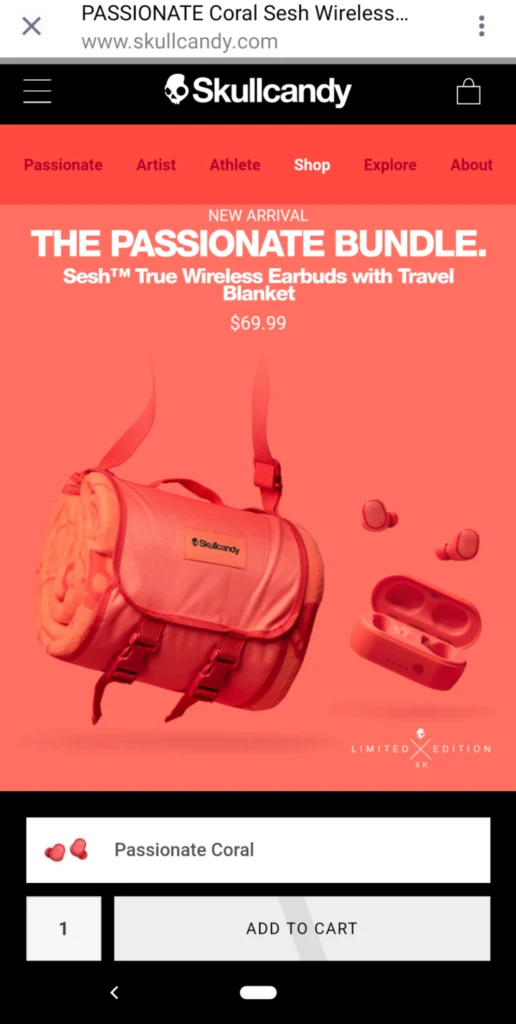
The Skullcandy example below shows a simple landing page that keeps the price and call to action prominent while maintaining a mobile-friendly layout.
Step 7: Set Up Conversion Tracking Before Launch
Set up and test conversion tracking before your campaign goes live. Accurate tracking helps you measure performance and gives the advertising platform reliable conversion signals it can use for optimization.
Start by defining the events that matter across your funnel. For an ecommerce business, that might include product views, add-to-cart actions, checkout initiation, and purchases. A B2B lead generation campaign might track landing page views, form starts, form submissions, demo requests, and, eventually, qualified opportunities or closed revenue.
Next, configure the tracking methods required for the platforms you use. These may include:
Meta Pixel alongside the Conversions API (CAPI)
TikTok Pixel and Events API
LinkedIn Insight Tag and Conversions API
First-party CRM or ecommerce conversion data
Analytics platforms such as GA4 for an additional view of user behavior and attribution
Step 8: Choose the Right Campaign Structure and Budget
Keep your campaign structure simple enough for the platform to learn efficiently. Separate campaigns when there is a meaningful difference in objective, funnel stage, market, or product, but avoid dividing your budget across too many small audience segments.
Set budgets based on the expected cost of the conversion you plan to make. If each ad set receives too little spend, it may take longer to generate enough data for reliable optimization. When appropriate, campaign-level budgeting lets platform algorithms shift spend toward the audiences and creatives that produce better results.
Your bidding strategy should also reflect your campaign goals. Maximum-delivery bidding can help generate the most conversions from a set budget, while cost-cap or manual bidding provides more control over what you are willing to pay per result.
We also recommend leaning into AI automations and optimization tools, especially when you have straightforward goals and a simple audience profile.
For example, Swiss sportswear brand On tested Meta's Advantage+ Shopping Campaigns in Japan. The automated campaign handled elements such as targeting, placements, and budget allocation. Meta reported a 60% lower cost per conversion and 4.7x incremental ROAS compared with On's usual conversion campaigns.
Step 9: Launch, Learn, and Optimize
Once the campaign is live, treat the initial results as a learning opportunity and optimize as you go.
Give campaigns enough time and conversion volume to produce meaningful data before making premature changes.
Review performance across audiences, creatives, placements, offers, and landing pages to identify patterns that may be helping or limiting conversions.
Pause clear underperformers and gradually shift more budget toward campaigns, audiences, and creative variations delivering stronger business results.
Refresh creative as performance changes. Introduce new hooks, messages, formats, and concepts instead of relying on one successful ad indefinitely.
Make major changes one variable at a time where practical. This makes it easier to understand what contributed to a meaningful improvement or decline.
Use conversion data and campaign analytics to guide the next round of testing, so each campaign builds on what you learned from the previous one.
Step 10: Measure the Metrics That Actually Matter
If conversions are the goal, measure the metrics that show both business impact and the efficiency of getting there. Some KPIs tell you what the campaign produced, while others help explain why performance improved or declined.
Conversion Rate
Of course, this is the main metric. Conversion rate shows the percentage of people who complete the desired action, such as a purchase, registration, or lead submission. Use it to evaluate how effectively your audience, offer, creative, and post-click experience work together.
When using benchmarks, compare your performance with recent data for the same platform, campaign type, and industry rather than relying on broad averages.
Cost Per Acquisition (CPA)
CPA shows how much you spend, on average, to generate a defined acquisition or conversion. Rising CPA can point to issues such as weaker audience response, creative fatigue, landing-page friction, or inefficient delivery.
Cost Per Lead (CPL)
CPL measures the average amount spent to generate a lead, such as a form submission or demo request. For lead-generation campaigns, evaluate CPL alongside lead quality rather than treating every submitted lead as equally valuable.
Return on Ad Spend (ROAS)
ROAS measures how much attributed revenue you generate for every dollar spent on advertising. It is particularly useful for ecommerce and other campaigns where revenue can be connected directly to ad spend.
Customer Acquisition Cost (CAC)
CAC takes a broader view of what it costs to acquire a new customer and may include expenses beyond paid social media spend. Comparing CAC with customer lifetime value can help you judge whether acquisition remains financially sustainable as you scale.
Click-Through Rate (CTR)
CTR measures the percentage of impressions that generate a click. It can help you assess how well the creative and messaging attract interest, but a strong CTR does not guarantee that those clicks will convert.
Cost Per Click (CPC)
CPC shows how much you pay, on average, for each click. It is useful for monitoring traffic efficiency, but it should be evaluated alongside conversion rate, CPA, and downstream business outcomes.
Landing Page Conversion Rate
The percentage of landing-page visitors who complete the intended action. This can help diagnose any issues with the landing page itself, especially if CTR is high.
We recommend evaluating all these metrics together to measure campaign performance and diagnose issues, as no single KPI tells the whole story.
How to Choose the Right Paid Social Platforms?
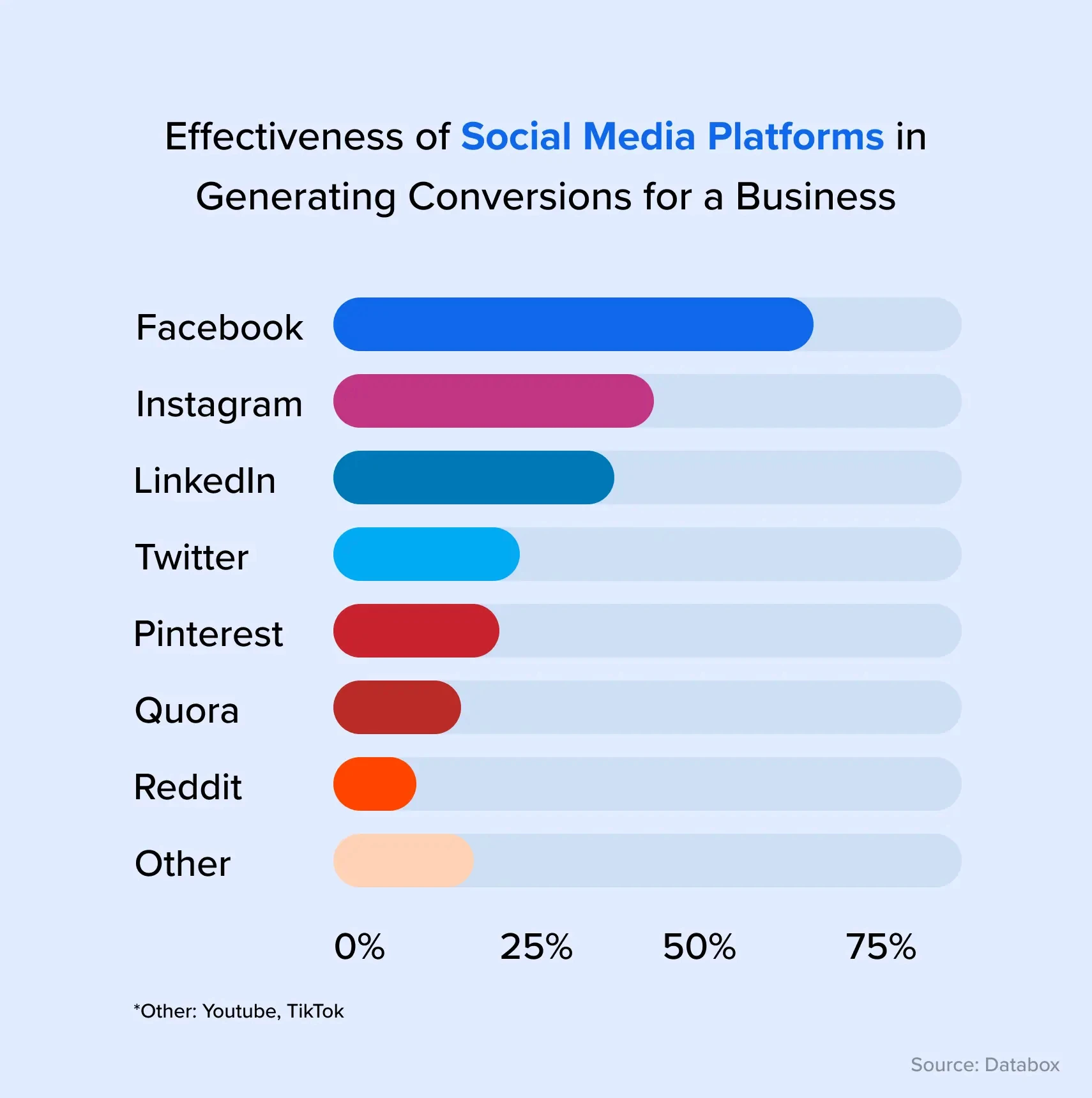
While your brand can have a presence on virtually all social media platforms, for advertising, it's best to stick to the most relevant ones. This depends on your brand's niche and whether your target audience is actually on those platforms.
Some platforms do better than others when it comes to conversion, but you can still run successful, high-converting campaigns even on platforms with relatively low conversions.
Meta Ads
Meta ads are a strong starting point for many B2C brands because Facebook and Instagram support everything from broad prospecting and brand awareness to ecommerce, lead generation, and retargeting. Facebook is also the most popular social app.
Meta can deliver decent ROI when you have enough conversion data and creative variations for its algorithms to optimize delivery, with formats including Reels, Stories, carousel ads, video, static images, and dynamic product ads.
LinkedIn Ads
LinkedIn ads are usually the strongest fit for B2B companies selling higher-value products or services where professional context matters. But they can also be good for brands selling products or services professionals may need (for example, a productivity app or a course marketplace).
Advertisers can target users according to attributes like job title, seniority, company, company size, and industry, while Matched Audiences supports contact targeting, website retargeting, and account-level targeting for ABM campaigns.
TikTok Ads
TikTok ads are great for discovery-driven products and brands that can communicate their value through short-form video. Creator-led videos, product demonstrations, testimonials, and UGC-style creative can fit naturally into the way people consume content on the platform.
TikTok's Spark Ads also let brands turn their own organic posts or authorized creator posts into paid ads while retaining the engagement connected to the original content.
For eligible markets and businesses, TikTok's commerce tools can also shorten the path between product discovery and purchase.
YouTube Ads
YouTube ads are best when video plays an important role in explaining, showing, or building consideration for a product or service. You can run formats including skippable and non-skippable in-stream ads, in-feed video, bumper ads, and YouTube Shorts, while Google's audience tools provide access to in-market, custom, demographic, first-party, and retargeting audiences.
YouTube, unlike Meta or TikTok, can feature cinematic awareness and branding ads, too, like the ones you see on TV.
Other Platforms
Don't overlook smaller or more specialized social media channels when their audience behavior matches your campaign.
Pinterest can be particularly useful for visually driven categories and shoppers in planning or discovery mode, with keyword, interest, shopping, retargeting, and automated targeting options.
Snapchat can make sense for younger mobile-first audiences and campaigns suited to immersive visual or AR experiences.
Reddit offers unusually granular community and keyword targeting for advertisers trying to reach people discussing specific interests or problems.
X can be useful when campaigns benefit from real-time conversations, interests, keywords, events, or topic-driven targeting.
In some cases, these niche platforms can outperform the largest networks because their audiences are more concentrated, their advertising environments better fit the buying context, or there is less competition for the same users.
Here's a side-by-side view of where each paid social platform tends to fit:
How to Diagnose a Paid Social Campaign That Isn't Converting
When a paid social campaign underperforms, avoid changing everything at once. First, identify where the funnel is breaking, then diagnose the likely causes at that stage. You can follow the troubleshooting sequence below:
Low CTR
A low CTR usually points to a problem with the creative, hook, audience, or message.
Check whether the ad earns attention quickly, makes the value proposition clear, and feels relevant to the target audience within the first few seconds.
Good CTR But Low Landing Page Conversion Rate
If people are clicking but not converting, the problem may sit with the offer, landing page, trust signals, conversion friction, or ad-to-page message match.
Review whether the post-click experience delivers exactly what the ad promised and makes the next step simple.
Good Conversion Rate but High CPA
A healthy conversion rate does not necessarily mean the campaign is efficient if traffic is too expensive. There are ways to scale ads without killing CPA.
Examine CPC, audience quality, bidding strategy, conversion value, and overall campaign economics to determine whether the issue happens before the click or whether the conversions themselves aren't valuable enough.
Performance Declines Over Time
Falling CTR, rising CPA, or weakening conversion rates usually signal creative fatigue or audience saturation.
Review frequency and audience reach, then introduce genuinely fresh creative concepts, hooks, formats, and angles. Don't over-rely on endless minor edits to the same ads.
Platform Results Don't Match Analytics or CRM Data
Large differences between platform-reported conversions and your analytics or CRM data may indicate tracking or attribution issues.
Check event configuration, attribution windows, duplicate conversions, tracking setup, and other data connections before using the numbers to make major optimization decisions.
Build a Paid Social Conversion Engine With Creative Milkshake
High-converting paid social campaigns rarely come from a single winning ad. They depend on the right audience, offer, creative system, landing experience, tracking, and continuous testing working together.
Our team at Creative Milkshake helps you turn that process into a repeatable paid social program. We develop and test conversion-focused creative across Meta, TikTok, and YouTube, using creator-led and brand content designed for the way people actually consume content on each platform.
If your paid social performance has stalled, we can audit your current campaigns, identify where creative or strategy may be limiting conversions, and build a testing plan around the opportunities we find.
Book a strategy call with us to discuss the next steps for improving your paid social conversion rate.
FAQs
How much do paid social ads cost?
Paid social costs vary widely by platform, industry, audience, objective, location, and competition. As one benchmark, WordStream found that Facebook traffic campaigns averaged $0.70 per click in 2025, while lead campaigns averaged $27.66 per lead across industries.
Which social media ad formats convert best?
There is no single ad format that consistently converts best across every audience and platform. In our experience, short-form video and UGC-style creative can perform well on platforms such as Meta and TikTok. Test different formats, hooks, messages, and creative concepts against the same conversion goal to identify what works for your audience.
Which paid social platform is best for conversions?
There is no universally best platform for conversions. The right choice depends on your audience, offer, campaign goal, creative, and buying context. Meta may suit broad B2C acquisition, LinkedIn can work well for B2B targeting, while TikTok can be effective for discovery-driven products and creator-led campaigns.
Why is my paid social ad cost rising?
Your paid social ads may be costing more due to increased advertiser competition, audience saturation, creative fatigue, higher CPMs or CPCs, lower conversion rates, or changes in targeting and platform algorithms. Review the full funnel, including audience targeting, ad creative, bidding and budgeting, landing-page performance, and conversion tracking.
Which social media ad platforms does Creative Milkshake support?
Creative Milkshake can cover Meta Ads, TikTok Ads, and YouTube Ads. We offer full campaign services, but can also fill strategy, creative, or execution gaps in your team.
How does Creative Milkshake optimize paid social ads for conversions?
Besides the usual strategic choice of ad format and sharp targeting, we emphasize the creative heavily. It's the single most important factor for conversions, so we continuously test and optimize creatives to keep ROAS high and CPA low.