Paid social teams need a steady flow of fresh creative, but producing more ads does not automatically lead to better performance.
According to Nielsen, campaigns whose ads attracted attention, featured the brand, connected personally with audiences, and prompted action generated 30% higher sales lift than campaigns that did not follow those creative principles.
The challenge gets harder as you scale. You need to decide which ideas are worth testing, what each campaign should teach you, and how those learnings should shape the next round of creative.
A strong creative strategy gives you a repeatable framework for turning audience insights, customer needs, brand messaging, performance data, and campaign objectives into ideas you can test, measure, and refine.
This guide shows you how to build that system and scale your paid social creative while keeping brand consistency, strategic thinking, and performance in focus.
Need to produce more paid social creative without losing strategic direction? Creative Milkshake’s performance creative process brings research, in-house production, testing, and iteration together so performance data from each campaign informs the next round of creative.
TL;DR
Creative strategy is now a major paid social growth lever because platform automation has reduced the advantage of manual media buying and because creative quality plays a bigger role in performance.
Start with the customer, then build outward. Use audience insights to define messaging pillars, turn those into creative angles, and develop distinct, testable concepts for different stages of customer awareness.
Build a repeatable testing and learning system. Test meaningful differences in hooks, formats, proof, CTAs, and storytelling, then analyze performance at the element level and feed those learnings back into future creative strategy.
Adapt creative to each platform without losing strategic consistency. Meta, TikTok, and YouTube require different formats and execution styles, but all should stay aligned with the same brand strategy, marketing goals, and customer needs.
What Is Creative Strategy in the Context of Paid Social?
In paid social, creative strategy is the process of deciding what messages, concepts, formats, and visual approaches should be used to achieve specific campaign objectives.
It connects audience insights, customer needs, brand messaging, and marketing goals with the actual ad creatives shown across social media platforms.
Without a clear creative strategy, your team can end up producing ads without a strong reason behind what they are testing or why. This can lead to weaker ideas, inconsistent messaging, and creative that fails to capture attention or drive action.
In fact, a strong strategy defines which angles, offers, hooks, and formats are worth testing. It also guides storytelling and visual direction while giving teams a clearer way to evaluate performance and carry useful learnings into future campaigns.
Why Creative Has Become a Major Paid Social Growth Lever
Creative has always mattered in paid social, but it now carries more strategic weight. Platforms are automating more campaign decisions, competition for audience attention is growing, and ad recommendation systems increasingly use creative alongside other signals to determine which ads to show to which people.
These shifts give creative strategy a bigger role in how campaigns differentiate and perform.
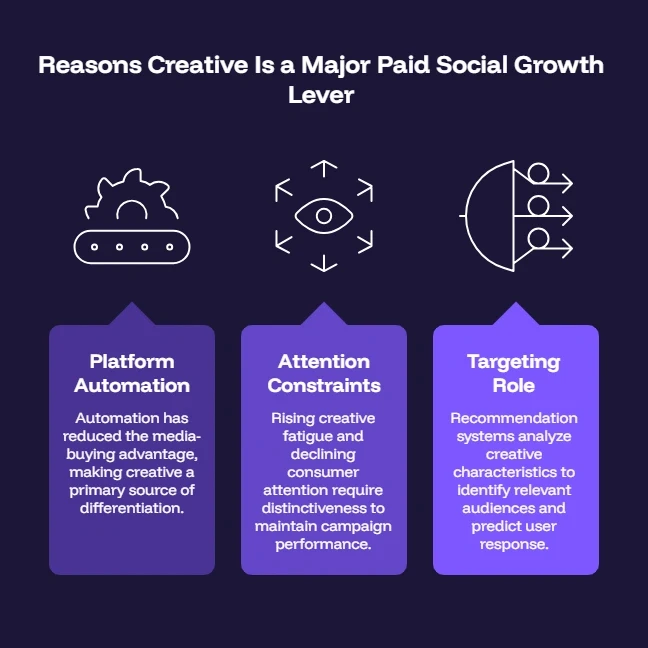
1. Platform Automation Has Reduced the Media-Buying Advantage
Paid social platforms have automated many of the decisions that once separated highly skilled media buyers from everyone else.
Meta’s Advantage+ tools, for example, can automate audience targeting, budget allocation, placements, and bid adjustments, while its recommendation systems increasingly determine which ads should be delivered to which users.
Meta reported in 2025 that Advantage+ Audience, which uses AI to reach relevant audiences, delivered a 15% lower cost per result for awareness-objective campaigns.
Media-buying expertise still matters for areas such as campaign strategy, measurement, economics, and oversight. But when advertisers have access to similar automation, bidding technology, and campaign structures, creative becomes a major source of differentiation.
The concepts, offers, storytelling, brand messaging, and ads you feed into these systems give the algorithms different inputs to work with.
2. Attention and Creative Fatigue Have Become Bigger Constraints
Getting an ad delivered is only the first challenge. Getting someone to actually notice it is the bigger battle.
Kantar’s Media Reactions research in 2024 found that just 31% of consumers globally said ads on social media platforms captured their attention, down from 43% the previous year. Kantar argues that the bar for earning attention is rising across generations, making creative distinctiveness increasingly important.
Creative fatigue adds another challenge. Repeatedly showing similar ads to the same audience can reduce their ability to attract attention and contribute to declining performance over time.
If you’re running an expansive campaign with a broad audience, you need a steady stream of genuinely different hooks, messages, imagery, and formats.
3. Creative Now Plays a Bigger Role in Targeting
The relationship between creative and audience targeting has changed.
Modern recommendation systems use far more than manually selected demographics or interests. They analyze behavioral signals alongside ad characteristics to predict which people are more likely to respond.
Meta’s latest advertising models provide a clear example. Its GEM recommendation model learns from user activity alongside signals such as location, ad format, and creative representation. This allows the system to learn relationships between user behavior and the characteristics of different ads.
As a result, your creative can contribute to how the platform identifies relevant audiences. An ad built around a specific customer problem, product use case, human insight, or creator can help the platform identify the type of person likely to engage or convert.
How to Build a Paid Social Creative Strategy Framework
A scalable paid social creative strategy should give marketing, creative, and media teams a repeatable yet adjustable way to move from customer insights to campaign execution, testing, performance measurement, and iteration.
The following framework reflects the approach we use as a creative-first paid social agency.
1. Start With the Customer
Strong paid social creative starts with an understanding of the customer.
Before writing a creative brief or choosing a visual direction, identify what your audience actually cares about.
The strongest paid social creatives are usually built around a real problem, motivation, objection, desire, or moment in the customer journey.
KFC offers a simple example of an audience insight shaping the creative idea. Customer research found that people particularly looked forward to the first bite of their KFC meal. The brand turned that insight into the central idea behind its “First Bite” campaign.
To gain useful customer insights, look at sources such as customer interviews, reviews, sales calls, social comments, search behavior, analytics, audience research, and feedback from customer-facing teams.
We suggest asking questions such as:
What problem is the customer trying to solve?
What outcome do they actually want?
What objections or concerns might stop them from taking action?
What alternatives or competitors are they considering?
What language do customers use to describe the problem?
What proof would make the product or offer more believable?
What changes as they move through different stages of the customer journey?
These insights can then inform the angles, hooks, messages, and concepts you develop for paid social.
Starting with the customer research also prevents creative strategy from becoming overly brand-centric. Your brand strategy and marketing goals still set the boundaries, but the message should be expressed through the lens of customer needs.
2. Define Your Core Messaging Pillars
Once you understand the customer, define the small set of messaging pillars that should consistently shape your paid social campaigns.
These are the core ideas you want your audience to associate with your product or brand, such as a key customer benefit, a differentiating capability, a problem you solve, or a reason to trust you.
Your messaging pillars should sit at the intersection of customer needs, brand strategy, and business goals.
They give the creative team clear strategic direction while still leaving room to explore different hooks, formats, angles, and executions.
A software brand, for example, might build its messaging around saving time, reducing operational complexity, improving visibility, and delivering measurable ROI.
Insider tip: Our team at Creative Milkshake keeps messaging pillars intentionally focused. When too many messages compete for priority, creative gets harder to test, compare, and refine.
3. Turn Messaging Pillars Into Creative Angles
Messaging pillars define what you want to communicate. Creative angles determine how you frame that message so it becomes relevant and compelling to the audience.
For example, a messaging pillar around saving time could generate several creative angles, like:
The frustration of wasting hours on manual work
A before-and-after comparison
A customer testimonial about increased productivity
A product demonstration showing how quickly a task can be completed
A provocative question about the cost of inefficient processes.
This is where audience insights, competitor analysis, creative research, and human insight become particularly useful.
Creative angles for the core campaign message can come from the questions or concerns target customers have. And each question or concern can become a different angle for communicating the same underlying message.
4. Turn Creative Angles Into Testable Concepts
The next step is turning those angles into concrete creative concepts that can actually be produced, launched, and measured.
A concept combines the angle with an execution. This can include the hook, format, imagery or video style, storytelling structure, offer, CTA, and other elements that shape how the idea appears in the feed.
When N26, a digital bank based in Europe, came to Creative Milkshake to address the plateauing performance of its paid social, our team came up with the testable concept of producing user-generated content (UGC). The idea was to replace branded imagery with videos from real users delivering the brand’s value proposition.
The concept gave the team a meaningful alternative to test against the brand’s existing creative and ultimately delivered stronger cost efficiency.
The key is to make each concept distinct so that the test yields useful information. Changing one word in the headline or swapping the background image may create another deliverable, but it won’t create a meaningful strategic test.
Instead, test differences that can teach you something about the audience, such as:
Problem-led vs. benefit-led messaging
Product demonstration vs. customer storytelling
Creator-led content vs. polished brand creative
Emotional hooks vs. rational proof points
Customer testimonials vs. direct product claims
Short-form video vs. static imagery
5. Match Creative to Customer Awareness
Not every customer needs the same message. Someone who has never heard of your brand requires a different creative approach from someone who already knows the product, has visited the landing page, or is comparing you with competitors.
Paid social campaigns can reach people at very different levels of awareness, so your creative should reflect what the audience already knows and what they need to understand next.
Your creative brief should also make the intended awareness level or stage of the customer journey clear.
Here’s a simple table that shows which type of creative suits which level of awareness:
As awareness increases, your creative can become more product-specific, proof-driven, and direct.
6. Choose the Right Creative Format
Remember, a strong idea can underperform if you deliver it in the wrong format. Organize formats around the job the ad needs to perform.
The best format depends on the message, product, target audience, social media platform, and the action you want the customer to take.
Useful creative formats by campaign goal include:
Demonstration
Product demos
Before-and-after creative
Side-by-side comparison
Problem-solution videos
Social Proof
UGC-style videos
Testimonials
Customer stories
Reviews
Education
Educational explainers
Listicle videos
How-to content
Problem-awareness videos (news, stats, insights, trends, etc.)
Authority
Founder-led videos
Expert-led videos
Podcast clips
Interview clips
Visual and Product-Led Creative
Static ads
Carousels
Motion graphics
Product-focused creative
Avoid treating format as an afterthought in content production. Instead, include it in the creative brief and test multiple expressions of the same idea across different formats.
A winning concept might begin as a creator video, then be adapted into static imagery, a carousel, an animation, or a landing page asset. This lets the creative team extend successful ideas across marketing channels while learning which formats drive the strongest engagement and performance.
7. Bake the CTA into the Creative
When you want the audience to take a specific action, make that next step clear within the creative itself rather than relying entirely on the platform’s CTA button.
The CTA can appear naturally in the script, visuals, and ad copy. It should clearly highlight what you want someone to do next, whether that means learning more, signing up, starting a trial, or making a purchase.
This becomes particularly important for middle- and lower-funnel campaigns, where the creative needs to move someone from interest toward action.
For example, the creatives we made for 8Sheep Organics featured creators on Instagram and TikTok opening with a catchy hook, talking about the products and their benefits, and ending the video with a clear call to action, including a very visible URL of the website.
8. Build a Structured Creative Testing System
Creative testing should be systematic enough to generate reliable learning.
We suggest starting by defining what you are testing and why. Each batch of ad creatives should be tied to a clear hypothesis about the audience, message, angle, format, offer, or execution.
For example, you might test whether a problem-led hook performs better than a benefit-led hook, whether creator-led content outperforms polished brand creative, or whether customer proof improves conversion rates.
Keep each test focused enough to understand what influenced performance. If you change the hook, visual style, offer, CTA, and format all at once, it becomes much harder to understand what actually drove the difference in performance.
Also, separate concept tests from execution tests. Concept tests compare broader ideas, angles, or messages, while execution tests explore different ways of presenting an established concept.
Set clear KPIs and metrics based on the campaign objective. This could include thumb-stop rate, video play actions, CTR, landing page conversion rate, CPA, ROAS, engagement, or other performance indicators.
Most importantly, look beyond a single winning ad and identify patterns across concepts, audiences, and funnel stages.
Use those findings to shape the next creative batch. Strong concepts can be refined, adapted into new formats, or expanded into related angles, while weaker tests can still reveal what to change next.
9. Analyze Creative Performance at the Element Level
To improve creative strategy over time, analyze which elements within the creative appear to be driving performance.
Break each ad down into components like the hook, message, visual style, creator, product demonstration, proof point, CTA, offer, format, and landing page connection.
For example, if several high-performing ads use customer testimonials but different hooks and formats, social proof may be the more important signal. If short-form videos consistently generate strong engagement but weak conversion rates, the format may be earning attention while the body, offer, or CTA needs work.
Element-level analysis helps separate the underlying creative lesson from the performance of one individual execution.
Use platform analytics alongside downstream metrics such as CTR, video retention, conversion rate, CPA, and ROAS to identify recurring patterns. You can also tag assets by variables such as angle, audience need, hook type, format, imagery, and CTA. This makes it easier to compare similar creative choices across campaigns.
Over time, these patterns give your team a clearer understanding of which creative elements work, for which audiences, and under which conditions. These learnings can then shape future briefs, concepts, and testing priorities.
10. Feed Creative Learnings Back Into Strategy
The final step is closing the feedback loop. As campaigns generate new audience and performance data, your creative strategy should evolve with what you learn.
Look for patterns across stronger and weaker concepts and use them to revisit the strategic decisions made earlier in the process.
Ask questions such as:
Which customer needs consistently drive engagement?
Which hooks generate attention?
Which proof points improve conversion?
Which formats, creators, offers, or visual styles perform best for different campaign objectives?
These findings should inform the next creative brief.
Over time, this creates a compounding advantage. Performance data improves the creative strategy, the strategy produces better concepts, and those concepts generate new audience insights.
Platform-Specific Creative Strategy for Paid Social
The framework above provides a foundation, but your creative strategy should still adapt to the behavior, formats, and recommendation systems of each advertising channel.
A concept that performs well on Meta may need a different hook, pacing, visual style, or level of polish to work on TikTok or YouTube. As our own expertise is in Meta, TikTok, and YouTube, those are the platforms we’ll cover below:
Meta Creative Strategy
For Meta, prioritize creative diversity and placement flexibility.
Facebook and Instagram campaigns can appear across Feeds, Stories, Reels, and other placements, so strong creative operations should produce concepts that adapt across formats.
But if we had to pick one format to favor, that’d be Reels. Meta recommends native 9:16 video with audio and key creative elements placed within the safe zone.
In fact, Meta also reported in 2026 that ad sets where at least 20% of creative assets were 9:16 videos with audio were associated with a 7% lower CPA than ad sets where those assets made up less than 20% of the creative mix.
A practical Meta creative mix can include:
Creator-led and UGC-style Reels
Customer testimonials and social proof
Product demonstrations
Problem-and-solution videos
Static ads with strong visual messaging
Carousels for multiple benefits or features
Partnership Ads using creator content
Variations built around different customer needs, hooks, and messaging angles
Don’t assume that more assets automatically create more diversity. Five videos using the same script with different opening lines are still largely the same concept.
Also, choose formats based on your audience, message, product, and campaign objective. Give Meta genuinely different creative inputs through customer motivations, value propositions, storytelling structures, concepts, and formats. Then use performance data to identify which directions deserve further testing and investment.
TikTok Creative Strategy
TikTok generally rewards a more TikTok-first approach. Branded visuals with little to no human element simply won’t do well on this platform.
Ads need to compete with creator content in a fast-moving entertainment feed, so overly polished advertising can sometimes feel disconnected from its surroundings.
TikTok itself recommends creative that feels native, short, human, authentic, and built around fast storytelling. This is what we’ve learned works great with TikTok ad creatives:
Start quickly. Use movement, dialogue, a provocative statement, a relatable problem, or an interesting visual to create a hook within the opening seconds.
Introduce the product naturally, use sound and on-screen text as part of the storytelling, and avoid making viewers wait too long to understand what the video is about.
Influencer content and UGC can be particularly valuable here. Instead of forcing creators to read a tightly controlled brand script, give them the messaging pillars, product information, creative brief, and guardrails, then allow room for their own expression.
Trends can also provide useful storytelling templates but only when there’s a genuine connection to the product or audience.

YouTube Creative Strategy
YouTube requires a more flexible creative approach because viewing behavior ranges from fast Shorts consumption to longer, more intentional video watching.
Your creative strategy should account for format, viewing context, campaign objective, and video length.
Google’s core framework for YouTube advertising is the ABCD model:
Attention
Branding
Connection
Direction
In practice, this means getting into the story quickly, introducing the brand early, creating an emotional or personally relevant connection, and giving viewers a clear action to take.
Google reports that campaigns applying its ABCD principles can generate up to a 30% lift in short-term sales likelihood and a 17% lift in long-term brand contribution.
For performance campaigns, create enough variety to work across YouTube’s different surfaces. This can include horizontal 16:9 videos for traditional viewing, vertical 9:16 assets for Shorts, and square creative where appropriate.
Google specifically recommends supplying creative across horizontal, vertical, and square orientations.
Unlike Meta’s platforms and TikTok, YouTube is better suited to deeper storytelling. Provided your creative grabs the audience’s attention and holds it, it can be used to deliver longer messaging, such as a demo, an explainer, or a customer story, that ultimately drives clicks and potential conversions.
Best Practices for Effective Paid Social Creative
Paid social platforms and creative formats keep evolving, so your operating process needs to stay flexible. These practices can help your creative team work more consistently as campaigns scale:
Create multiple creative brief templates: Build different brief templates for creator-led ads, product demonstrations, testimonials, static creative, and larger campaign launches. This gives each type of work the right level of structure.
Build a shared creative library: Maintain a centralized collection of past ads, concepts, references, and campaign examples. A well-organized library makes useful inspiration easier to find and helps teams avoid unnecessary duplication.
Prioritize meaningful creative diversity: Focus on distinct concepts, messages, formats, and executions rather than increasing asset volume through minor variations.
Use AI to accelerate creative workflows: AI can help generate hook variations, explore messaging directions, summarize performance data, and surface patterns across large creative libraries. However, human judgment should still guide strategy, brand decisions, and final execution.
Make Creative the Paid Social Power Play with Creative Milkshake
Creative has become one of the most important variables in paid social performance. Targeting, media buying, and optimization still matter, but stronger creative gives those systems better inputs to work with.
We’ve seen this across the work we do for brands on Meta, TikTok, and YouTube ads.
Our process starts with strategy, where we define the messaging, creator approach, ad formats, and platforms that best fit the campaign. We then test different concepts and executions, use performance data to understand what works, and invest further in the directions that show the strongest potential.
Creative Milkshake can help you build, execute, and refine a paid social creative strategy around your audience and performance goals.
Book a call to speak with a senior creative strategist.
FAQs
What are the different types of creatives for paid social?
Paid social creatives can include short-form video, static images, carousels, animations, product demonstrations, testimonials, creator-led or UGC-style ads, influencer content, and longer-form video. The right mix depends on the platform, campaign objective, target audience, and stage of the customer journey.
Do different social media platforms need different creative strategies?
Yes, Meta, TikTok, YouTube, LinkedIn, and other platforms have different formats, user behaviors, and content expectations, so creative should be adapted accordingly. You can use similar ad assets, but they should be modified for the platform format and consumption.
How many ad creatives should you produce?
A practical starting point is 3 to 5 meaningfully different creatives per ad group, although the right number depends on the campaign’s size and duration. TikTok recommends this range to give its delivery system more options. Test distinct hooks, angles, formats, or messages rather than minor variations, then refresh the creative mix as you gather performance data.
How often should creatives be refreshed for paid social?
There is no fixed refresh schedule because creative fatigue depends on factors like audience size, spend, frequency, and campaign performance. Platforms like Meta typically indicate when fatigue kicks in. Plus, you can monitor metrics like CTR and engagement to see if a creative has had its run.
How does Creative Milkshake test creative performance?
At Creative Milkshake, we test creatives for concept, messaging, format, and specific elements. Test campaigns start with a hypothesis that defines what needs to be tested. Then, we look at metrics relevant to the campaign goal and ad format to understand performance patterns and apply the learnings to the creative before scaling the budget.
Can Creative Milkshake manage ongoing creative testing and campaign optimization?
Yes, Creative Milkshake continuously tests different creative variations to optimize performance and prevent fatigue. And we don’t rely on minor changes. Instead, we make creatives noticeably different with a new hook, offer, and visual, even if the underlying message or featured creator is the same.