
Imagine you’re spending thousands on ads, clicks look fine, and traffic’s coming in.
But what about your demos, trials, and revenue? They’re pretty much flat.
In that case, something’s definitely off.
Here’s the part most SaaS advertisers don’t want to admit: it’s usually not your ads.
It’s everything around them: your ad funnel, your messaging, your landing pages, and even how your campaigns are set up to learn.
And because all your creatives look “fine,” you may not know exactly where to start fixing them.
So, stick with us. By the end of this guide, you’ll see exactly where your funnel is bottlenecking and what to fix first. You’ll learn what’s actually blocking conversions and what to change to turn clicks into a pipeline.
P.S. If you want a team that builds ads as a system, Creative Milkshake does exactly that. Contact us today to finally see better results!
TL;DR
Most SaaS ads fail because of fixable structural problems.
Treating all platforms the same way (Google ≠ Facebook ≠ LinkedIn) kills campaigns.
Generic, feature-focused creative fails to stop the scroll or speak to buyer pain.
Your landing page is likely killing conversions your ad worked hard to earn.
Wrong campaign objectives and broken tracking make the algorithm optimize for the wrong outcomes.
A mismatched offer for the wrong funnel stage repels qualified buyers.
Cold audiences need trust before commitment (most SaaS ads skip this entirely).
What Are SaaS Ads, Exactly?
SaaS ads are paid campaigns run by software companies to drive demos, trials, or sign-ups across platforms like Google, Meta, LinkedIn, and YouTube.
Simple as that.
But here’s where it gets tricky… SaaS isn’t e-commerce. You’re not selling a $40 product on impulse. You’re asking someone to commit to a tool that impacts their workflow, team, and budget.
So the journey is naturally longer, more people get involved, and trust matters a lot more.
That’s why your paid campaigns can get clicks but still struggle with conversion rate.
Format-wise, you’re usually working with:
Search ads (Google)
Video ads (YouTube/Meta)
Display, native, and paid social (Meta, LinkedIn, and even TikTok in some cases)
Now, let’s talk about what this actually costs you.
The Real Cost of Underperforming SaaS Ads
Let’s be honest, “ads not working” translates into wasted ad spend.
You’re already putting 20-30% of your marketing budget into paid. So when things don’t convert, it compounds fast. If your click-through rate is good, but SQLs don’t come in, your budget is not put to good use.
Now, let’s consider the SaaS ad costs per channel, along with best use cases:
If you’re investing in most tactics, costs can add up quickly.
But here’s the trap: you see a high CTR, lots of traffic, and maybe even solid engagement on your social ads.
Feels like progress, right?
Not really.
If your call to action isn’t converting, or your funnel has gaps, those clicks mean nothing. Just more advertising mistakes getting expensive.
Alright, so where exactly is all this going wrong?
Why Most SaaS Ads Don’t Convert: 8 Common Problems and How to Fix Each One
Below, we’ll discuss the real reasons your funnel stops bringing leads, from ad fatigue to weak creative variations and messy audience segmentation. Let’s break them down.
1. You Are Matching the Wrong Intent to the Wrong Channel
From our experience, many teams make this mistake.
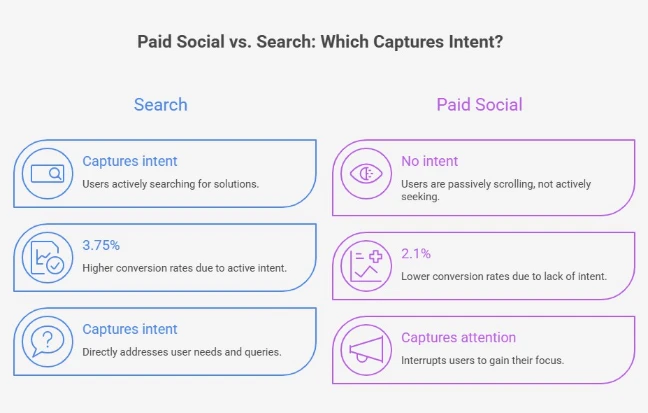
You’re treating Google and paid social as if they serve the same purpose. In reality, they operate at different stages of intent.
Search captures existing demand. Someone types “best CRM software” because they are already evaluating options.
Paid social works differently. You are reaching users who are not actively searching, so the goal is to capture attention and build interest.
When you send cold traffic directly to a “Book a demo” page, conversion rates drop because the user is not ready for that step.
Quick reality check: search ads convert at 3.75% vs. 2.1% for paid social. That gap comes from intent, and doesn’t just reflect ad quality.
Here is where the problem might lie.
Informational keywords on Google bring in low-intent clicks, while cold social traffic is pushed into high-commitment actions too early. The mismatch happens on both sides.
Fix it like this:
Segment search by intent. Separate high vs. low intent queries.
Then align offers by stage (TOF, MOF, BOF).
Use ad retargeting to warm people up instead of forcing a decision upfront.
And most importantly… stop expecting Meta to behave like Google.
2. You Are Asking for Too Much Commitment Too Soon
Someone just clicked your ad and is seeing your brand for the first time, yet your move is… “Book a demo”?
That is a high level of commitment for someone with limited context.
Here’s the thing: most SaaS buyers aren’t ready to convert at this stage of the funnel. Not because your product isn’t good, but because they don’t fully understand the benefit yet.
So the friction isn’t how you formulated the CTA. It’s the timing.
You’re skipping steps.
Instead, build an offer ladder that matches where they are:
Free tool
Calculator
Ungated case study
Playbook
Product walkthrough
Then demo
This approach builds trust before asking for commitment.
Behavior-based targeting is also important. Someone who watched 75% of your video shows a different level of interest than someone who clicked on it and bounced.
Avoid pushing demos too early. SaaS buyers want to understand value and see proof before committing.
The product comes after that.
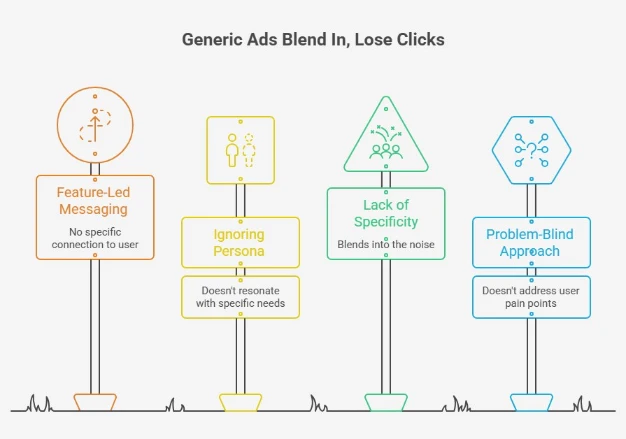
3. Your Creative Is Generic, Feature-Led, and Too Easy to Ignore
Let’s be honest; your ad probably sounds like everyone else.
“All-in-one platform.”
“Transform your business.”
These statements are broad and do not communicate specific value.
Users do not engage with category-level messaging. They respond to messages that reflect their situation.
Problem-led messaging performs better because it highlights a recognizable issue and connects it to a clear outcome.
There’s a reason 65% of marketers say personalized ads outperform generic ones. Specificity captures attention, while generic messaging is overlooked.
Instead of leading with features:
Define the exact persona
Describe the workflow they are struggling with
Highlight the friction they experience
Support it with clear outcomes and proof
People are not initially focused on your product. They are focused on solving a problem.
Make that clear, and your ads become harder to ignore.
4. Your Targeting Is Broad and Narrow in the Wrong Places
This issue is easy to miss, but it can hurt performance over time.
Some teams implement broad audience targeting too early in an attempt to scale. That can bring in cheaper clicks, but with low intent. Then they narrow targeting too aggressively, which raises CPMs, slows delivery, and limits what the platform can learn.
This usually creates a loop where neither approach works well.
In many cases, the problem is focusing too much on static attributes and not enough on behavior.
Job titles, industries, and company size can help, but they do not tell you how interested someone actually is. Behavioral signals provide that context.
Instead of relying too heavily on audience assumptions, adjust your structure like this:
Keep prospecting broader, but add clear guardrails
Exclude existing users, irrelevant segments, and low-quality traffic
Build retargeting audiences based on behavior, not just interests
Segment campaigns by funnel stage: cold, warm, and bottom of funnel
The behavioral questions matter more here:
Who clicked?
Who watched?
Who returned?
We have seen that when targeting reflects the buyer journey more closely, campaign performance becomes easier to improve.
5. Your Landing Page Breaks the Promise
This is one of the most frustrating problems because the ad may already be doing its job.
People click and show interest. Then the landing page creates friction that stops them from moving forward.
When CTR is high but conversions stay low, the issue is generally post-click friction.
Common causes include:
A weak or unclear headline
An offer that is not immediately obvious
Too many CTAs competing for attention
Long forms
A poor mobile experience
Slow load times
Messaging that does not match the ad
That last point matters a lot. When the message or offer changes after the click, trust drops quickly.
Here is how to fix it:
Keep the headline and offer aligned with the ad
Match the tone and visual direction from the ad to the page
Reduce form fields
Remove distractions around the main action
Add credible proof, such as testimonials, results, or logos
Make the next step easy to understand
Once someone clicks, your goal is not to impress them with more information. You need to maintain momentum and make the next action feel straightforward.
But if your landing page isn't working, check this out:
6. Your Tracking Is Broken, so the Platform Is Learning From Bad Signals
This is where things can become hard to diagnose.
You may think your campaigns are underperforming, when the real issue is that your data is incomplete or inaccurate. That problem is common: 38% of marketers say attribution is their #1 analytics problem.
Here is what usually goes wrong:
Your pixel or CAPI is misconfigured and not tracking events correctly
Events are duplicated
The wrong conversion event is being recorded
Your CRM is not capturing UTMs properly
The platform starts optimizing for weak signals, such as clicks, instead of qualified outcomes
When that happens, good campaigns can appear weak, while poor campaigns can look better than they are. That is how budgets get wasted and optimization decisions go off course.
Here is how to fix it:
Audit your pixel, CAPI, and CRM together
Review your event hierarchy
Remove duplicate events
Track the full path from ad to lead to opportunity
When your tracking is inaccurate, every decision after that becomes less reliable.
7. You Are Optimizing for Cheap Leads Instead of a Qualified Pipeline
Many teams see this as progress, but it usually is not.
Low CPL looks efficient in reports, but if demos aren’t scheduled and deals don’t close, you have a problem.
That problem is not lead volume, from our experience, but rather lead quality.
In fact, only 6.2% of SaaS leads turn into sales opportunities, which means most low-cost leads were unlikely to convert.
Here are the factors most likely to negatively influence your lead quality:
Forms are too easy to complete, with little qualification
The wrong personas enter the funnel
Follow-up is delayed or inconsistent
The platform optimizes for “Lead” instead of revenue-based signals
As a result, lead volume increases, but pipeline quality does not.
Fix it like this:
Add qualification questions (role, company size, intent)
Ad-optimize campaigns beyond the “Lead” event when possible
Track conversion rates from lead to demo to closed deal
Build feedback loops between marketing and sales
8. You Do Not Have a Creative Testing System, so Fatigue Beats Learning
This issue tends to develop gradually.
You find an ad that performs well and continue running it. Still, over time, performance declines. Then, you start making minor changes, such as adjusting a thumbnail or rewriting a line, but the underlying concept remains the same.
While you might think this is structured testing, it’s actually just extending a single idea beyond its effective lifespan.
Remember: Creative fatigue is expected in advertising, even with great assets. Without new inputs, performance will decline.
What works instead is consistent creative testing.
This means introducing new hooks, new angles, and different ways to frame the same problem. We don’t mean you need to make purely surface edits, but rather try meaningful variation.
To make this effective:
Test new creative concepts regularly
Refresh ads on a defined cadence
Separate testing campaigns from scaling campaigns
Track performance by hook, angle, persona, and funnel stage
This approach creates a repeatable learning process.
This is how we approach creative testing at Creative Milkshake, too.
Our focus is on structured experimentation and performance-driven decisions. In one case, this meant producing 15 new concepts, iterating five times, and launching 60 ads while scaling Meta spend.
Lesson learnt: Scaling does not depend on finding a single winning ad. Instead, we advise you to build a system that consistently produces effective creatives.
Pro tip: Check out our guide on why creative testing fails for most teams so you know what to avoid.
So, now that you know the problems and how to fix them, let’s see how to put it all together in a 30-day plan.
A 30-Day Plan to Fix Underperforming SaaS Ads
If performance feels inconsistent, the goal is understanding what is happening across your funnel and making targeted adjustments. Here is a structured 30-day plan to regain control.
Week 1: Diagnose the Real Break Point
Start by reviewing the full journey, from impression to closed deal. Looking only at ad metrics will not show where performance drops.
Identify where users stop progressing:
Low CTR usually points to weak targeting or creative
High bounce rates suggest a disconnect between ad and landing page
Leads that do not progress indicate qualification or follow-up issues
It’s important to define the problem clearly before making changes because each issue and funnel stage requires a different approach.
Week 2: Fix the Conversion Path
Once the issue is clear, align the full conversion path. The offer, campaign objective, ad message, and landing page should all support the same action and audience intent.
Reduce friction across the page:
Shorten forms to collect only essential information
Keep messaging consistent from ad to landing page
Add proof, such as testimonials, case results, or client logos
Around 81% of users abandon forms before completing them, so reducing unnecessary fields can have a direct impact on conversion rates.
Review your tracking setup as well. If tracking is inaccurate or incomplete, optimization decisions will not reflect actual performance.
Week 3: Rebuild Creative and Targeting
At this stage, focus on improving inputs.
Develop new ad variations based on persona and funnel stage instead of relying on a single message for all audiences.
Adjust targeting structure:
Separate campaigns by intent and funnel stage
Align channel strategy (search for demand capture, paid social for demand generation)
Refine retargeting audiences based on behavior
Remove audience overlap and add exclusions where needed
This helps the platform learn from clearer signals and improves consistency across campaigns.
Week 4: Tighten Lead Quality and Scale Rules
Shift the focus from lead volume to pipeline performance.
Measure how your SaaS leads move through the funnel:
Lead to demo conversion rate
Demo to close rate
Use these metrics to identify where drop-offs occur and whether leads are qualified.
Improve follow-up speed and consistency, since delays often reduce conversion rates.
When increasing your advertising budget, evaluate whether campaigns are generating qualified opportunities and revenue. Scaling without this visibility may increase costs without improving outcomes.
So… what does “good” actually look like?
What Good SaaS Ads Actually Look Like
Good SaaS ads are built to move qualified buyers through a multi-step decision process, from initial awareness to sales conversations.
In SaaS, the goal is not immediate purchase.
You need to progress from click to engaged user, to qualified lead, to pipeline, and then, finally, to revenue.
That means your ads, targeting, and offers must reflect how SaaS buyers evaluate tools: slowly, comparatively, and with a clear focus on outcomes.
Here is what that looks like across channels.
Google (Search): Capture Existing Demand with High-Intent Offers
On Google, strong SaaS ads focus on users who are already evaluating solutions.
What works:
Keywords with clear commercial intent (“best [category] software,” “[tool] alternatives,” “[tool] pricing”)
Landing pages that match evaluation-stage expectations (comparisons, use cases, demos)
Offers that help buyers make decisions
Here’s a good example for someone trying to find a Jellyfish alternative:

What to implement:
Separate campaigns for high-intent vs. informational queries
Use competitor and alternative keywords intentionally
Align landing pages with evaluation (not education)
Track demo bookings and qualified conversions, not just clicks
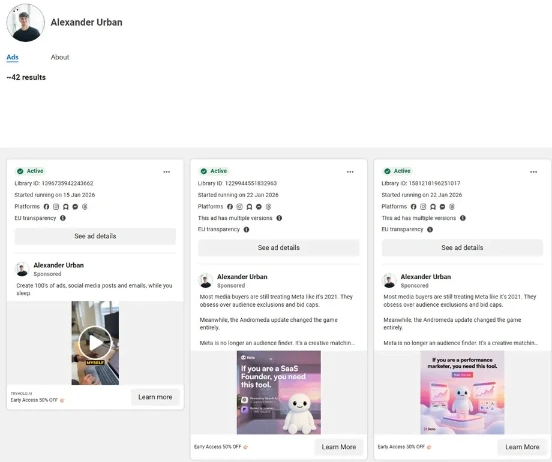
Meta (Paid Social): Create Demand and Qualify Through Behavior
On Meta, SaaS users are not actively searching for products. Good SaaS ads here create awareness and guide users into consideration.
What works:
Problem-led hooks that reflect real workflows
Mid-funnel offers (playbooks, tools, case studies)
Retargeting based on engagement depth
Example:
Hook: “Your sales team is hitting targets, but pipeline isn’t growing. Here’s why.”
Creative: Short video explaining the gap (e.g., lead quality vs. volume)
Offer: Free diagnostic or playbook
CTA: “Get the playbook” (not “Book a demo”)
Retargeting layer:
Users who watched 50–75% → product walkthrough
Users who visited key pages → demo offer
This one fits the bill pretty well:
What to implement:
Build TOF, MOF, BOF campaigns separately
Use video and native-style creatives tied to real problems
Retarget based on behavior, not just clicks
Delay demo CTAs until intent signals are stronger
LinkedIn: Reach the Right Personas with Contextual Value
LinkedIn performs best when targeting specific roles involved in buying decisions, especially in B2B SaaS.
What works:
Messaging tailored to role (e.g., VP Engineering vs. Head of Marketing)
Offers tied to business impact (efficiency, revenue, cost reduction)
Content that reflects internal decision-making
Like so:
What to implement:
Segment campaigns by role and seniority
Adapt messaging to each persona’s priorities
Use document ads, case studies, and benchmark reports
Focus on pipeline impact, not feature lists
YouTube: Build Consideration Through Explanation and Proof
YouTube is effective for explaining complex SaaS products and building trust over time.
What works:
Problem → solution → outcome structure
Short explainers or product walkthroughs
Retargeting viewers into deeper funnel stages
What to implement:
Use skippable in-stream ads with strong first 5 seconds
Build audiences based on watch time
Retarget engaged viewers with deeper content
Focus on clarity over production complexity
Reddit: Engage High-Intent Communities Without Breaking Context
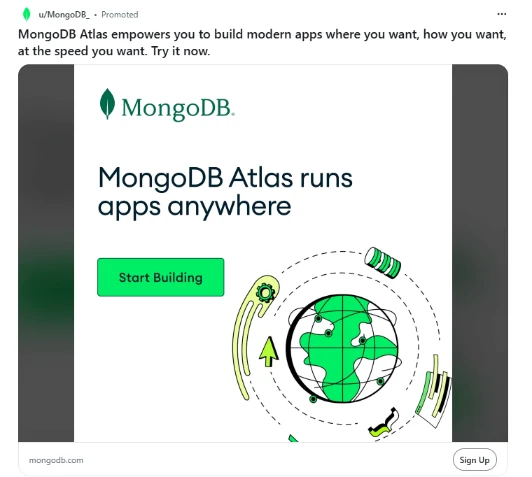
Reddit works differently from most paid channels. Users are not browsing passively, and they are not responding to polished ad messaging. They are reading discussions, looking for solutions, and evaluating tools based on real experiences.
For SaaS, this creates a strong opportunity, but only if your ads match the tone and expectations of the platform.
Here’s a neat example:
What to implement:
Target relevant subreddits where your ICP is active
Write ads in a native, discussion-style format
Focus on real problems and practical insights
Avoid overly polished or sales-heavy language
Use mid-funnel offers (teardowns, case studies, diagnostics)
Retarget engaged users with stronger intent offers later
What All High-Performing SaaS Ads Have in Common
Across channels, effective SaaS ads share a few consistent traits:
They align with buyer intent and funnel stage
They focus on specific problems and workflows
They connect messaging to measurable outcomes
They guide users through steps instead of forcing early decisions
They are tied to pipeline metrics, not just surface-level performance
In practice, this means structuring campaigns so that each interaction moves the buyer closer to a decision, with clear signals at every stage.
Here are some more examples that just work:
Alright, now let’s turn this into action.
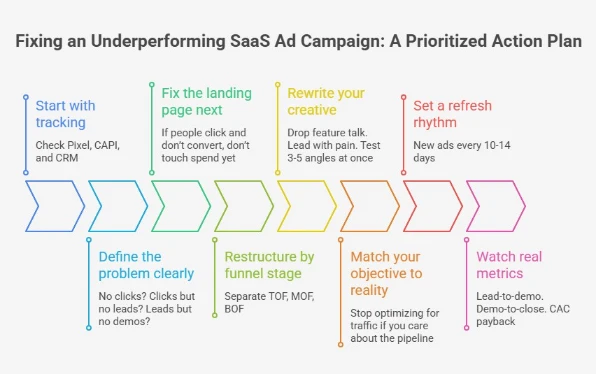
Fixing an Underperforming SaaS Ad Campaign: A Prioritized Action Plan
If your SaaS ad campaign is underperforming, the best place to start is with a clear order of operations. Now, let’s make this clear: you do not need to change everything at once, but you do need to identify the main issue first, then fix each part of the funnel in the right sequence.
So here’s the exact sequence to get things back on track:
Start with tracking: Check your Pixel, CAPI, and CRM setup first. If your tracking is misconfigured, you cannot trust the performance data or make good decisions from it.
Define the problem clearly: Separate low clicks, low lead volume, low demo bookings, and low sales quality. Each issue points to a different part of the campaign.
Fix the landing page next: If people are clicking but not converting, look at the page before you adjust spend. In many cases, the page is where the drop-off happens.
Restructure by funnel stage: Separate TOF, MOF, and BOF campaigns. Each stage needs a different message, offer, and level of commitment.
Rewrite your creative: If your ads focus too much on product features, shift the message toward the problem, outcome, or use case. Also, try to test several angles at the same time so you can compare what actually moves performance.
Match your objective to reality: If you care about pipeline, don’t optimize for traffic alone. Choose the conversion event that reflects meaningful progress in the funnel.
Set a refresh rhythm: Refresh ads every 10 to 14 days, or sooner if performance starts to decline. This helps you avoid fatigue and keeps testing consistent.
Watch real metrics: Pay attention to lead-to-demo rate, demo-to-close rate, and CAC payback. These metrics tell you more than click-through rate alone.
Follow this order when you troubleshoot performance. Fixing an underperforming campaign usually comes down to identifying the right issue early and solving it before moving to the next step.
Where Creative Milkshake Actually Changes the Game
Creative Milkshake improves the system that leads to your ad performance. Many SaaS teams run a small number of tests without a clear structure, which makes it harder to understand what’s driving results.
Instead, our approach is to build a structured creative process. This includes testing different angles, hooks, personas, and formats at the same time, so performance differences become easier to measure and act on.
Messaging also shifts based on the channel.
We won’t be using the same positioning everywhere; we always adjust the creative to match how each platform works. What performs on Meta, where users are not actively searching, requires a different approach than Google, where intent is already present.
This type of structure connects directly to performance. When messaging, targeting, and testing are aligned, it becomes easier to improve CPA, conversion rates, and scalability over time.
For example, we worked with LOLA to rebuild its creative strategy. Our team tested multiple formats and focused on performance-driven creative. As a result, revenue increased by 165%, while CPA decreased by 40%.
Here is an example of that work:
Fixing SaaS Ad Performance Starts With the System
If your ads are not converting, the issue is typically not the ads themselves. In many cases, performance is affected by how the full system is set up, including intent, creative, landing pages, and tracking.
When these elements are misaligned, small inefficiencies add up. Low-intent traffic, unclear messaging, weak page experience, or inaccurate signals can all reduce conversion rates across the funnel.
Once you address these areas in the right order, your performance becomes more predictable. Traffic is more likely to convert into qualified leads, and leads are more likely to move into the pipeline. Getting better results starts with identifying the main constraint in your funnel and fixing it before moving to the next step.
If you need support with structuring this process across creative, funnel, and performance, reach out to Creative Milkshake today! We’ll review your current setup and find out exactly what changes can make the most impact.