AI UGC ads sound like the perfect fix for every tired ad account.
Production costs are rising, creative fatigue is real, and your media buyer needs more assets yesterday. Then AI shows up and promises endless variations, instant scripts, synthetic creators, translated voiceovers, and fresh formats at a fraction of the cost.
Tempting? Very...
But the real question is whether people believe the ad enough to stop, click, and buy. Some AI-led creative can speed up learning. But others can quietly damage trust.
So, in this guide, we'll break down where AI UGC fits, where it falls apart, and how to test it without filling your account with cheap-looking variants.
Pro tip: Need human creators behind your next testing sprint? Check out our guide to the best UGC agencies to find partners built for high-performing paid social creatives.
TL;DR
AI UGC ads work best for fast hook testing, localization, simple demos, retargeting, and creative refreshes.
They are weaker when the ad depends on trust, lived experience, emotional proof, or sensitive claims.
AI works best beside real creators rather than as a default replacement.
The strongest setup is usually hybrid. This means AI-assisted testing, creator-led proof, and studio-quality execution when brand control matters.
Performance should be judged beyond CTR.
Disclosure, usage rights, and brand safety matter.
The goal is better creative learning, instead of just more content.
What Are AI UGC Ads?
AI UGC ads are paid ads designed to look and feel like user-generated content, while being created or assisted by AI tools. They can include AI avatars, synthetic product demos, AI-edited creator clips, AI-generated scripts, AI voices, and AI-assisted variations of real creator footage.
AI UGC does not always mean fully fake creators. Some brands use AI for scripting, editing, resizing, translation, hooks, or post-production while still using human creators or studio footage. Others use hyperrealistic AI avatars or AI actors to create creator-style ads from scratch.
So when marketers talk about AI-generated UGC ads, they are usually talking about a spectrum. On one end, you have human-led content with AI support. On the other end, you have fully synthetic creative made through video generation tools, avatars, and AI models.
Here's how easy that process is with AI tools and video generator:
Why Are Brands Testing AI UGC Ads Now?
Brands are testing AI UGC ads because paid social needs more creative volume than most teams can produce manually. Meta, TikTok, Reels, Shorts, and creator-style feeds move quickly, and these environments reward fresh creative that looks native to the platform.
In IAB’s 2026 AI advertising study, 83% of ad executives said their company had deployed AI in the creative process, up from 60% in 2024. The highest reported use was in social ads at 85%.
That makes sense. Performance teams need more tests, more localized versions, and more ways to keep campaigns moving.
So, here are the main reasons this shift is happening:
Creative fatigue is happening faster.
Teams need more hook, angle, and CTA variations.
AI makes localization and versioning easier.
Paid social teams want faster learning cycles.
AI can reduce production friction, while strategy still decides what deserves budget.
The rise of AI UGC is less about novelty and more about speed. The problem is that speed can create weak ads if nobody is guiding the creative direction.
Do AI UGC Ads Actually Work?
AI UGC ads can work, but only when the creative concept, platform, product category, audience, and testing setup are right.
For example, a large study across 500M+ impressions and 3M+ clicks found AI-generated ads recorded a 0.76% CTR versus 0.65% for human-made ads, and performed comparably after strict statistical controls.
That kind of data is useful, especially for performance marketers who need to make faster creative decisions. Still, it should not be read as proof that AI automatically beats human creators. In paid social, the winning ad usually has the clearest hook, strongest message-market fit, and best format for the placement.
AI UGC performance usually looks strongest when the goal is testing variations quickly. It becomes weaker when the brand expects AI to replace real human proof. So the smarter question is where AI fits in your creative system.
When AI UGC Ads Work Best
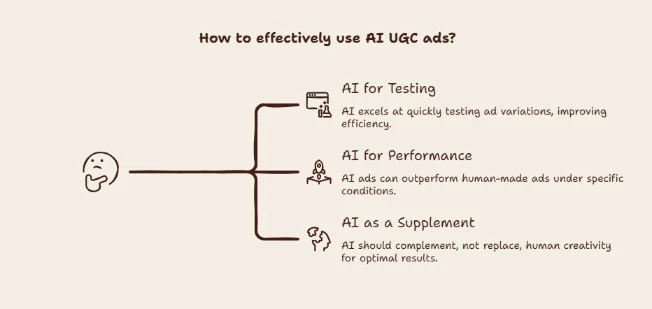
AI UGC ads work best when the brand needs speed, variation, localization, or low-risk testing before investing in heavier production. This is where AI has real value. It can help teams move from one idea to several directions quickly, then use data to decide what deserves more budget.
Here are the places where AI UGC usually makes the most sense.
Hook and Angle Testing
AI UGC is useful when a team needs to test multiple openings before investing in creator production. That might mean testing different pain points, product claims, objectives, CTAs, or first-three-second structures. A single ad script can become several versions, each built around a different message.
This is where A/B testing helps.
Each variation should test one clear hypothesis, such as whether customers respond better to a problem-first hook or a benefit-first hook
TikTok’s creative guidance says 90% of ad recall impact is captured within the first six seconds. And its performance ad recommendations suggest using 3-5 different creatives per ad group with clear differences between them.
That makes the opening angle one of the most important parts to test before putting more budget behind a creative direction.
Still, random volume is where things get messy. A/B tests should answer a specific creative question. Otherwise, your team ends up with noise instead of learning.
Localization and Market Expansion
AI can help translate, dub, subtitle, adapt, and version UGC-style ads for different markets. That is especially useful when the core concept works, but the language, cultural reference, offer, or product context needs adjusting.
For example, a fintech app might keep the same product benefit while adapting the pain point for Spain, Germany, or the UK. A beauty brand might keep the same routine structure while changing the voiceover, captions, and offer.
AI can make those changes easier, but human review still matters for nuance, tone, and compliance.
Simple Product Demos and Explainers
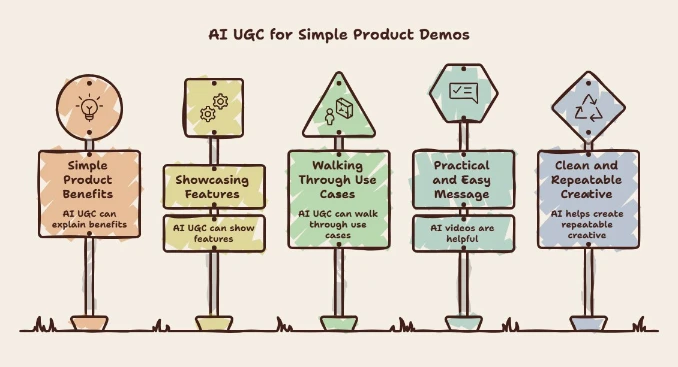
AI UGC can work well when the ad needs to explain a simple product benefit, show a feature, or walk through a use case. Think app walkthroughs, SaaS feature explainers, beauty routine steps, ecommerce demos, and subscription offer explainers.
This is also where AI videos can be helpful, especially when the message is practical and easy to understand. If the ad only needs to show how something works, AI can help teams create clean, repeatable creative.
Retargeting and Offer Testing
AI UGC can work well after someone already knows the brand. At that stage, the ad does not have to build all trust from scratch. It can reinforce benefits, answer objections, test discount angles, or show product use cases.
This is a good place to test new hooks, proof points, and offer framing. It can also help campaign growth because the audience already has some context. The ad can focus on moving people from interest to action.
Static and Image Ad Variation
AI UGC is also useful beyond video. It can support image ads, review-style graphics, testimonial-style overlays, product-in-use visuals, and creator-style stills. AI can also help turn product visuals into social-ready formats with captions, layouts, and ad presets.
This works best when the image still feels specific to the product. Generic design templates can look clean, yet still fail because the buyer does not learn anything useful.
When AI UGC Ads Don’t Work
AI UGC ads don’t work when the ad depends on trust, lived experience, emotional proof, or category-specific credibility. That is the uncomfortable part. AI can make content faster, but speed does not automatically create belief.
Here are the situations where brands need to be careful.
When Trust Matters More Than Speed
Real creator UGC is usually stronger when the ad needs a believable personal experience.
This means customer testimonials, sensitive pain points, health and wellness claims, finance decisions, and parenting products. It also includes luxury, high-ticket purchases, and any offer in which the viewer needs to believe that a real person has used the product.
This is why UGC creators still matter. They bring lived experience, personality, hesitation, imperfection, and natural delivery. Those are hard to fake well.
Plus, 95% of advertisers reported concerns about AI in creator marketing, with the biggest concern being loss of human connection.
When the Creator Looks Synthetic
AI UGC fails fast when the face, voice, gestures, or delivery feel slightly off. Even if the script is solid, a synthetic-looking creator can make the whole brand feel less trustworthy.
Also, we think a hyper-realistic voice can help, but it can also make the ad feel strange if the mouth movement, pacing, or emotion does not match.
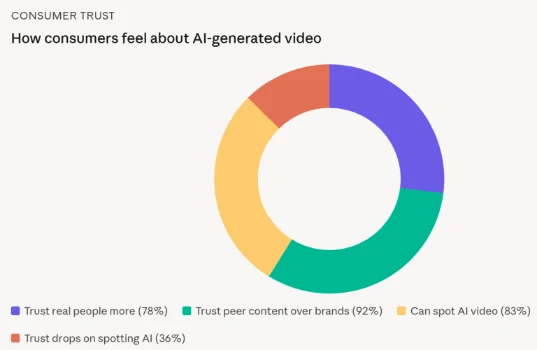
That matters because, according to Animoto research, 83% of customers claim they can recognize an AI-created video, and 36% say recognizing AI lowers their trust in the brand.
When the Script Sounds Generic
Most bad AI UGC ads fail because the message sounds like every other AI-generated ad. You have probably seen the type: big promises, fake enthusiasm, vague pain points, and a hook that could apply to any product.
An AI UGC video needs a real insight behind it. The content creator, real or synthetic, should sound like they understand the buyer’s problem. Otherwise, the ad feels like a template wearing a creator costume.
When the Brand Needs Control or Is Regulated
Premium, luxury, or highly regulated brands may need a more controlled production style. AI can help with ideation and versioning, yet fully synthetic creator ads may dilute the brand if they look careless.
Creative Milkshake’s Napper work is a useful adjacent example here. It was a studio UGC case study that showed UGC does not always need a gritty, home-filmed look.
The brand used a more polished style that still felt native and aligned with its premium positioning. That is exactly the kind of balance brands need when authenticity and polish both matter.
AI UGC vs. Real UGC vs. Studio UGC: How Should You Choose?
You should choose between AI UGC, real UGC, studio UGC, and hybrid creative based on the job each ad needs to do. AI UGC vs. real UGC is a useful comparison, but the smarter choice usually depends on funnel stage, risk, brand positioning, and how much proof the audience needs.
Each format has a place. Here are the best ways to think about them:
Creative Milkshake fits this hybrid layer better than a pure AI-generator positioning. Our work combines research, scripting, creator and studio production, post-production, and performance iteration. And that is exactly what brands need when deciding which format deserves budget.
How To Test UGC Ads With AI Without Wasting Budget
You can test UGC ads with AI without wasting budget by treating every variation as a controlled creative hypothesis. UGC ads with AI can produce a lot of output quickly, but your ad account needs structure. Otherwise, you only create scalable workloads with no clear learning.
Here are the steps for building a creative testing engine:
Start with one hypothesis: For example, people may be skipping because they do not understand the product quickly enough.
Build 3-5 hook variations: Avoid jumping straight into 20 random ads. Keep the product, offer, and audience consistent.
Test one variable at a time: Compare hook versus hook, avatar versus avatar, or CTA versus CTA.
Separate cold traffic from retargeting: AI UGC may perform differently depending on how much the audience already knows.
Measure beyond CTR: Look at thumb-stop rate, hold rate, CPC, CVR, CPA, ROAS, comment sentiment, and landing page behavior.
Graduate winners: Turn the best AI-tested angles into real creator UGC, studio UGC, or higher-quality paid social assets.
Refresh before fatigue hits: Use learnings to build the next batch, rather than more versions of the same ad.
A Superscale analysis of 50 creative variations estimates testing those variations costs around $99 with AI versus $7,500-$10,600 with traditional creators. That cost gap is why AI is so useful for early learning.
Creative Milkshake’s Body&Fit case is a useful adjacent example here because it shows the power of getting more from a single video by changing hooks, callouts, and voice-overs. This was a structured variation lesson, rather than a direct AI UGC case study, and it shows why creative learning matters more than raw output.
What Makes AI UGC Ads Feel Fake?
AI UGC ads feel fake when the creative lacks specificity, believable delivery, or a clear connection between the creator, product, and buyer.
The uncanny feeling usually starts small. Then the viewer senses that the ad is assembled from parts instead of shaped around a real customer insight.
These are the most common reasons AI UGC feels off:
The avatar does not match the audience or product.
The voice sounds too polished or emotionless.
The hook feels copied from a generic AI template.
The ad makes a personal claim that no real person can stand behind.
The product is barely shown.
The edit looks native, while the message feels vague.
The CTA is too aggressive for the funnel stage.
The same AI face or format appears too many times across the account.
Features like auto captions and a perfect background can make a creative look cleaner, but they do not fix a weak strategy. Viral UGC ads usually work because they feel specific, useful, and believable.
AI UGC should be judged by that same standard.
Compliance, Disclosure, and Brand Safety Basics for AI UGC Ads
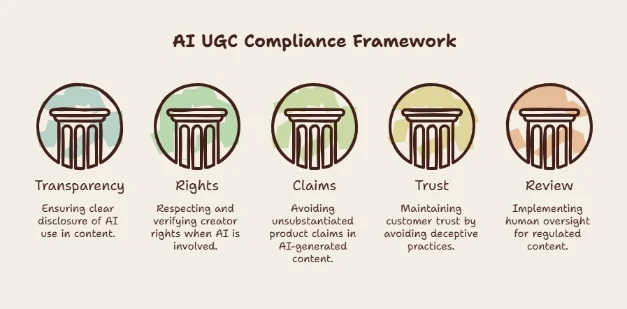
AI UGC can create efficiency, but it also creates new risks around transparency, rights, claims, and customer trust. This is especially important for regulated categories, sensitive products, and brands that rely on credibility.
So, keep the process practical.
These are the basics:
Avoid inventing fake customer experiences.
Be careful with synthetic testimonials.
Disclose AI use where required by platform, region, or brand policy.
Avoid medical, financial, or dramatic product claims without proof.
Keep a human review layer for regulated categories.
Check creator rights if AI is used to alter real creator content.
Make sure product shots and claims match the actual offer.
Monitor comments for trust signals and confusion.
AI ethics & safety standards should be part of the workflow from the beginning. Hidden synthetic content can damage trust if the viewer feels tricked, even when the ad performs well at first.
Why AI UGC Still Needs a Creative Strategy
Creative Milkshake fits into AI-assisted UGC-style ads as a performance creative partner for brands that need to decide what to test, how to produce it, and when to scale it.
We use AI-assisted research, scripting, and post-production to deliver more ad variants faster. Meanwhile, our hybrid model combines studio polish with creator-led, platform-native ads.
That distinction matters. We do not need to be positioned as a simple AI generator. The value sits in the system around the output: research, creative testing, production, performance analysis, and iteration.
AI can speed up production. The strategic value is knowing which ideas deserve to be produced in the first place.
Ready to turn AI-assisted creative into ads that actually scale? Contact Creative Milkshake today, and let’s build a smarter testing system for your next winning campaign.
FAQs
Do AI UGC ads work for image ads too?
Yes, AI UGC image ads can work when the creative uses review-style layouts, product-in-use stills, testimonial-style overlays, or localized static variations. The image still needs strong proof, a clear product context, and a CTA that matches the buyer’s stage.
How do I make UGC ads with AI for free?
You can make UGC ads with AI for free by using tools for scripts, captions, editing ideas, image drafts, and basic voiceover concepts. Free workflows can help with early content creation, but they may include watermarks, limited rights, lower quality, or weaker brand control.
Are AI UGC ads better than hiring real creators?
No, AI UGC ads are not always better than hiring real creators. AI is usually stronger for speed and variation, while real creators are stronger for credibility, lived experience, and storytelling. The best approach is to test ideas with AI, then scale winners with creators or professional studio setups.
Can I use AI UGC ads on TikTok?
Yes, you can use AI UGC ads on TikTok, as long as they feel native to the platform. Focus on sharp hooks, quick pacing, captions, visible products, direct address, and platform rules around synthetic creative. Trend awareness helps, but chasing viral videos alone rarely builds lasting performance.