


High-trust industries like healthcare, finance, and legal services operate under a different kind of pressure when it comes to paid social.
Every click carries more weight here. You’re asking people to take action on decisions that affect their health, finances, or personal security.
This changes everything.
You can’t rely on aggressive messaging or vague promises. Every ad needs to feel credible, clear, and compliant at the same time. Privacy updates and platform limitations have also reduced how precise your targeting can be.
As a result, creative has become the most important part of any paid social strategy in these industries.
At Creative Milkshake, we’ve seen this shift firsthand. As targeting becomes less reliable, creative has taken the lead in driving performance across high-trust industries.
And the data backs this up. Nielsen found that creative quality drives up to 56% of a campaign’s sales impact, while Google reports it can reach up to 70%. This makes creative a key driver of paid media performance.
If your creative doesn’t build trust quickly, your campaigns will struggle to perform, no matter how much you spend.
In this blog, we’ll cover:
What makes paid social strategy different in high-trust industries, and why traditional approaches fall short
The creative principles and formats that help you build trust and improve performance
Messaging frameworks that reduce hesitation and increase conversions
How to test, scale, and optimize creative without running into compliance issues
So, let’s get started!
What Makes High-Trust Industries Different in Paid Social Strategy
High-trust industries are different because your audience is more cautious, your messaging is more restricted, and your margin for error is much smaller. You can’t rely on aggressive tactics or broad targeting. You need to earn trust quickly while staying compliant.
This combination changes how your paid social strategy works from the ground up.
Let’s discuss this in detail:
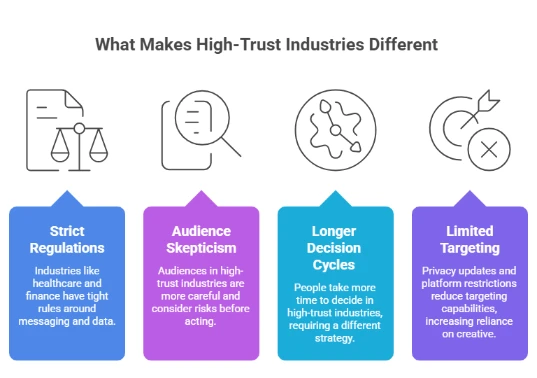
1. Strict Regulations and Compliance Requirements
You’re working within tight boundaries from the start. Industries like healthcare and finance come with strict rules around what you can say, how you say it, and even how you collect and use data.
Claims need to be accurate and verifiable. Disclaimers mostly need to be included.
And sometimes, even wording that seems harmless in other industries can land you in trouble here.
This pressure is very real.
In fact, 27% of healthcare providers say maintaining HIPAA compliance is one of their biggest ongoing challenges, which directly affects how patient data can be used in marketing.
On the financial side, compliance restrictions can reduce how much ad testing you can do by around 35%, which limits optimization and experimentation.
All of this naturally limits how creative you can get with messaging. It also means every ad needs to go through an extra layer of scrutiny before it goes live.
2. Higher Audience Skepticism and Risk Sensitivity
Your audience is naturally more careful. They don’t make impulse decisions. They consider outcomes, risks, and credibility before taking action.
And we can see that skepticism growing across the board. About 63% of consumers think companies aren’t transparent about consumer data use, which makes people more hesitant to trust what they see in ads.
So, if something feels unclear or exaggerated, they’ll scroll past without a second thought.
That’s why trust signals matter more here. Clear messaging, real proof, and a sense of credibility make a noticeable difference in how your ads perform.
3. Longer Decision-Making Cycles
People take more time to decide. They might click on your ad today, do some research, compare options, and come back days or even weeks later.
This means your paid social strategy can’t rely on quick conversions alone.
You need creative that supports the entire journey. Some ads should educate. Others should build confidence. The right combination of ads and channels is what moves people closer to a decision.
4. Limited Targeting Capabilities and Higher Reliance on Creative
Targeting isn’t as precise as it used to be. Privacy updates and platform restrictions have reduced how much control you have over audience data.
This shift has been building for a while. As Nitin Gupta, Forbes Councils Member, explains:
“Not long ago, third-party data was the savior for marketers... However, with consumers demanding transparency in how their data is collected and used, as well as the subsequent tightening of GDPR, CCPA, and other privacy laws, it is quickly becoming obsolete.”
And after Apple introduced its privacy changes with iOS 14.5, about 96% of users opted out of app tracking, which dramatically reduced the amount of data advertisers could rely on. This is a huge chunk of signal gone almost overnight.
In high-trust industries, this challenge hits even harder because you’re already working with stricter rules around data usage and audience targeting.
So what happens? Creatives have to carry more responsibility. They need to attract the right people, communicate clearly, and filter out low-intent users.
When targeting becomes less reliable, your creative needs to do more of the work.
Why Creative Drives Performance in High-Trust Paid Social Strategy
At this point, it’s clear that targeting alone won’t carry your paid social campaigns. With stricter regulations, limited data, and a more cautious target audience, your ad creative becomes the main factor that influences how people respond.
When your creative is clear, credible, and relevant, it improves click-through rates, conversion rates, and overall cost efficiency. Plus, it reduces hesitation during the customer journey, which is critical in high-trust industries where decisions take longer.
With time, creative becomes your main lever for scaling paid social media campaigns. New angles, updated ad copy, and fresh creative formats help you maintain performance and reach new audience segments without relying heavily on targeting.
Core Creative Strategies for High-Trust Industries
So, what actually makes creative work in high-trust industries? Well, it comes down to the following core principles we have shared below.
1. Clarity Over Cleverness
The fact is, clarity wins every time.
Your audience isn’t looking for witty hooks or abstract messaging. They want to understand what you offer, how it works, and whether they can trust it. If your ad creative feels confusing or too clever, they’ll move on without thinking twice.
We recommend keeping your messaging simple and direct. Your ad copy should clearly explain the value, set the right expectations, and answer basic questions upfront.
The easier it is to understand your offer, the more likely people are to engage with your paid social ads and take the next step.
Here’s a simple example. In one of our paid social campaigns for American Express, the ad opens with a clear hook: three reasons why this card is the right fit for you. It quickly highlights key benefits and keeps the message easy to follow.
2. Authority and Credibility Signals
In high-trust industries, people look for clear signs that your brand is credible.
And these signs matter more than you might think. For example, 81% of consumers say they need to trust a brand before even considering buying from it.
That’s where your creative comes in.
Your ad creative should highlight proof points like certifications, qualifications, or years of experience.
Even simple cues like “licensed,” “certified,” or “trusted by X clients” can influence how your audience perceives your brand.
Featuring experts also helps. A doctor, advisor, or specialist in your creative adds context and makes your message more believable.

In our daily practice, we have noticed that these signals help your audience feel more confident before they engage with your paid social ads.
3. Consistency Across Funnel Stages
Remember: one strong ad isn’t enough. Your messaging needs to stay consistent across the entire customer journey.
Someone might see your ad on social media, visit your landing page, and come back later through another campaign. If your messaging changes too much at each step, it creates confusion and breaks trust.
Therefore, keep your positioning, tone, and key points aligned from awareness to conversion. When people see the same message repeated across different touchpoints, it feels more reliable and easier to trust.
In the long run, this consistency helps you build confidence and moves your audience closer to taking action.
4. Compliance-Friendly Creative Execution
You can’t say whatever you want in your paid social ads. There are clear rules around how you present your offer, and ignoring them can get your campaigns rejected or even flagged.
That doesn’t mean your creative has to feel restrictive. You just need to be more precise with how you communicate.
Avoid exaggerated claims or anything that sounds unrealistic. Phrases like “guaranteed results” or “instant approval” can create compliance issues, especially on platforms like Facebook and LinkedIn Ads.
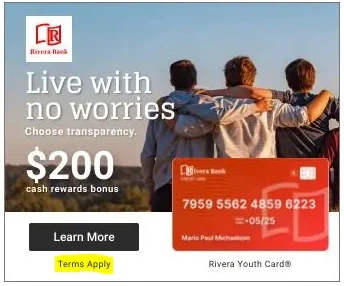
Disclaimers also play a role here. In finance, healthcare, and legal ads, you need to include important context such as eligibility, risks, or limitations.
Insider tip: The key is to include them without disrupting the flow of your ad creative. Keep them visible but not overwhelming.
You’ll also need to stay aligned with platform policies and industry regulations. For example:
Healthcare ads need to follow strict privacy and data usage rules, so you’ll see wording like “consult a licensed professional,” “results may vary,” or messaging that avoids referencing personal conditions directly.

Legal ads need to avoid misleading claims and tend to include disclaimers such as “past results do not guarantee future outcomes” or jurisdiction-specific statements, depending on where the service is offered.
Financial services ads require clear risk disclosures and can’t promise specific outcomes, which is why phrases like “subject to approval,” “terms apply,” or “capital at risk” are commonly included.
Read Next: How to Scale Paid Social Without Killing CPA.
High-Performing Creative Formats in Paid Social for High-Trust Industries
In this section, we’ll focus on execution. After all, the right ad formats make your message easier to understand and help build credibility from the first interaction. So, here’s what we recommend:
1. Educational Content Ads
Educational formats work well because they help your audience understand before they take action.
Instead of pushing for a quick conversion, you walk them through how your product or service works. This reduces confusion and builds confidence early in the customer journey.
You’ll mostly see this in formats like:
“How it works” creatives that simplify complex offerings
Carousel ads that guide users through a process or key benefits
Explainer videos that break down how a service works step by step
Below, we have shared an example of an explainer video ad by National Debt Relief:

As per our experience working with various teams, we have noticed that ads that feel informative and easy to follow drive better engagement and help people move forward with confidence.
2. Testimonial and Case Study Ads
Testimonial and case study formats show your customers the real outcomes.
Instead of explaining your value, you let your customers do it for you. This makes your ad creative feel more credible and easier to trust from the start.
This trust is backed by data as well. Around 49% of consumers say they trust online reviews as much as personal recommendations from friends or family, which shows how powerful this tactic can be.
You’ll usually see this in formats like:
Customer stories that highlight real experiences or transformations
Reviews, testimonials, or ratings shown directly in the ad
Problem and solution style creatives that walk through a real use case
Before and after visuals that clearly show the difference
Here’s a simple example. In one of our paid social campaigns for amp.ai, we used a clear before-and-after visual to show the transformation. The results are easy to understand at a glance, which makes the ad more convincing without needing complex messaging.
We have seen that these formats help your audience see what to expect and how your product or service performs in real situations. This clarity makes it easier for them to engage with your paid social ads and move forward with more confidence.
3. Expert-Led Video Content
Expert-led formats add instant credibility to your ad.
When your message comes from someone with real expertise, it feels more trustworthy and grounded. This is even more important when your audience is making decisions that involve risk or long-term impact.
You’ll usually see this in formats like:
Doctors, financial advisors, or consultants speaking directly to the camera
Talking-head videos that explain a topic, process, or solution
Expert breakdowns that simplify complex information
These formats make your ad feel more informative and reliable. They come across as guidance from someone who knows what they’re talking about.
Pro tip: Expert-led video content makes it easier for people to engage with your paid social ads because it builds trust quickly and makes complex information easier to understand. When people see a credible expert explaining something clearly, they don’t have to question the source or decode the message. That reduces hesitation, so they’re more likely to watch longer, click, or interact.
4. UGC-Style Content (With Control)
When your ad looks like something people usually see on social media, it blends in better and doesn’t feel overly promotional. This makes it easier to capture attention and hold it.
In fact, campaigns that use UGC-style content also tend to see higher conversion rates, with some reporting 29% lift in web conversions.
You’ll see this in formats like:
Creator-style videos that feel native to platforms like Instagram Reels or TikTok
Casual product demos, shopping hauls, or real-life use cases
Short-form video content that focuses on everyday experiences
For example, pharmaceutical brands like Sanofi have used influencers to create UGC-style ads where creators talk through everyday pain points and show how they use the product. The format stays simple, but the messaging is more controlled, focusing on real-life context. This makes the content easier to trust and engage with.
While this style feels natural, you still need to guide how the message is delivered.
That’s why this content is usually guided or lightly scripted. You keep the tone natural, but make sure the key points, claims, and disclaimers stay aligned with your ad creative guidelines and platform standards.
This balance between authenticity and control helps your paid social ads feel more engaging while staying compliant.
5. Risk Reversal Messaging
When someone is unsure, they don’t take action.
This hesitation is common in high-trust industries because your audience is thinking about risk before anything else. Your job is to reduce that risk as much as possible.
One way to do that is through risk reversal.
You make the next step feel safer and easier to try.
And there’s real consumer behavior behind that. 82% of consumers say free returns are an important consideration when shopping online. This shows how strongly people value having a low-risk way out.
Plus, 76% say they’re more likely to choose an option that offers an instant refund or exchange, which points to the same underlying idea: people move faster when the downside feels smaller.
In ad copy, that can show up as:
Free consultations or initial assessments
Product demos or trial access
Guarantees or easy cancellation terms
For example, in one of our paid social campaigns for Skinny Gummies, we included a clear 21-days return guarantee at the end of the ad. It gave people a safety net, which made the offer feel less risky and easier to try.
These signals make the next step feel safer. Instead of committing right away, your audience feels like they’re just exploring.
When the perceived risk goes down, engagement improves, and more people move forward in the customer journey.
Creative Testing Strategy for High-Trust Paid Social Campaigns
Once your creative is live, the focus shifts to testing and improving performance in the mid to long term.
You don’t need to test everything at once. We’ve seen that small and controlled changes give you much clearer insights than testing too many variables at once.
What to Test
Start with the elements that have the biggest impact. This usually comes down to your hook, the messaging angle, and the format of your ad.
You can test:
Trust-focused hooks versus curiosity-driven ones
Authority-led messaging versus empathy-driven messaging
Video content versus static formats
In our experience, even small changes in the hook or messaging angle can lead to noticeable improvements in click-through rates and overall engagement.
How to Structure Testing
Structure matters just as much as what you test.
Keep your tests controlled. Change one variable at a time so you can clearly see what’s driving performance. If you adjust too many things at once, it becomes difficult to track what actually worked.
We’ve noticed that keeping your campaign setup stable also makes a big difference. Consistent audience targeting and ad set structure give you cleaner insights and make performance tracking more reliable.
Scaling Winning Creative
Once you find something that works, the next step is scaling it without hurting performance.
Increase your ad spend gradually instead of making sudden jumps. This helps maintain stability as your campaigns grow.
At the same time, keep refreshing your ad creative. Remember, even strong ads lose effectiveness in time due to ad fatigue.
Insider tip: When a creative starts performing well, don’t rush to replace it. Instead, duplicate it and test small variations like a new hook, a different opening frame, or a slight change in ad copy. This helps you scale performance while still learning what actually drives results.
Here’s a quick example from our work with N26. When performance started to plateau, we shifted from polished product ads to more authentic UGC-style creative and tested multiple variations across paid social campaigns.
The results were clear. We achieved:
40% lower cost per ad recall
19% drop in cost per action intent, and
65% decrease in cost per registration.
This shows how creative variation, backed by structured testing, can drive meaningful performance improvements at scale.
Read Next: Ad Creative Testing: Methods & Best Practices.
Platform-Specific Creative Considerations
Different social media platforms respond to different types of creative, so your approach needs to adjust based on where your ads are running.
Meta Ads (Facebook & Instagram)
These platforms work well for testimonial and educational creatives. You can combine clear messaging with social proof to build trust while still driving performance. Formats like carousel ads, short videos, and reviews work well across different audience segments.
TikTok Ads
Content on TikTok needs to feel native and less polished. Creator-style videos, quick demos, and trend-aligned content perform best. Your hook matters a lot here. If you don’t capture attention in the first few seconds, people will scroll past.
YouTube Ads
This platform gives you more room to explain. Longer-form videos, expert-led content, and step-by-step breakdowns work well here. It’s a good channel for building deeper trust and supporting longer decision-making cycles.
How Creative Impacts Performance Metrics in Paid Social Strategy
Creative directly impacts key performance metrics in paid social campaigns. Strong ad creative improves click-through rates, increases conversion rates, lowers cost per acquisition, and drives better return on ad spend.
At the end of the day, everything comes down to performance.
Your creative shapes how people engage, convert, and move through the customer journey.
You’ll typically see this impact across key metrics:
Click-through rates improve with clear, trust-driven hooks
Conversion rates increase when your messaging feels credible and easy to understand
Cost per acquisition decreases as trust reduces friction
Return on ad spend improves when your creative aligns with your target audience
When your creative sets the right expectations from the start, more people engage and follow through. As trust builds, fewer users drop off, which improves overall efficiency across your paid social campaigns.
Build a High-Trust Paid Social Strategy with Creative Milkshake
Creative plays a central role in how your paid social strategy performs in high-trust industries. When your messaging is clear, credible, and consistent, it becomes easier to build trust and guide your audience through the decision-making process.
Key Takeaways
Creative has become the main driver of performance as targeting capabilities continue to decline across paid social platforms.
Clear and simple messaging helps your audience understand your offer faster and builds trust from the first interaction.
Credibility signals like certifications, expert presence, and real customer proof influence how your brand is perceived.
Consistent messaging across the customer journey reinforces trust and reduces confusion at different touchpoints.
Different creative formats serve different purposes, from education to proof to engagement.
Native and relatable content performs better on social media when it aligns with platform behavior.
Structured testing helps you identify what works, while small variations help you scale without losing performance.
Strong creative improves key metrics by increasing engagement, reducing friction, and supporting better conversion outcomes.
If you’re looking to improve your paid social strategy in high-trust industries, our team at Creative Milkshake can help you build compliant and performance-driven creative systems. We handle strategy, production, testing, and scaling with a focus on delivering creative that drives real results.
Book a strategy call with us today to build a paid social approach that combines compliant messaging, strong creative, and consistent performance.
FAQs
Why is creative more important than targeting in high-trust industries?
Targeting has become less reliable due to privacy changes and platform limitations. Creative now plays a bigger role in attracting the right audience, building trust, and driving engagement and conversions.
What types of ads work best for high-trust industries?
Educational, testimonial, and expert-led ads perform best. These formats help explain the offer clearly, build credibility, and reduce hesitation before someone takes action.
How do you stay compliant while running paid social ads?
You stay compliant by following platform policies, avoiding exaggerated claims, and using clear, accurate messaging. Including the right disclaimers and staying aligned with industry regulations also helps prevent issues.
How often should creative be refreshed?
Creative should be refreshed every 4 to 6 weeks, or earlier if performance starts to drop. Regular updates help avoid ad fatigue and keep your campaigns performing consistently.
What makes Creative Milkshake different from other paid social agencies?
We focus on building creative systems that connect strategy, production, and testing. This helps you scale paid social campaigns with consistent performance instead of relying on one-off ads.
Does Creative Milkshake handle both creative production and media buying?
Yes, our team manages both. We align creative development with paid social strategy, so your campaigns are optimized from concept to performance.