
You’re investing a serious budget into paid media, the strategy is clear, the creative is strong, and your media team is ready to launch.
And then the ad gets stuck in review.
If you’re a founder, you want control. Brand protection matters, investor perception matters, and public mistakes can be expensive.
If you’re a growth lead, you’re accountable for revenue. You measure growth weekly. You live inside CPA, ROAS, and cash flow targets.
And yet, your ad performance is being shaped by something no dashboard shows: your approval structure.
Approval loops don’t just slow production. They directly damage ad performance by limiting testing velocity, softening bold hooks, delaying data collection, and shrinking your scaling windows.
In performance media, speed creates momentum, and delays create costs.
In this article, we’ll break down exactly how approval structures hurt ad performance, why high-growth brands prioritize speed, and how to fix bottlenecks without sacrificing brand control.
P.S.: And if you already suspect your approval process is limiting growth, it may be time to rethink how your creative system is structured. That’s exactly what we help brands solve at Creative Milkshake.
TL;DR
If you’re short on time, here’s the short version:
Approval loops reduce ad performance by limiting creative volume and testing velocity.
Sequential reviews delay launches and slow algorithm learning.
Softened messaging weakens CTR and conversion rates.
Fewer iterations mean higher CPA and lower scaling potential.
60% of creative professionals spend up to one full day per week chasing approvals.
75% say delayed approvals directly waste team budgets, which translates into wasted media opportunities.
High-growth brands use single decision owners and time-boxed feedback cycles.
Speed and volume improve ad performance; friction reduces it.
Your approval process is either compounding results or quietly draining them.
What an Approval Loop Really Looks Like in Performance Media
Approval loops sound responsible, structured, and mature.
In practice, most of them are slow, fragmented, and misaligned with how performance media works.
Here’s what that usually looks like:
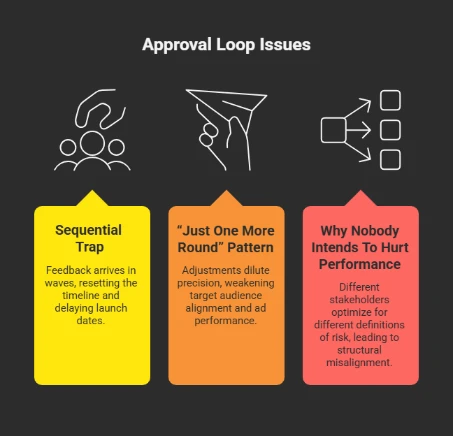
The Sequential Trap
In most teams, the process begins with creative building the ad concept and producing the first draft. From there, it moves to performance for platform alignment and media considerations, then to brand for tone and positioning checks.
After that, legal may review compliance details, and finally, leadership steps in with final input before launch.
Individually, each step makes sense. The problem is not the people involved; it is the sequence.
Feedback rarely arrives at the same time; instead, it comes in waves.
Creative revisions are made, timelines shift, and just as the team feels ready to launch, another stakeholder introduces additional changes.
The process resets, and momentum quietly disappears.
As a result, launch dates shift, media plans need adjusting, and time-sensitive offers lose impact. Meanwhile, competitors are already testing variations, collecting data, and iterating.
The deeper issue is structural misalignment. Performance media runs on rapid iteration, real-time feedback, and constant optimization.
Sequential approval chains were built for static brand campaigns, not rapid testing cycles on Meta Ads or Google AdWords.
Every additional round does more than extend a timeline. It slows down learning cycles, reduces testing volume, and limits how quickly a campaign can scale.
Over time, that delay shows up directly in performance results.
The “Just One More Round” Pattern
This is where performance starts to weaken.
The adjustments seem harmless at first glance: headlines get softened, claims become more cautious, visuals are simplified, and CTAs turn more conservative.
Individually, none of these adjustments feels risky. But collectively, they dilute precision.
Bold hooks become neutral. Specific targeting becomes broader to “avoid alienating anyone.” Clear positioning gets generalized to appeal to everyone, which usually means it connects with no one.
This weakens the target audience alignment. And in performance media, specificity drives engagement.
Data supports this. CreativeX analyzed 1.8 million video ads across $2.4 billion in media spend and found that every 10 percentage point improvement in Creative Quality Score led to a 6.3% reduction in cost per completed view.
Here’s the implication:
Platforms reward clarity and strong creative signals. If your approval loop consistently loses clarity or slows iteration, you’re suppressing the signals platforms use to prioritize your ads.
Remember that quality and speed work together. Strong creative needs space to stay sharp, and performance needs the freedom to evolve quickly.
Why Nobody Intends to Hurt Performance
It is important to recognize that approval loops rarely exist because someone wants to slow down growth.
In most cases, every stakeholder involved is acting responsibly based on their role.
A brand protects its reputation, legal reduces exposure, leadership wants oversight, and growth teams focus on revenue targets and scaling velocity.
Everyone is optimizing for a different definition of risk.
Founders focus on long-term positioning and public scrutiny. Growth leads focus on weekly revenue, CPA trends, and scaling velocity. Both perspectives are rational, and both are necessary for a healthy business.
The friction appears when those incentives aren’t aligned around a shared operating model. The misalignment is more structural.
When risk avoidance consistently outweighs experimentation, campaigns move more slowly.
Paid media platforms reward systems that test, learn, and adapt faster than competitors. A structure built primarily to prevent mistakes can unintentionally limit performance.
P.S.: This dynamic becomes more visible with UGC-style creative. Strong UGC hooks don’t scale through committees. If every bold angle gets softened in review, performance suffers before launch.
How Approval Loops Reduce Ad Performance in Practice
Approval loops don’t just create internal frustration. They have a measurable impact on your performance media engine.
And here’s the worst part: you won’t see “approval friction” inside Meta Ads Manager or Google AdWords.
What you’ll see instead are the symptoms that follow:
Lower CTR.
Higher CPA.
Stalled learning phases.
Fatigued creatives.
Those outcomes rarely begin inside the ad account. They mostly start upstream in the operating model that controls how quickly creative can move.
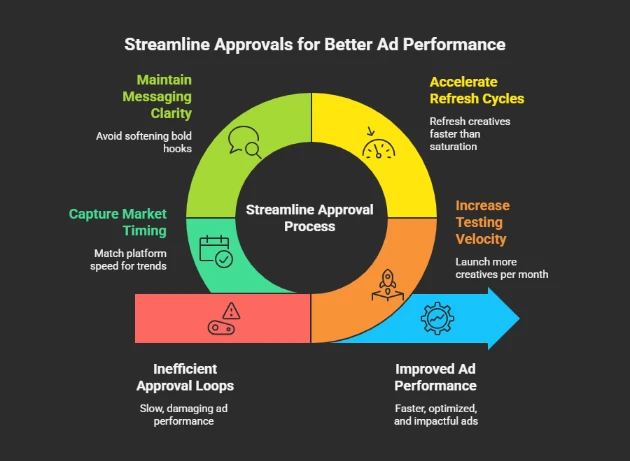
Let’s break this down operationally.
Ad performance improves through speed and volume. Platforms reward signal density. So, the faster you test, the faster you optimize. And the more variations you run, the stronger your data.
Approval loops directly reduce both speed and volume.
1. Fewer Creative Tests Per Month
If your team needs multiple stakeholders to sign off on every iteration, testing velocity drops. Instead of launching 20 creatives, you launch 6. Instead of weekly drops, you go monthly.
With limited variation entering the account, the algorithm has less data to learn from. Optimization slows, and scaling decisions rely on weaker signals.
This pattern appears across platforms. Buffer analyzed 11.4 million TikTok posts across 150,000 accounts and found that posting 6–10 times per week resulted in 29% more views per post compared to once weekly. However, posting 11+ times led to 34% more views.
Different platform, but same principle: volume compounds visibility.
If that dynamic holds for organic distribution, imagine what reduced iteration does to paid campaigns where you’re competing in auctions.
2. Slower Creative Refresh Cycles
Creative fatigue is inevitable in paid media because audiences respond to novelty and quickly tune out repetition. When approval timelines stretch into weeks, refresh cycles fall behind audience saturation.
As frequency increases and new variations do not enter the account fast enough, click-through rates begin to decline. Conversion rates soften, and cost per acquisition gradually rises.
And because you’re launching less frequently, you collect data more slowly. That delay pushes optimization decisions further out, which means algorithms stabilize later than they should.
When stabilization slows, scaling windows narrow and opportunities to capitalize on strong performance become shorter.
Over time, the effect compounds. Slower refresh cycles reduce testing speed, delayed testing weakens learning, and weaker learning limits scale.
As Brian Bowman, a former Forbes Councils Member, explains:
“Heavy, constant creative testing is necessary to uncover winning ads that significantly improve ROAS. Large direct response advertisers are testing hundreds of creatives and must deliver a steady supply of new concepts to avoid ad fatigue and maintain positive ROAS at scale. Top-performing ads often last fewer than 30 days, which means continued testing is necessary to offset natural performance decline.”
3. Messaging Dilution
Messaging dilution is one of the quieter side effects of long approval cycles.
As feedback stacks, bold hooks soften. Clear positioning becomes more generalized to satisfy multiple perspectives. Strong claims lose urgency after legal revisions and executive edits.
The ad may feel safer internally, yet performance usually declines because specificity and tension have been reduced.
That's why platforms are already algorithmically prioritizing better-built creatives. If your internal structure weakens clarity or slows iteration, you’re fighting both internal friction and external AI selection systems.
4. Lost Market Timing
Timing matters more than most teams realize. Trends move quickly, and cultural moments rarely align with internal calendars.
The Typeface Signal Report found that teams experiencing burnout were 230% more likely to miss cultural or viral moments.
Meanwhile, 71% of organizations with over 1,000 employees need more than a day to approve real-time content, and 27% need more than a week.
In performance media, even a week can erase an opportunity.
If your approval loop can’t match platform speed, your competitors capture the attention first.
The core takeaway is simple: ad performance improves through speed and volume. Approval loops reduce both.
And the platform doesn’t care why you’re slow.
P.S.: Creative testing only works when approval speed matches testing ambition. If you can’t launch consistently, ad performance plateaus.
How to Streamline Your Ad Approval Process for Better Performance
If approval loops are structural, fixing them requires structural changes.
Based on our experience, high-growth brands redesign it around speed, accountability, and controlled experimentation. They recognize that ad performance depends on iteration volume, not perfection before launch.
Let’s see what that looks like in practice:
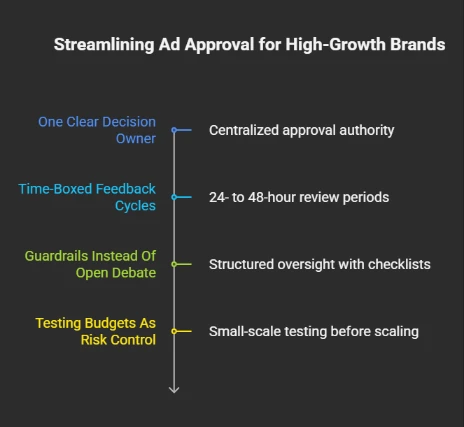
1. Assign One Clear Decision Owner
The most effective change is defining ownership.
Instead of 5 stakeholders with implicit veto power, designate one accountable decision owner. Input remains welcome, and discussion can happen, but final approval authority sits with only one person.
This removes the silent reset problem where a late-stage feedback restarts the entire process.
It also clarifies the common goal. Is the objective brand safety at all costs? Or is it a measurable ad performance within predefined guardrails?
We have learned that when your goal is explicit, reviews become more focused rather than open-ended.
Centralized accountability stabilizes timelines, and deadlines become real instead of flexible suggestions. As a result, creative teams stop operating in anticipation of endless revisions.
In fact, data shows that agencies that streamline approval workflows report up to 40% faster campaign launches. Faster launches mean faster data collection, which improves optimization cycles.
2. Set Time-Boxed Feedback Cycles
From what we’ve seen working with various growth teams, is that open-ended review windows are silent performance killers.
When feedback does not have a defined deadline, approvals stretch, and momentum fades.
High-growth teams use 24 to 48-hour review cycles. Feedback is consolidated, comments are specific, and silence is treated as approval once the deadline passes.
That last rule alone changes behavior.
When stakeholders know that delayed input means launch proceeds, urgency increases, decisions become more focused, and over-analysis decreases.
In performance media, a delay of several days can narrow scaling windows and reduce early traction.
Time-boxing review cycles align internal processes with the pace of digital platforms.
3. Define Guardrails Instead of Debating Every Detail
Many brands try to maintain control through open-ended review conversations. A more effective approach is to define clear guardrails in advance.
Our team at Creative Milkshake uses a structured approval framework that includes:
Claims checklists
Compliance frameworks
Brand voice boundaries
Visual standards
Approved messaging hierarchies
Once those guardrails exist, creative teams operate within them. Review shifts from subjective preference to checklist validation.
This removes the emotional layer of “I don’t like this” and replaces it with “Does this violate our framework?”
It also reduces dependency on fragmented tools. If feedback lives across Slack threads, email chains, and scattered docs, revision cycles multiply. Consolidated systems shorten them.
The goal is a structured oversight.
4. Control Risk with Structured Testing Budgets
Many teams view risk in performance media as something to avoid.
A more practical perspective is recognizing that under-testing usually creates a larger long-term risk.
Instead of debating hypothetical downsides before launch, we suggest starting with controlled exposure. Allocate limited testing budgets, measure early performance signals, scale what works, and pause what does not.
This is how platforms like Meta and Google AdWords are designed to work. The system rewards experimentation within defined limits rather than waiting for universal internal confidence.
Controlled testing reduces exposure while still generating real market feedback. You do not need full organizational certainty before launch; you just need defined guardrails and measurable thresholds.
Monotype’s Scaling Creative Operations survey found that 57% of creative teams spend more than a quarter of their time on non-creative tasks like compliance checks and workflow bottlenecks.
That time reduces creative output and limits testing capacity.
If your team spends more time chasing approvals than producing and testing creative, ad performance slows before the algorithm even has a chance to optimize.
Remember that high-growth brands protect reputation through structure and protect revenue through speed.
With the right system in place, both priorities can operate together.
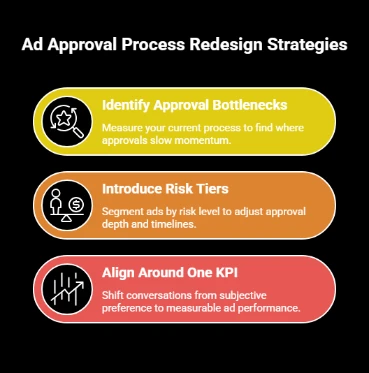
3 Effective Strategies to Redesign Your Approval Process for Stronger Ad Performance
If you want stronger ad performance, start by auditing the system itself. These could be a good starting point:
1. Identify Where Approvals Slow Momentum
First, measure your current process.
How long does it take from first draft to launch?
How many stakeholders are involved?
How frequently do revisions reset timelines?
How many approval rounds occur on average?
Data shows how common this friction is. StreamWork’s 2025 Approval Survey found that 60% of creative professionals spend up to one full day each week chasing approvals. Meanwhile, 85% report approval delays beyond planned timelines, and 75% say delayed approvals directly waste team budgets.
When a significant portion of team capacity goes toward approval coordination, creative output naturally declines. Reduced output limits experimentation, and limited experimentation weakens performance over time.
2. Introduce Risk Tiers
Not all ads carry equal risk.
So why do they require identical approval depth?
Introduce tiers:
Tier 1: standard performance ads with lighter review requirements and faster turnaround.
Tier 2: aggressive claims or new angles that require moderate review and defined guardrails.
Tier 3: brand-level or high-visibility campaigns that involve executive oversight and extended review timelines
Each tier has different review intensity and timeline requirements.
Standard performance ads shouldn’t require executive sign-off every time, as it unnecessarily slows testing cycles.
Higher-risk campaigns can still maintain deeper review structures where scrutiny genuinely matters.
Risk segmentation allows you to protect your reputation while maintaining the speed required for sustained performance.
3. Align Around One KPI
Remember that strong approval systems align around a measurable outcome.
Shift conversations from “Do we like this?” to “Does this improve ad performance?"
This question reframes feedback around measurable outcomes.
Growth leaders already track CPA, ROAS, and contribution margin. And founders track long-term positioning. The bridge between them is data.
If you anchor approval discussions around performance impact instead of subjective preference, friction decreases.
You also eliminate endless creative debates that don’t connect to revenue.
Performance media thrives on iteration. Approval systems should support that, not slow it down.
P.S.: At Creative Milkshake, our performance-driven process is designed around this principle. Defined workflows, clear ownership, and KPI alignment ensure that creative testing moves quickly while staying accountable to business results.
Build Faster-Moving Campaigns with Creative Milkshake
Approval structures need to evolve to match the pace of performance media.
In performance media, creatives, algorithms, and competitors move fast. If your internal process doesn’t operate at the same speed, ad performance weakens no matter how strong your media buying is.
At Creative Milkshake, we focus on closing that operational gap.
We work with brands and growth teams to redesign approval workflows around real testing velocity and measurable outcomes.
This includes clarifying decision ownership, setting practical guardrails, and aligning reviews with defined performance metrics instead of subjective preference. Brand protection remains intact, while experimentation continues at the speed required to compete.
If your current approval process limits how quickly you can act on performance data, it may be time to rethink the structure behind it.
If you are ready to strengthen both your process and your creative output, let’s talk.
FAQs
What Affects Ad Performance?
Ad performance depends on creative quality, testing velocity, targeting, budget structure, and technical setup. Strong CRM and revenue data feedback loops also matter. When approvals slow launches or reduce iteration, results weaken before meaningful data even accumulates.
Why Do Social Media Graphics Get Stuck in Approval Loops?
Approval loops usually stall because ownership is unclear and feedback arrives in separate rounds. Without a single decision owner and time-boxed reviews, revisions stack up, and timelines quietly slip.
What Is the Biggest Challenge in the Approval Process?
The biggest challenge is misalignment. Brand teams focus on risk, growth teams focus on revenue, and leadership looks at long-term impact. Without a shared KPI, approvals default to caution instead of experimentation.
What Are the Types of Approval?
Most performance approvals fall into three tiers: standard testing ads, higher-risk claims or new angles, and brand-level campaigns. When every campaign receives the same review intensity, testing slows unnecessarily.
Does Faster Approval Always Lead to Improved Ad Performance?
Not on its own. Speed without structure can create compliance issues or tracking gaps. Structured speed, with clear ownership and defined guardrails, improves performance while protecting the brand.
How Does Creative Milkshake Help Reduce Approval Bottlenecks?
Creative Milkshake redesigns approval workflows to increase testing velocity. We clarify decision ownership, implement risk tiers, streamline feedback cycles, and align performance tracking with business goals.
Can Creative Milkshake Improve Ad Performance Without Increasing Ad Spend?
Yes. Stronger performance often comes from faster iteration and better signal quality rather than larger budgets. When approvals stop restricting testing, platforms receive cleaner data and optimize more effectively.