Media buying is far more complex today than it was a decade ago. There are more channels, more formats, and more decisions to make at every stage. It’s no longer limited to purchasing ad space. You’re dealing with multiple platforms that all work differently.
Global advertising spend crossed $1 trillion in 2025, and most of that now goes into digital. Your budget likely flows through platforms like social media, search, Connected TV, and retail platforms. And each comes with its own rules, data limitations, and optimization levers.
More options can easily lead to poor decisions. Many brands spread budgets too thin, chase impressions instead of outcomes, or depend too much on automation without a clear strategy.
So, the first step is to understand the different types of media buying, what they offer, and how they align with your business goals. That’s what you’ll learn in this guide.
TL;DR
Media buying today spans multiple channels, formats, and systems, so strategy matters more than ever.
Core buying types include direct, programmatic, RTB, and private marketplaces, each with different levels of control and scale.
Programmatic dominates digital advertising, but requires strong tracking and setup to avoid wasted spend.
Search and retail media capture high-intent demand, which makes them key for conversion-focused campaigns.
Paid social drives discovery and engagement, but performance depends heavily on creative quality.
Display and native ads work best for awareness and retargeting, not direct conversions.
Audio, podcast, and DOOH expand reach beyond screens and support omnichannel strategies.
Retail media, CTV, social commerce, and AI-driven buying are the fastest-growing areas to watch.
The right media mix depends on goals, budget, data access, and industry, not trends.
Long-term success comes from building a connected system across channels, data, and creative.
P.S. Not sure which media buying approach will actually drive results for your brand? Creative Milkshake builds data-backed creative and paid media systems that help you choose the right channels and scale profitably.
Media Buying Types: A Quick Review
Core Types of Media Buying
The foundational types of media buying essentially absorb all the different options your marketing team has. For most brands, one core type is typically enough to orchestrate a strong media-buying strategy, but for some, a combination may be necessary.
Let’s look at each and their use cases, strengths, and tradeoffs.
Direct Media Buying
Direct media buying involves negotiating and purchasing ad space directly from a publisher or media outlet. This could mean premium homepage takeovers, sponsorships, newsletter placements, or even traditional TV advertising and radio slots.
For example, brands like Nike still negotiate high-impact homepage placements with major publishers like The New York Times or secure television airtime during major events, such as, the Super Bowl.
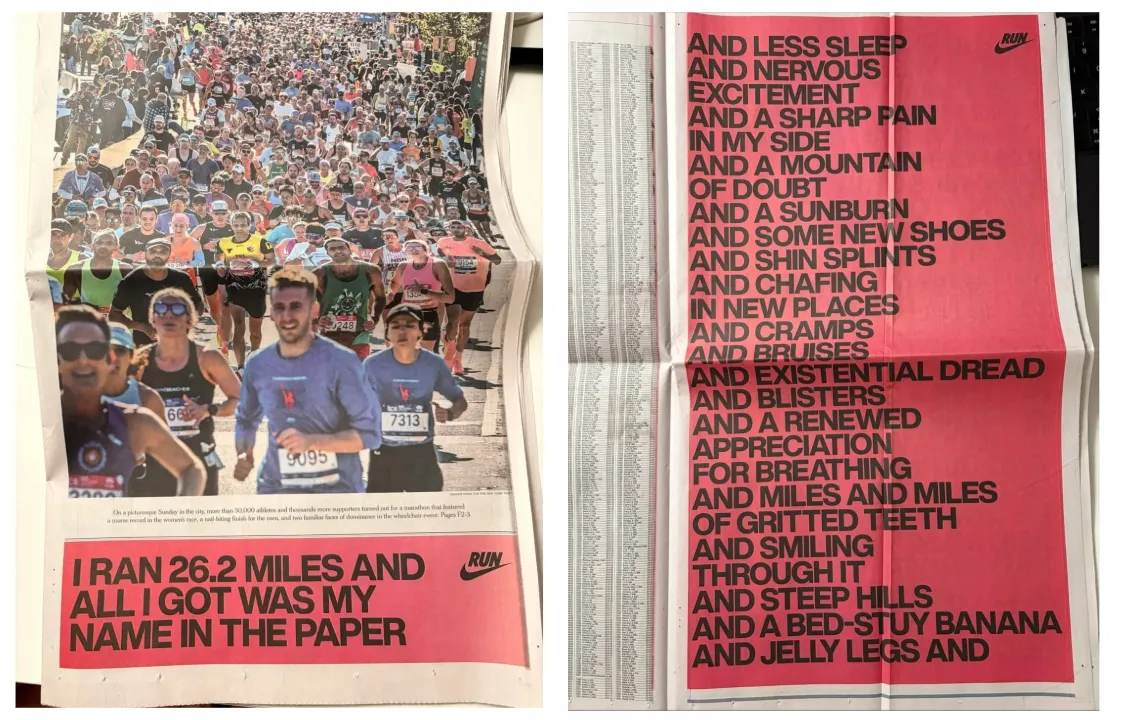
Direct placements can deliver higher brand recall than standard programmatic display ads. That’s especially the case with premium media, environments with higher brand recognition and quality content.
Premium media placements are 50% more effective at positive perceptions and 30% more effective at driving stronger purchase intent.
You typically execute direct buys through an insertion order, locking in specific placements, pricing, and impressions upfront.
Pros
Full control over ad placements and context
Access to premium, brand-safe media inventory
Strong for brand awareness and high-impact campaigns
Cons
Limited flexibility once campaigns go live
Requires manual negotiation and relationship management
Higher costs compared to automated programmatic options
Programmatic Media Buying
Programmatic media buying automates the purchase of digital media using software and algorithms. Instead of negotiating manually, you use media-buying or demand-side platforms such as Google Display & Video 360, Amazon DSP, or The Trade Desk to access vast ad inventory across websites and apps.
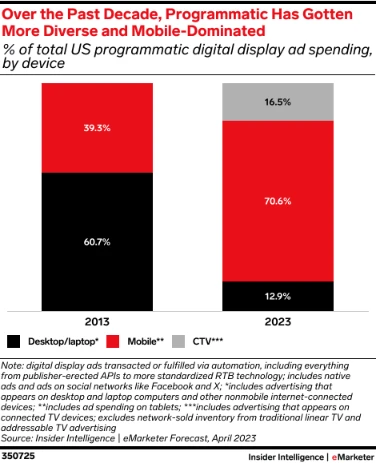
In fact, programmatic now accounts for the majority of digital display advertising in the U.S., 90% to be exact.
These platforms allow you to manage campaigns, targeting, and measurement from a single interface while reaching users across multiple channels.
If done right, it can be highly efficient for large-scale display and video campaigns, particularly on mobile. As of 2023, most programmatic spend goes toward mobile devices, where your audience may be.
Pros
Scalable access to massive ad inventory
Advanced targeting using audience data and behavior signals
Real-time optimization based on campaign performance
Cons
Less transparency in where ads appear (risk of being blocked or misplaced)
Requires a strong ad tech stack and expertise
Can lead to wasted spend without a proper tracking setup
Real-Time Bidding (RTB)
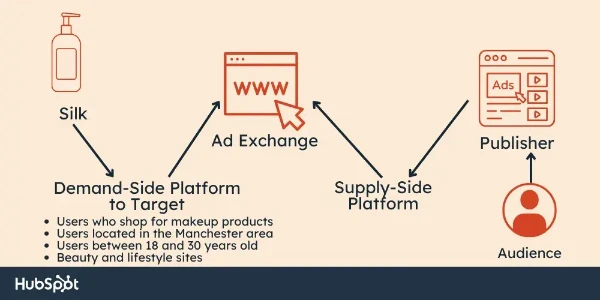
Real-time bidding is a subset of programmatic buying, in which ad impressions are auctioned in milliseconds via ad exchanges. Each time a user loads a page, demand-side platforms bid on the available advertising space. That’s how it also works with Google Ads and Bing Ads.
For example, when running display campaigns in Google Ads, your ads are competing in real-time bidding auctions for each impression.
In our daily practice, we have noticed that RTB is highly effective when paired with retargeting ads and strong performance signals. This is particularly important in lower-funnel campaigns where discovery is the goal.
Pros
Cost-efficient bidding based on the real-time value of each impression
Ideal for performance-driven advertising campaigns
Enables granular targeting and dynamic optimization
Cons
High competition can inflate costs in valuable segments
Vulnerable to ad fraud and low-quality inventory
Requires constant monitoring of cost metrics and KPIs
Private Marketplaces (PMPs)
Private marketplaces sit between direct and open programmatic media buying. Publishers offer exclusive ad inventory to selected advertisers via invite-only auctions.
For example, a premium publisher like Forbes may offer a PMP deal where only selected media buyers can bid on its audience. Platforms like The Trade Desk and Amazon DSP facilitate these deals.
PMP deals may deliver higher viewability rates than open exchange buys, simply because publishers have large, niche audiences. That makes them valuable for brand-focused campaigns, but also more expensive.
Pros
Higher-quality, brand-safe media inventory
Better transparency compared to open exchanges
Strong balance between automation and control
Cons
Higher cost than open programmatic buys
Limited scale compared to open exchanges
Requires relationships or access via media buying agencies
Channel-Specific Media Buying Types
The next layer is choosing the right media channels. Each channel behaves differently in terms of targeting, cost structure, and impact across the funnel, so your media buying strategy must adapt accordingly.
For simplicity, we’re exclusively focusing on digital channels.
Search Media Buying
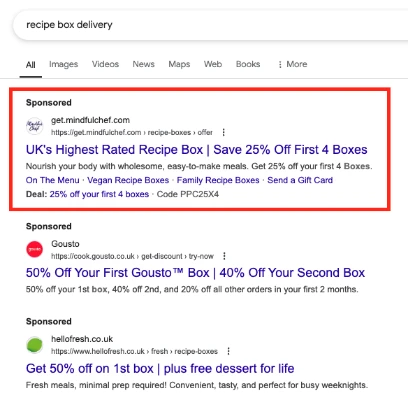
Search is still the highest-intent channel in digital marketing, where you capture demand rather than create it. Through search engines like Google, you bid on keywords and appear on search engine results pages (SERPs) using pay-per-click ads.
Google reports that businesses average $2 in revenue per $1 spent on Google Ads.
We have seen the best results when keywords align with campaign objectives (e.g., transactional vs. informational intent), landing pages are optimized for conversion, and campaigns are clearly structured by intent.
Pros
High-intent traffic with strong conversion rates
Clear attribution and measurable KPIs
Scalable with proper keyword expansion
Cons
Rising CPCs in competitive industries
Limited for upper-funnel brand awareness
Requires continuous optimization of bids and ad copy
Social Media Buying
Social media platforms like Meta, TikTok, and LinkedIn dominate attention-based advertising campaigns, particularly for discovery and engagement. This is where paid social comes in, combining creative storytelling with precise audience targeting.
With seriously massive audiences, social media has become a must for most media buyers, whether they do it manually or programmatically.
Just look at the numbers. Instagram has 3 billion active users globally. Other platforms like TikTok, Snapchat, and LinkedIn aren’t far behind. These platforms offer a massive audience.
The ROI from these channels depends on several factors. But most marketers (54%) consider Facebook to deliver the highest ROI.
Pros
Advanced targeting using behavioral and interest data
Strong for engagement and mid-funnel nurturing
Highly visual, ideal for storytelling and creative production
Cons
Creative fatigue can reduce performance quickly
Attribution challenges due to privacy changes
Platform volatility (algorithm changes, rising costs)
This is where Creative Milkshake shines. We help you run revenue-focused paid social campaigns with creator-generated images and videos. Check out case studies.

Display Advertising
Display, again, is a foundational format in programmatic advertising. It lets you reach users across websites via banners, video, and rich media. And you can buy display ad space in so many ways, depending on your target audience, budget, and goals.
Despite channels like social media dominating the middle and lower-funnel marketing, display is still quite relevant, at least for discovery. HubSpot’s 2026 State of Marketing report found 27% of marketers use display ads as part of their marketing strategy.
Insider tip: In our experience, display works best when paired with retargeting and strong audience segmentation. Otherwise, you risk spending money on clicks that don’t translate to revenue impact.
Pros
Massive reach across the web
Effective for retargeting and frequency building
Supports upper- and mid-funnel campaigns
Cons
Lower click-through rates compared to search
Banner blindness reduces engagement
Risk of low-quality media inventory without proper controls
Native Advertising
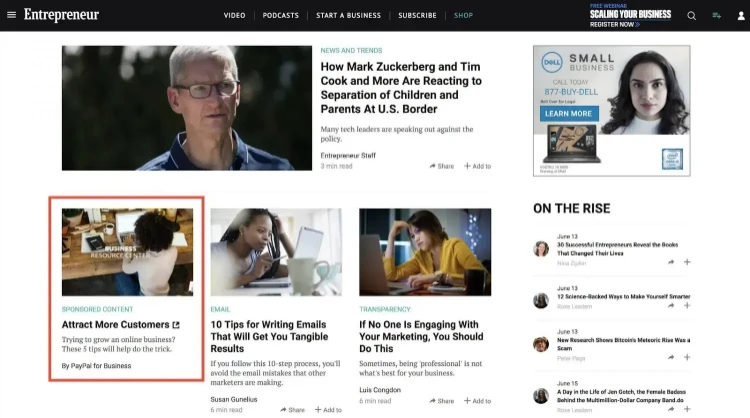
Native ads blend into the content experience, for example, sponsored articles or in-feed recommendations. They’re supposed to be non-intrusive and match the user experience.
Platforms like Taboola and Outbrain dominate this space. According to Outbrain, native ads generate 53% more views than traditional display ads, which makes them effective for content-driven strategies.
We’ve seen that SaaS brands mostly use native advertising to drive email signups and top-funnel education, typically done through articles, as PayPal did in the example below.
Pros
Non-disruptive format improves engagement
Strong for storytelling and educational content
Higher trust compared to traditional display
Cons
Requires high-quality content to perform
Lower direct conversion rates
Can be misaligned if the content doesn’t match the user's intent
Audio & Podcast Media Buying
Audio is growing big time, particularly through Spotify and podcast networks. It allows you to reach users in moments when visual channels can’t, such as during commutes, workouts, or multitasking.
In fact, eMarketer reports that digital audio ad spend in the U.S. alone surpassed $7 billion, with steady year-over-year growth. This is hardly surprising given the massive popularity of podcasts.
Audio ads can be part of programmatic media buying. They can also be a direct buy, especially if you want the podcast hosts to read the ads.
And if the podcaster also publishes video, you get exposure on platforms like YouTube, too. This is why brands sometimes combine programmatic audio with host-read podcast ads for better authenticity and recall.
Like search, this format is also great for increasing visibility. 69% of listeners say they’re introduced to new products through ads in podcasts.
Pros
High engagement and attention retention
Less competition compared to the visual channels
Strong for niche audience targeting
Cons
Limited direct attribution
Creative production requires strong scripting
Not ideal for immediate conversions
Digital Out-of-Home (DOOH)
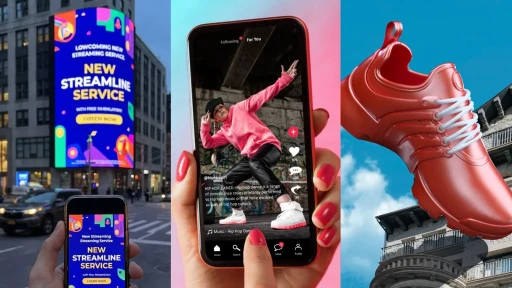
Out-of-home has gone digital. The screens in malls, airports, and city centers are dynamic ad spaces that brands can use to grab attention. Of course, it’s not as fine-tuned or targeted as paid social or audio, but it’s still a powerful medium for increasing brand awareness.
DOOH can now be bought programmatically, allowing real-time optimization similar to online channels.
It’s now a massive industry, worth over $9 billion, which shows marketers are flocking to it. And consumers are buying what they show. 73% favor this format.
DOOH can form part of a multichannel strategy that targets the audience at different levels. For example, retail brands sync DOOH campaigns with mobile retargeting to reinforce messaging across devices (via geotargeting).
Pros
High visibility and strong brand awareness impact
Increasing integration with programmatic systems
Works well in omnichannel strategies
Cons
Limited granular targeting compared to digital channels
Measurement can be less precise
Higher entry costs for premium locations
Media Buying Types to Watch in 2026 and Beyond
The next wave of media buying is being shaped by privacy changes, platform consolidation, and AI-driven automation.
Some channels are climbing the ranks and gaining media-buyer attention. Similarly, optimization is becoming the name of the game as marketers and media buyers face increasing pressure to drive results.
Below, we have shared the most important emerging and fast-growing buying types you should actively evaluate.
Retail Media Buying
Retail media has quickly become one of the most powerful forces in digital marketing for e-commerce and CPG brands. Platforms like Amazon Ads, Walmart Connect, and Instacart allow you to buy advertising space directly within shopping environments using high-intent audience data.
This means your ads appear closer to the point of purchase, where users are already in a buying mindset. This direct connection to transaction data gives retail media a clear advantage over traditional programmatic channels.
That’s why around 65% of marketers said that retail media will play a bigger role in their media mix. These ads also receive the most attention of all, according to a Capgemini study.
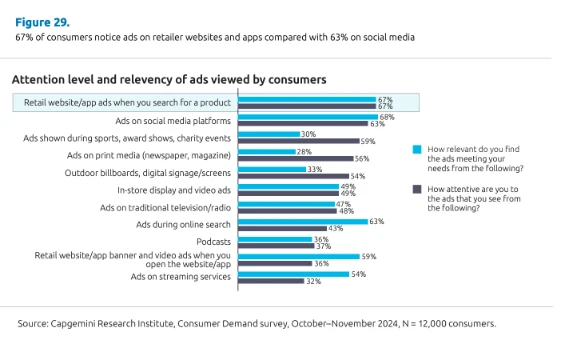
In practice, brands using retail media networks see:
Higher conversion rates due to proximity to purchase
Stronger ROAS compared to paid social in bottom-funnel campaigns
Better attribution using first-party purchase data instead of relying on third-party cookies (which are slowly dying anyway)
Connected TV (CTV) & OTT Buying
Connected TV and OTT (over-the-top) media are the next big thing in advertising. These are replacing TV advertising as more people flock to Smart TVs and streaming services.
CTV ad spending is poised to account for 40% of global ad spend by 2030.
Brands can even buy premium ad inventory on platforms like Hulu, Roku, and YouTube. Unlike traditional TV, CTV and OTT ads come with the possibility of targeting and monitoring (like you do with social video ads):
You combine the storytelling power of television with programmatic buying precision
You can target households using first-party data and behavioral signals
You can track outcomes beyond impressions (ROAS, CPA, completion rate, view-through attribution, etc.)
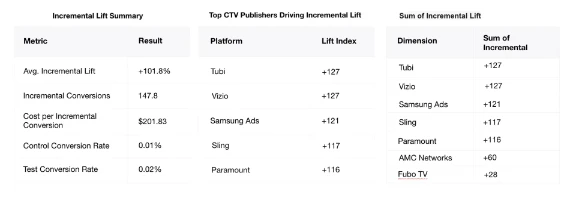
We’ve seen brands improve branded search lift after adding CTV to their mix, particularly when synced with search and paid social campaigns. One brand that combined both linear and CTV saw a 101% lift in conversions (shown by the platforms in the figure below).
Social Commerce Media Buying
Social platforms aren’t just discovery engines. In fact, they are full-funnel commerce ecosystems. That’s thanks to features like TikTok Shop, Instagram Checkout, and Pinterest Shopping that let users convert without leaving the platform. It’s already driving over $87 billion in sales annually.
This shift is redefining advertising campaigns, as ad placements now sit directly inside the purchase journey. For the marketing team, this shortens the sales funnel approach dramatically.
But to win in social commerce, you need optimized ad creatives and visuals to drive instant conversions. That’s because the goal is not just to create awareness but to convert on the spot. And that requires a little more maneuvering.
Also, use platform-native tools like pixels, conversion events, and in-app checkout data to improve performance.
Read Next: Best Agencies for TikTok Shop Advertising - Expert Rankings
Influencer & Creator-Led Media Buying
Influencer marketing has evolved into a structured media buying approach. Creators now act as both distribution channels and content producers, which allows you to reach audiences through trusted voices and platform-native formats.
Instead of just paying for reach, you are effectively buying:
Trust within a specific target audience
Native content that performs better than traditional ads
Built-in distribution across multiple media outlets (TikTok, YouTube, Instagram)
Data shows that businesses earn an average of $5.78 for every $1 spent on influencer campaigns.
From what we have seen, brands get the most value when creator content is integrated into paid social campaigns. This is where many teams fall short. They treat influencer content as a one-off collaboration instead of using it as a scalable performance asset.
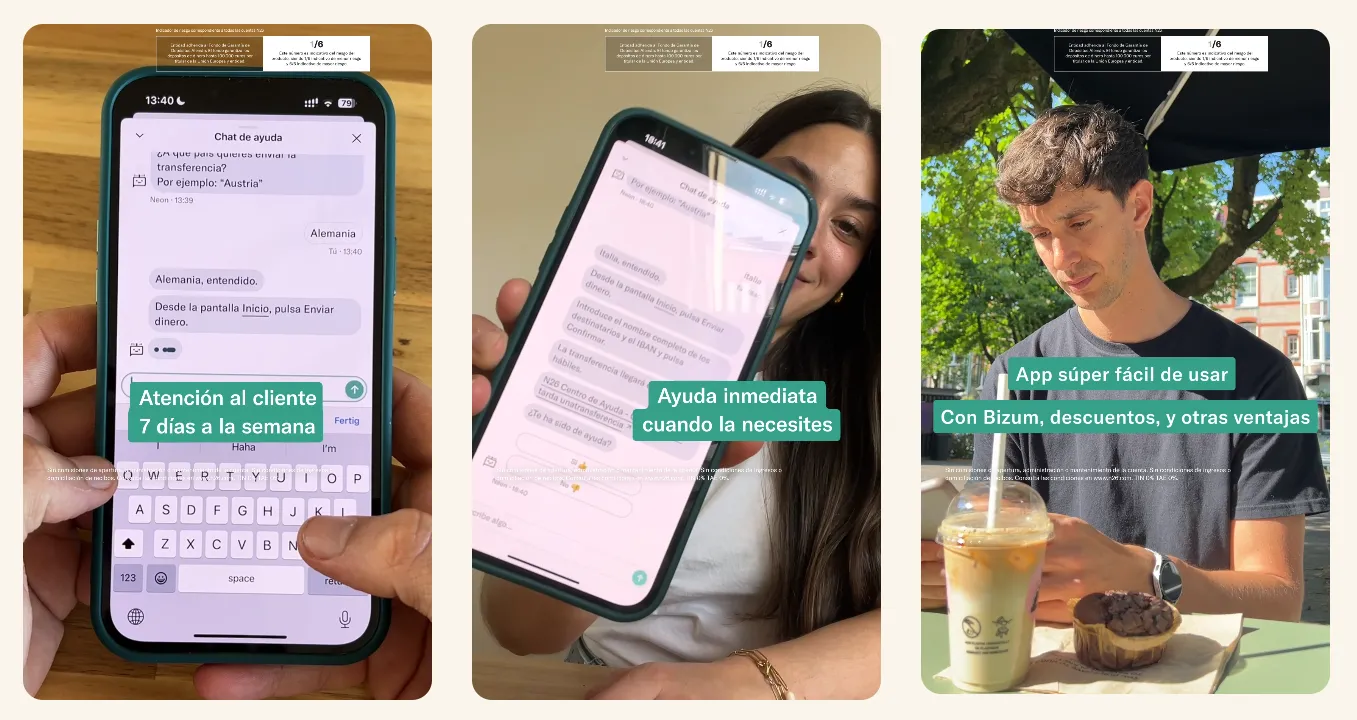
In one example, N26, a mobile bank, saw its cost per registration lower by 65% when using UGC. We conducted rigorous A/B testing on UGC creatives and leveraged Meta’s Advantage+ to optimize placements.
AI-Optimized Media Buying
AI has been the backbone of programmatic media buying. But now it’s transforming how campaigns are planned, executed, and optimized.
Platforms like Adobe Sensei, Google Performance Max, and The Trade Desk use machine learning to automate targeting, bidding, and creative optimization based on large datasets.
AI is making things easier for you while improving performance. Google reports that advertisers using AI-driven campaigns like Performance Max see better performance and more transparent insights.
AI is helpful in:
Budget allocation across media channels
Predicting high-performing ad placements
Automating retargeting ads and creative variations based on user behavior
So, if you’re not using it in some shape or form within your media buying framework, it’s high time you did.
How to Choose the Right Type of Media Buying
Remember: your brand might not need every type of media in the mix. You could chase trends and go where most marketers are heading. But the smart thing to do is take a step back and match your goals, budget, data maturity, and expertise with the right media types.
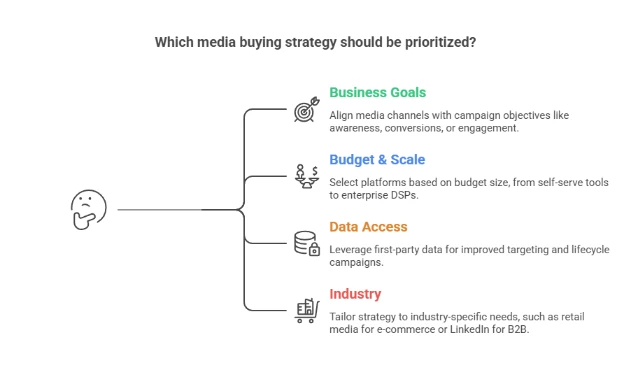
The most effective media planners and media buyers structure decisions around four key dimensions.
1. Business Goals
Your campaign objectives should directly determine which media channels and buying approaches you prioritize. A mismatch here is one of the most common reasons for underperforming advertising campaigns.
Awareness → CTV, display, DOOH
If your goal is reach and brand awareness, you need high-impact, scalable formats like CTV, display, and out-of-home campaigns that deliver broad exposure. Use video-first ad creative and storytelling formats to drive home the message. Plus, measure success through reach, frequency, and lift, not just clicks
Conversions → Search, paid social, retail media
If you are focused on direct revenue, prioritize high-intent environments with search campaigns on search engines. Social and retail media networks are also great for this purpose, especially if you’re selling a product in that retail environment (online/offline). Use strong CTAs, optimized landing pages, and a clean tracking setup.
Engagement → Social, influencer
If your goal is interaction and mid-funnel movement, there’s nothing better than social media, influencers, and UGC. We swear by them, having delivered engagement + conversions for many brands through these very channels.
2. Budget & Scale
Your available budget determines the media mix, too. If you have a bigger budget, you can likely have a diverse mix of media. Your budget also determines whether you lean toward self-serve tools like Google Ads or Meta Ads, or more advanced programmatic buying infrastructure.
Small budget → Self-serve platforms
You can use tools like Google Ads, Meta Ads, and Reddit Ads. These platforms offer built-in dashboard reporting and simplified targeting. We typically recommend starting with 1-2 platforms and scaling only after hitting stable KPIs.
Enterprise → DSP + PMPs
Based on our experiemceLarger brands benefit from DSPs like The Trade Desk or Google Display & Video 360. You can combine open exchange buying with Private Marketplaces for premium ad inventory.
3. Data Access
Your ability to leverage data is now one of the biggest performance drivers in programmatic media buying.
We have noticed that brands with strong first-party data (CRM, site behavior, purchase history) outperform those relying on third-party cookies. They can benefit greatly from programmatic media buying, especially when they empower platforms with clean, first-party data.
Pro tip: For a self-serve route, sync CRM data into platforms like Meta Ads or Google to improve targeting. This can help enable lifecycle-based campaigns (new vs returning users).
4. Industry
Different industries require fundamentally different media buying strategy frameworks.
E-commerce, CPG, FMCG → Retail media, social commerce
If you’re selling a product online, focus on conversion-driven channels with strong retargeting. Use dynamic ad content and product feeds.
B2B → LinkedIn, programmatic display
89% of B2B marketers use LinkedIn. It’s where decision-makers are. Similarly, programmatic display can be great for creating awareness and gradually walking the lead through the funnel. Of course, that calls for precise professional targeting and account-based strategies.
Local businesses → Search + local media
If you’re a small business targeting a local audience, prioritize search and geo-targeted campaigns. Use location-based ad placements and local SEO signals. And if your budget allows, you can also buy traditional media like local radio or digital media like DOOH.
Future-Proof Your Media Buying Approach with Creative Milkshake
The future of media buying is less about choosing between different media types and more about building a flexible system that connects.
And for that to happen, you need quality data (first-party, privacy-compliant), reliable technology (integrated, not fragmented), and strategy (aligned with real business outcomes).
When these pieces come together, campaigns become more efficient over time. Without them, rising costs, signal loss, and platform complexity will continue to impact performance.
If you’re looking to scale paid social with creator-led content, Creative Milkshake can assist you. With in-house production and creative testing, our experts create ads that can also be repurposed across emerging media like CTV and podcasts.
Book a free strategy call to build a media buying system that actually scales.
FAQs
What is the most effective type of media buying in 2026?
There is no single best type of media buying. It depends on your campaign objectives and where your target audience sits in the funnel. Search and retail media typically drive the highest ROAS for conversions, while CTV and display are stronger for brand awareness. Paid social and influencer marketing work best for engagement and mid-funnel movement.
Is programmatic media buying still worth it?
Yes, programmatic media buying remains essential, as it powers most digital media through automation and real-time bidding. Platforms like The Trade Desk and Google Display & Video 360 enable scalable targeting and optimization.
What replaces cookies in media buying?
As third-party cookies decline, brands are shifting toward first-party data and privacy-safe tracking methods like contextual targeting. This also includes CRM data, server-side tracking, and platform-native tools, such as conversion APIs, rather than browser-based pixels.
What type of media buying does Creative Milkshake handle?
Creative Milkshake supports full-funnel media buying across media channels like search and social. Our approach combines media planning, creative strategy, creator engagement, and performance optimization. The goal is to align every campaign with measurable revenue outcomes.
How much budget should go to each type?
There is no fixed split, but most media buying agencies allocate budgets based on funnel priorities. Typically, 50-60% goes to performance channels, 20=30% to growth channels, and 10-20% to awareness. The right mix depends on your campaign, historical cost metrics, and performance data.
What tools are used for media buying?
Commonly used media-buying platforms include Google Ads, Meta Ads, TikTok Ads, and programmatic platforms such as The Trade Desk and Amazon DSP.