Not all UGC hooks are built to scale.
Some are great at grabbing attention in the feed. They drive clicks, generate engagement, and look like clear winners in the early days of a campaign.
But once budgets increase, the same hooks start losing efficiency. Conversion rates soften, CPA climbs, and the creative that once looked strong suddenly stops performing.
But the problem isn’t always creative fatigue or audience saturation.
In many cases, the hook simply wasn’t designed to support scale. Platforms themselves highlight how critical this opening moment is. TikTok reports that 90% of ad recall happens within the first 6 seconds of a video, which means the hook shapes how the entire ad performs.
This small window forces a different way of thinking about UGC ads.
In this article, we’ll break down why many hooks fail under budget expansion, the psychology behind hooks that hold performance, and the hook frameworks teams can reuse across Meta and TikTok. Keep reading.
P.S.: Struggling to keep UGC ads performing as budgets grow? At Creative Milkshake, we design hook testing systems and platform-native ads built specifically for Meta and TikTok.
TL;DR
If you only remember a few things, remember these:
UGC hooks fail at scale because they stop the scroll, but do not qualify buyers. A high CTR can mask weak conversion intent.
Platforms push advertisers toward variation. TikTok recommends running 3–5 different creatives per ad group and multiple ad groups per campaign when testing, which naturally supports rotating hook variants instead of relying on a single winning creative.
Hooks that scale have a structure that qualifies the right viewer early, creates tension tied to the buyer’s problem, and then resolves it with a clear product promise.
Novelty-driven hooks are fragile. If a hook works only because it feels new in the feed, performance usually drops once impressions increase.
On Meta, hooks need faster clarity and stronger qualification. On TikTok, creators have slightly more narrative room, but the opening seconds still determine retention.
The most reliable scaling approach is systematic hook testing: keep the body of the ad stable, rotate hook variations, and track which frameworks maintain CPA and CVR as spend increases.
What is a UGC hook?
In paid social, a UGC hook is the opening moment of a video ad that determines if the viewer keeps watching or scrolls past. It usually happens in the first few seconds of the video. That opening line, visual, or situation frames the entire message that follows.
For performance teams, the hook does more than stop the scroll. It signals who the ad is for and sets the context for the offer.
A strong hook aligns attention with intent. It pulls in viewers who recognize the problem, the situation, or the goal being addressed. That alignment is what allows UGC ads to hold performance once delivery increases.
Without it, the ad may generate clicks and engagement, but the traffic rarely converts once spend grows.
Why UGC Hooks Break Under Budget Expansion
A hook can look strong at low spend and still fall apart once delivery expands.
At first, the signals look promising: The ad gets clicks, the engagement is solid, and the creative seems ready to scale. Then the budget increases and performance starts to slip.
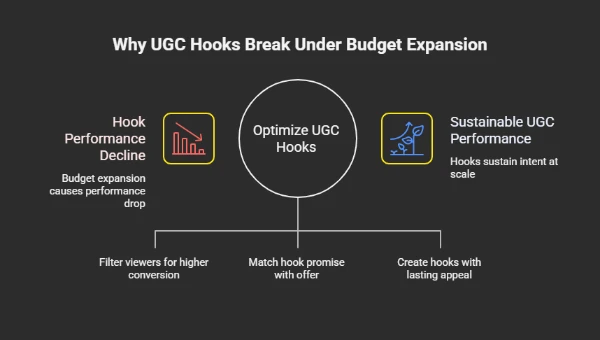
CTR may hold for a while, but CVR drops and CPA rises. Nothing else changed. The hook simply was not built to sustain intent at a larger volume.
From what we have seen working with performance teams, this pattern shows up frequently when hooks focus on attention but ignore intent.
Let’s see which are the most common causes:
1. Scroll-Stop Does Not Equal Purchase Intent
Some hooks are great at getting attention but weak at filtering the right viewer.
This creates a common pattern: strong CTR, softer CVR, and rising CPA as spend grows.
In our experience working with performance teams, this happens when a hook focuses purely on curiosity and ignores purchase intent.
The ad keeps attracting clicks, but too many come from people who were never likely to convert.
2. Emotional Spike Without Funnel Alignment
Other hooks create interest, but set up the wrong expectation.
The opening promises one thing, while the offer or landing page presents another. This disconnect adds friction and weakens conversion.
At scale, that gap becomes much more expensive.
3. Novelty-Dependent Performance
Some hooks work because they feel fresh in-feed.
A creator stands out, the edit feels different, and the delivery catches attention.
We have noticed that novelty-driven hooks usually look strong in early testing but struggle once delivery expands.
Over time, that novelty fades. And if the hook only works in one exact version, it will not scale well across new creators, offers, or angles.
The Structural Psychology Behind Scalable UGC Hooks
Hooks that scale usually follow the same logic.
They qualify the viewer early, create relevant tension, and connect smoothly to the offer. This is what helps them hold performance as spending increases.
TikTok's creative best practices for performance ads emphasize the importance of this opening window. The platform recommends introducing the proposition within the first 3 seconds and prioritizing the hook within the first six.
The structure behind these hooks usually comes down to a few elements:
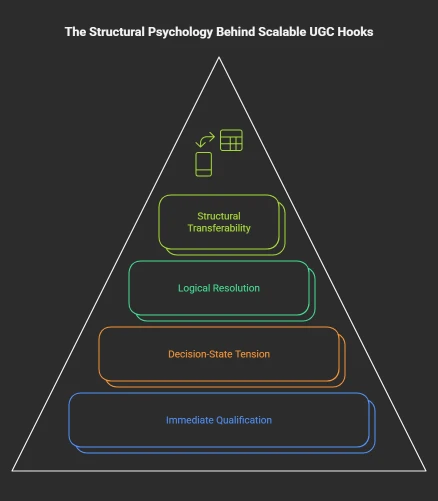
Immediate Qualification
Strong hooks quickly signal who the ad is for. It could be based on identity, situation, or belief:
“If you run Meta ads for a DTC brand…”
“If your CPA jumps every time you scale…”
“If you’re tired of products that overpromise…”
This helps attract viewers with stronger intent from the start.
Decision-State Tension
After that, the hook needs to surface a problem the viewer already feels.
This problem could be frustration, skepticism, wasted spending, or failed alternatives. This is what makes the message feel relevant instead of generic.
Logical Resolution
Once the tension is clear, the solution needs to follow naturally.
The offer should feel like the answer to the problem, not a random product drop in the middle of the ad.
Structural Transferability
A scalable hook is not just one line that worked once. It is a structure that can be reused across creators, scripts, and angles.
This matters because scale depends on repeatability. TikTok also recommends testing 3–5 different creatives per ad group with clear variation between them.
P.S.: If you want a faster way to review hooks, creatives, and performance signals, check our ad optimization cheat sheet. It breaks down what to test and what to scale.
10 Successful UGC Hook Categories
Remember that not all hooks behave the same once budgets increase.
Some rely on curiosity or novelty. They may perform early, then lose efficiency once impressions grow. Others are built around buyer intent, which helps them hold performance as delivery expands.
When we review high-spend ad accounts, one pattern shows up repeatedly. Hooks that clearly signal who the message is for tend to hold performance longer as budgets grow.
Below, we have shared proven hook categories that scale better across Meta and TikTok. Each one aligns attention with intent and can be repeated across creators and creative variations.
1. The High-Intent Identity Filter
These hooks qualify the viewer immediately. They signal who the message is for and filter out low-intent attention.
Hook examples:
“If you’re like me and [experience], this is for you.”
“Struggling with [issue]? Here’s what worked for me.”
“If you’ve ever wanted to [goal], watch this…”
“My favorite [product/category] picks…”
“What’s in my [bag/toolkit/setup]?”
“Are you making these mistakes that hurt your [strategy/metric]?”
“Help me pick between [option A] and [option B]…”
Where it performs best: Mid-funnel and bottom-of-funnel audiences.
Why does it hold under a higher budget:
Early qualification attracts viewers who already recognize the problem or goal. This usually leads to stronger conversion signals once delivery expands.
We usually recommend this type of hook when teams want cleaner traffic signals. The message quickly tells the viewer whether the ad is relevant, which usually improves conversion quality as delivery expands.
2. The Failed-Solution Hook
These hooks speak to people who have already tried other options and are frustrated with the result.
This frustration creates a strong entry point because the viewer is already in comparison mode.
In many campaigns we review, these hooks perform well when the audience has already experimented with other tools, products, or strategies.
Hook examples:
“I was struggling with [problem] until…”
“This is the only thing that helped me with [problem]…”
“Tired of [problem]? Try this…”
“I used to hate [task], but now…”
“The biggest mistake I made with [topic/process]…”
“Stop doing [common action]; it’s killing your [result].”
“Why your current [strategy/approach] is failing to [desired outcome].”
Where it performs best: Mid-funnel and retargeting audiences.
Why does it hold under a higher budget:
The hook attracts viewers already looking for a better answer. That intent tends to hold up better than curiosity-led traffic.
We have noticed that frustration-led messaging brings in audiences who are closer to making a decision, which helps performance remain stable as delivery expands.
3. The Specific Measurable Outcome Hook
These hooks frame the message around a clear result.
A specific outcome gives the viewer a faster way to assess relevance and value.
When teams test UGC ads at scale, outcome-driven hooks mostly outperform vague promises because viewers immediately understand what the ad is offering.
Hook examples:
“This is how I increased my [metric] using [strategy].”
“Here’s why so many [group] struggle with [problem].”
“Did you know a lot of [audience] abandon [action] before [desired action]?”
“People who follow this approach tend to see better [result].”
“3 tips to get rid of [problem]…”
“How I went from [state] to [improved state]…”
“This helped me save [resource] in [timeframe].”
“This is how I got [result] in [timeframe] without [objection].”
“Before and after…”
Where it performs best: Across the funnel, especially where proof matters.
Why does it hold under a higher budget:
Specificity filters attention better than vague promises. The clearer the outcome, the easier it is to attract viewers with real intent.
4. The Skeptical Buyer Confession
These hooks address resistance early.
They work well because they sound more like a real reaction than a polished sales setup. Viewers mostly respond to honesty more than hype.
Hook examples:
“I have a confession…”
“I didn’t think this would work, but here we are…”
“This is sponsored, but here’s the truth and my personal opinion…”
“You're not going to agree with me, but I think [belief/opinion].”
“Unpopular opinion: [statement]…”
“My honest reaction to [product/category]…”
Where it performs best: Mid-funnel and retargeting audiences.
Why does it hold under a higher budget:
These hooks lower resistance before it builds. This makes them useful in categories where buyers are skeptical or overexposed to ads.
When viewers feel the creator is being direct or transparent, the ad feels less promotional. This makes the message easier to accept, especially in categories where audiences see many ads.
5. The Cost-of-Inaction Hook
These hooks frame the downside of doing nothing.
Instead of leading with the product, they highlight the consequences of staying with the current problem.
In our daily practice, we see this approach perform well when the audience already understands the category but has not taken action yet.
Hook examples:
“Stop making this one mistake that’s killing your [metric].”
“This mistake can wreck your [result], here’s how to fix it.”
“Watch this before you [action].”
“Here’s why you’re not getting [result] and how to fix it.”
“Don’t fall for these common [category] myths that are holding you back.”
“Don’t watch this if you hate [result].”
“This small oversight could be tanking your [area]. Fix it now.”
“7 common pitfalls to avoid when [action].”
Where it performs best: Middle of the funnel.
Why does it hold under a higher budget:
A clear consequence creates urgency without forcing the pitch too early. This usually keeps the message relevant as delivery increases.
6. The Category Reframe Hook
These hooks challenge a common belief about the product category.
Instead of introducing the product immediately, they shift how the viewer thinks about the problem or solution.
This approach works well because it reframes the conversation before the product appears. When the viewer questions the old assumption, they become more open to the new idea.
Hook examples:
“Most people have been doing [activity] wrong this entire time.”
“Why I believe [common approach] is failing [group/audience].”
“[Category] that promise [outcome] is a scam; here's why.”
“Never spend a fortune on [category].”
“Did you know this simple change could be a game-changer for your [area]?”
“Stop doing [common action]; it’s not actually helping…”
Where it performs best: Top and mid-funnel audiences.
Why does it hold under a higher budget:
Challenging a familiar belief creates natural curiosity while still framing the real problem. This balance maintains engagement as impressions grow.
We have noticed that this type of hook works well in crowded categories because it changes the angle of the conversation rather than repeating the same claim viewers see in other ads.
7. The Proof-Density Hook
These hooks rely on volume-based validation.
Instead of presenting a claim alone, they reference reviews, recommendations, or widespread discussion around the product.
When viewers hear that many others are talking about a product, it reduces uncertainty and encourages them to pay attention.
Hook examples:
“This [product/category] keeps getting recommended, so I tested it.”
“[Platform] made me buy this.”
“So many people swear by this [product/category]…”
“A lot of people have tried this [product]; here’s what happened.
“My current favorites…”
“This is my [challenge] entry…”
“Everyone keeps talking about this [product/category], so I tried it.”
“This [product] has [a lot of reviews/a lot of hype]; let’s see if it’s worth it.”
Where it performs best: Mid-funnel and discovery campaigns.
Why does it hold under a higher budget:
Social proof scales well because the hook reflects collective behavior rather than a single personal claim.
Trust builds faster when viewers see that many others are already engaging with the product.
8. The Pattern Interrupt Hook
These hooks break the viewer’s automatic scrolling behavior.
They work by introducing a sudden visual or verbal interruption that forces attention.
In fast-moving feeds like Meta and TikTok, that small disruption can buy a few extra seconds of attention, which is enough to deliver the core message.
Hook examples:
“Wait… don’t scroll.”
“Stop scrolling for a second.”
“You need to see this.”
“Hold on, this changed everything for me.”
“Wait until you see this…”
“I didn’t expect this…”
Where it performs best: Top-of-funnel reach and cold audiences.
Why does it hold under a higher budget:
Interrupt-driven hooks can maintain strong thumb-stop rates when paired with clear messaging immediately after the interruption.
Insider tip: We usually suggest pairing this type of opening with a clear benefit in the next line so the interruption quickly turns into relevance.
9. The Curiosity Gap Hook
These hooks create a question that the viewer wants resolved.
The opening introduces an incomplete piece of information that encourages the viewer to keep watching.
Curiosity works well in short-form video because the viewer expects the answer to appear quickly.
Hook examples:
“You won’t believe what happened when I tried this…”
“Here’s something nobody tells you about [topic].”
“I wish someone had told me this earlier.”
“This completely changed how I look at [problem].”
“There’s one thing people get wrong about [topic].”
“I tried this so you don’t have to.”
“This surprised me.”
Where it performs best: Top and mid-funnel campaigns.
Why does it hold under a higher budget:
A strong curiosity gap encourages viewers to stay longer in the video.
Trust us, this works best when the payoff arrives quickly. When the viewer receives the answer early in the ad, retention and engagement usually stay stable as impressions increase.
10. The Relatable Moment Hook
These hooks describe a familiar situation that the viewer instantly recognizes.
Instead of introducing the product directly, they mirror a moment the audience has likely experienced.
Hook examples:
“You know that feeling when [situation]?”
“This happens to me every time I [activity].”
“If this has ever happened to you…”
“I can’t be the only one who deals with this.”
“POV: you’re trying to [task].”
“That moment when [situation].”
“Why does this always happen when [scenario]?”
Where it performs best: Top-of-funnel and broad audience targeting.
Why does it hold under a higher budget:
Recognition builds immediate relevance. When viewers see their own situation reflected, they are more likely to stay engaged with the message.
Meta vs TikTok: Strategic Hook Adjustments for Each Platform
The hook structure may remain the same, but execution varies by platform.
Meta and TikTok operate in similar environments, yet user behavior and content expectations differ slightly.
Let’s see why:
On Meta: Compression and Precision
On Meta, attention windows are shorter.
Users scroll faster through feeds like Instagram Reels and Facebook Feed, so hooks need to communicate value quickly. The opening usually benefits from clearer qualification and faster context.
Successful Reels ads capture attention immediately because viewers decide almost instantly if the content is worth watching.
This means hooks on Meta usually work best when they:
Identify the audience quickly.
Frame the problem immediately.
Introduce the value proposition early.
There is less room for long narrative setups. The hook needs to establish relevance fast so the viewer understands why the ad matters to them.
Audio also plays a role here. Meta reports that campaigns using music or voiceover in Reels can deliver up to 13% higher incremental conversions. This shows how sound can reinforce the opening moment of the ad.
On TikTok: Narrative Framing for Retention
TikTok allows slightly more narrative room, but the opening still carries most of the weight.
As we already mentioned, the platform explicitly recommends introducing the core proposition in the first three seconds and prioritizing the hook within the first six seconds to improve recall and watch time.
This window shapes how the viewer interprets the rest of the video.
TikTok hooks usually perform best when they feel creator-native. Instead of sounding like an ad, the opening resembles a natural piece of content in the feed.
This is also why creator variety matters. TikTok reports that two out of three users prefer brands to work with a variety of creators, supporting testing the same hook framework across different voices and formats.
For performance teams, the takeaway is simple: the hook structure can remain consistent, but the delivery style should match the platform’s native content patterns.
P.S.: Hook testing works best when the ad creative testing structure is clean. We break down practical methods for testing ad creatives in this guide.
How Creative Milkshake Applied Hook Testing in Real Campaigns
Hook frameworks become more useful when applied to real campaigns. Instead of relying on a single winning creative, teams test multiple opening angles across different concepts and formats.
Here are two examples of how Creative Milkshake approached this in practice:
iwoca
For iwoca, Creative Milkshake integrated hook testing into a structured creative iteration process. Our team explored different opening angles across new concepts, scripts, and formats, allowing the campaign to test multiple ways of introducing the offer while keeping the creative aligned with the broader paid social strategy.
LOLA
In LOLA’s campaign, our focus was on refreshing the opening message across both repurposed and new assets. Our team at Creative Milkshake tested different hook setups built around relatable situations and UGC-style storytelling, helping maintain variety in the creative mix as the campaign evolved.
These examples show how hook variation works best when it’s part of a structured creative system, not just a one-off idea.
From One Winning Hook to a Repeatable Creative System
Most UGC hooks can grab attention, but fewer can hold performance once spend increases.
The hooks that scale do three things well: they qualify the viewer, surface a real problem, and connect naturally to the offer.
That is what makes them repeatable across creators, formats, and new variations.
If your team wants a more structured way to test and scale UGC ads on Meta and TikTok, Creative Milkshake can help. We develop platform-native performance creatives and repeatable hook testing frameworks designed for paid social campaigns.
Contact us to learn how we approach hook testing and scalable UGC creative for paid social.
FAQs
What Are Some Good UGC Hook Examples?
Good hooks get specific quickly and signal who the message is for. In UGC videos, lines like “If your CPA keeps rising every time you scale…”, “I tried this for 7 days and here’s what happened”, or “You’re probably making this mistake with [topic]” work well because they qualify the audience and naturally lead into the message.
How Long Should a UGC Hook Be on Meta and TikTok?
Usually within the first few seconds. On TikTok, the proposition should appear in the first three seconds, while on Meta, the hook needs to land fast across different ad placement environments.
What Is the 3-Hook Strategy?
It means testing three different ad openings. The body stays mostly the same, which makes it easier to compare click-through rates and find the hook driving the strongest response.
How Quickly Should Hooks Be Rotated at Scale?
It depends on spending and how fast performance drops. In social media campaigns with higher delivery, fresh hooks usually need to enter faster to protect efficiency and engagement rates.
Can Creative Milkshake Help Us Build UGC Hooks for Both Meta and TikTok?
Yes. Our team at Creative Milkshake builds performance systems for user-generated content, including hook development, testing workflows, and platform-native UGC content for paid social.
Does Creative Milkshake Only Handle Creative, or Media Strategy Too?
Creative Milkshake handles both creative and media thinking. Our team builds hook systems that support broader marketing strategies, not just isolated ad concepts.