
Fintech is crowded, and trust is fragile in this niche. Now, picture your customer acquisition cost keeps climbing, too.
You already picked the channels, you already spent the budget, yet the results still feel uneven.
And when performance drops, it’s easy to change platforms or play with bids instead of fixing what actually drives outcomes.
Here’s the (most likely) issue: many teams focus on where ads run instead of first examining how the marketing funnel and creative work together. That misguided focus leads to weak conversion rates, low-quality leads, and slow scaling.
We’re not saying your ads don’t need any creative testing, but you should first look at your general strategy.
So, we’re going to help you get started.
Here, you’ll see how strong digital marketing fundamentals connect with modern creative systems that actually improve performance. You’ll learn what to test and see what drives results.
P.S. If you want help building ads that lower CAC and scale faster, Creative Milkshake can support your team with data-driven creative systems. Contact us today to learn more!
TL;DR
Fintech marketing works when you turn complex products into clear, trust-driven messages that guide user decisions.
Many performance issues come from weak strategy and creative, and not from channels or budget.
Strong results start with behavior-based audience targeting that improves LTV and lowers CAC.
Trust, clear messaging, and education directly improve conversion and reduce drop-offs.
Creative drives performance, so structured testing and iteration are key to scaling.
A good multi-channel strategy works best when it supports the full funnel and not just the acquisition stage.
Growth becomes predictable when you treat marketing as a system.
What Is Fintech Marketing?
Fintech marketing is the process of turning complex financial products into clear, trustworthy messages that drive real user action. Basically, it connects financial technology products with the right target audience and moves them from interest to usage.
Now, this sounds straightforward, but the execution is very specific (so it’s simple, but not easy).
After all, you must promote features while also building customer trust, explaining risk, and guiding decisions step by step.
That means every message needs to reduce doubt.
For example, a credit product ad that explains repayment terms clearly will convert better than one that only highlights rewards, because clarity lowers hesitation and improves conversion rate. We’ve noticed a similar mechanism in our work with content creators.
At the same time, fintech is expanding like wildfire. According to Fortune Business Insights, the global fintech market hit $394B in 2025 and is expected to reach $1,760B by 2034.
So, it’s clear that demand is not the issue. The challenge is making your product easy to understand and easy to trust.
That brings us to the next section.
Why Fintech Marketing Is So Hard (And Why Most Brands Fail)
Fintech marketing is hard because users hesitate, rules are strict, and decisions take time, which slows down results even when you increase spend. That is why fintech purchase cycles can stretch from 6 to 18 months, which means quick wins are rare.fintech marketing specialists need to account for GDPR, FCA, SEC, and similar rules from the start. On top of that, fintech purchase cycles can stretch from 6 to 18 months, which means quick wins are rare.
To understand where issues can arise, here are the key challenges:
High CAC and competition: You compete with well-funded brands, so your costs can rise fast. Without strong positioning, you can increase spend without improving return on ad spend.
Low trust by default: People question anything related to money. If your ads don’t show proof early, potential customers drop off before clicking.
Complex products: Features need explanation. If your messaging skips education, users don’t see the value and don’t convert.
Strict compliance rules: Your claims must be compliant with financial regulations (e.g., GDPR, FCA, SEC guidelines) and advertising standards. From our experience, this limits creative freedom and slows testing cycles.
Long decision cycles: Users compare, revisit, and delay. Without follow-up touchpoints, you lose them before conversion.
Because of this, just running ads rarely works. Performance improves when strategy and creative work together, where each message builds understanding, reduces risk, and moves the user forward with intent.
Here’s more info on this:
The next step is fixing them with the right structure.
The Core Pillars of Fintech Marketing
Once you understand where your performance breaks, the next step is fixing the right pieces in the right order. That’s where we can help.
Below are the core pillars we’re using at Creative Milkshake to shape how fintech campaigns improve results and scale with more control.
1. Deep Audience & ICP Definition
Strong performance starts with knowing who you are actually targeting. In the fintech industry, broad segments rarely work because your audience’s behavior varies too much.
So go deeper than demographics.
Look at how specific user segments handle money, how much risk they accept, and how they use similar products. For example, someone who checks rates daily behaves very differently from someone who only engages when prompted. That difference should change your messaging, your offers, and your funnel.
This is where real gains show up.
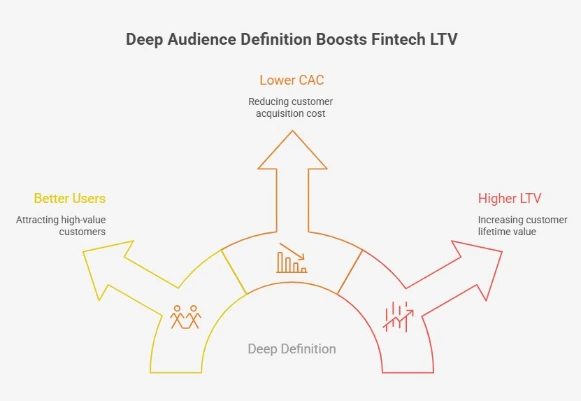
When your customer personas reflect highly specific behaviors, your ads attract better users, which lowers CAC and improves customer lifetime value.
Pro tip: One clear signal here is early product usage. Users who link multiple payment methods in week one show 5x higher LTV. That tells you what actions to push early in your funnel and what to highlight in your creative.
So instead of asking “who should we target,” focus on “what behaviors lead to long-term value.” Then build campaigns around that.
2. Trust as the Core Growth Lever
In fintech, growth follows trust. If users don’t feel safe, they don’t convert, no matter how strong your offer looks.
So, we recommend starting with transparency.
Be clear about fees, risks, and how your product works. This reduces hesitation and improves decision speed. Then layer in social proof, security messaging, and compliance-first marketing strategies that help users validate their choice before they click.
Security messaging also matters.
Show how people’s data is protected and how transactions are handled. This directly improves customer experience, especially for new users who are still unsure.
And then there’s expert content.
When you explain topics clearly and consistently, you build credibility over time. This supports both customer relationships and conversion, because users feel informed before they act.
Here’s a good example courtesy of Syfe, a digital investment platform in Singapore. Their Senior Wealth Advisor explains a smart money habit that everyone can build to start investing faster:
And this brings us to the next tactic:
3. Education-First Content Strategy
Content plays a direct role in driving conversions and shaping how users move through your funnel.
So, when you focus on content creation, you should answer real questions users have before they convert, just like we’ve seen with Syfe above.
Guides, explainers, and comparisons all play a role here. Each format moves users forward by removing a specific doubt.
For example, a comparison page helps users choose between options. An explainer video shows how the product works. And a guide answers a problem they are trying to solve. Each one improves clarity, which improves conversion.
Our client Wise, for example, offers business tips and how-to guides for entrepreneurs:
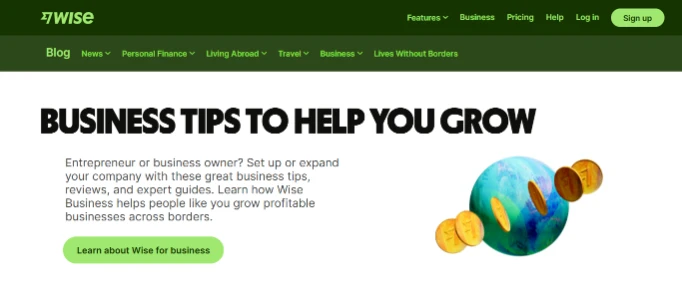
This tactic works because 72% of consumers prefer examples over general advice. So instead of broad claims, show how your product works in real situations.
In the long run, this builds authority. It also supports customer retention, because users who understand the product are more likely to keep using it.
Here’s why this should be your top priority:
4. Compliance-Driven Marketing
In fintech, compliance shapes how you market and not just what you say. This falls under YMYL (Your Money or Your Life), where accuracy directly affects people’s finances.
So:
Your messaging needs to be clear and precise.
Claims must be realistic.
Disclaimers must be visible.
Every detail needs to match how the product actually works.
When this is done well, it improves trust and reduces hesitation during decision-making.
At the same time, mistakes here are expensive. Misleading claims can lead to legal issues, but they also damage credibility. And once trust drops, performance follows. That’s why compliance should be built into your process early.
5. Full-Funnel Thinking (Not Just Acquisition)
Most fintech teams focus heavily on lead generation, but that’s only one part of the system.
Users move through stages. First awareness, then consideration, then conversion, and finally retention. Each stage needs different messaging, different creative, and different expectations.
This is where many campaigns lose efficiency.
We’ve seen how lots of awareness ads push too hard for conversion, while conversion ads reach users who are not ready. As a result, costs increase, and results stay inconsistent.
Instead, we advise you to align your funnel with how users actually decide.
Start by mapping your marketing goals to each stage. Then match your message to the user’s level of understanding. This creates a smoother path from first touch to long-term use.
6. Cross-Channel Integration
Fintech users don’t stay in one channel. They move between search, paid ads, email, and product touchpoints before deciding.
So your channels need to work together. SEO, paid campaigns, and lifecycle messaging should all support the same story. When they don’t, users get mixed signals, and conversion drops.
Remember: Consistency is extremely important. The same core message should carry across your social media marketing, landing pages, and follow-ups. This creates a clear path and improves how users understand your product.
At the same time, integration helps you use data better. Insights from one channel can guide improvements in another, which makes your overall system more efficient.
7. Creative Strategy as a Growth Engine
Creative drives performance more than most teams expect. It goes beyond the visual layer and focuses on how you communicate value, reduce doubt, and move users forward.
That means creative needs structure. Instead of launching isolated ads, you should build a system where you test angles, hooks, and formats continuously. For example, you can test different value propositions in short video content, track which one improves click-through and conversion, and then scale what works.
This approach turns creative into a growth lever. Each test gives you insight, and each insight improves your next iteration.
Now, this is where many fintech brands struggle. Creative usually becomes a bottleneck, especially when teams treat it as one-off production.
At Creative Milkshake, we help teams turn creative into a system. We build structured testing workflows that connect directly to performance data. That way, you don’t guess what works. Instead, you test, learn, and scale with clarity.
With the foundation in place, it’s time to choose where to apply it.
Fintech Marketing Channels That Actually Work
When your foundations are clear, you can choose channels that match how users actually discover, compare, and decide. These are the channels that tend to deliver the strongest results when used with the right structure:
Content Marketing (Education Engine)
Content works because it answers real questions before users commit. Blogs, guides, and webinars help people understand your product and feel more confident using it.
That confidence shows up in performance. Content marketing generates 3x more leads while costing 62% less than outbound marketing, which makes it one of the most efficient ways to drive growth.
More importantly, it supports conversion. When users already understand the product, they move faster through the funnel.
But content marketing goes beyond SEO-driven articles.
It includes formats like email sequences, social content, video explainers, case studies, and in-app education. These assets are designed to guide users across multiple touchpoints.
In fintech, this matters because trust is built through repetition and clarity.
A user might first see a short video.
Next, they read a guide.
They then receive an email breakdown before converting.
Content marketing connects those steps into a consistent narrative that reduces hesitation over time.
SEO (High-Intent Traffic)
SEO captures users who are already searching for solutions. These are high-intent queries like “best savings app” or “how to invest safely.”
But ranking is not enough. In fintech, authority matters, so your content needs to show experience, expertise, and trust signals. Clear explanations, accurate information, and consistent updates improve both rankings and conversion rates.
Unlike broader content marketing, SEO focuses on capturing existing demand.
That means structuring pages around search intent, optimizing on-page elements, building backlinks, and using technical improvements like schema markup and internal linking to improve visibility.
It’s a distribution system as much as a content strategy. Even strong content won’t perform if it’s not discoverable. SEO ensures your best assets appear at the exact moment users are actively looking for answers.
Paid Media (PPC & Social)
Paid media gives you speed and control. Search ads capture intent, while social ads help you introduce and explain your product.
The key is alignment. Search ads should match what users are already looking for. Social ads should focus on education and problem awareness before pushing action.
At the same time, compliance plays a big role here. Every claim and message needs to be accurate, which affects both creative and approval timelines.
Social Media (Community Building)
Social channels help you build long-term trust. Instead of pushing offers, you should focus on value. Share financial education, explain concepts, and create content that helps users make better decisions.
This ad for Kikoff offers a great example:
This approach strengthens your social media presence over time. It also supports retention, because users keep coming back for useful insights.
And the investment is growing. Fintech marketing budgets have increased by 45% over the past three years, which shows how important these channels have become in driving consistent growth.
Pro tip: If your campaigns feel inconsistent, the issue is usually in how your system is set up. For a clearer structure, check out our guide on running paid social for fintech brands.
But channel choice also depends on who you are targeting.
B2C vs. B2B Fintech Marketing
Before you adjust your campaigns, it helps to see how B2C and B2B differ in practice. The setup, messaging, and timelines are not the same, so your approach needs to match.
Here are the key differences side by side:
No matter the model, creative still decides how well campaigns perform.
Creative Strategy in Fintech (What Most Guides Miss)
Most teams treat creative as execution. That directly shapes performance in fintech. So before you scale spend, it helps to understand how creative actually drives results.
Here are the key pieces that make it work.
Creative Still Matters in Fintech
Start with the product itself. Financial tools are usually hard to explain, so your creative needs to simplify the value fast. If the message feels unclear, users hesitate, and your conversion rate drops.
Then comes trust. Users think about risk at every step, so your messaging needs to reduce doubt early. Clear wording, real use cases, and proof points help people move forward instead of dropping off.
On top of that, acquisition costs are high.
That means every impression needs to work harder. When creative improves clarity and trust, you get more conversions from the same spend, which directly improves efficiency.
What High-Performing Fintech Creative Looks Like
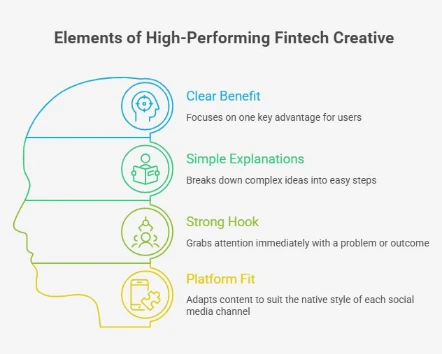
Strong creative follows a few simple rules.
It explains one clear benefit instead of trying to say everything at once. That focus helps users understand quickly and take action.
It keeps explanations simple. So, break the product into small steps or real-life examples so people can see how it fits their situation.
It starts with a strong hook. The first seconds decide whether someone keeps watching, so lead with a clear problem or outcome.
It fits the platform. Short-form video content on social works best when it feels native, not like a polished ad. In our experience, that’s where many teams fall behind, especially when trying to keep up with fast-moving fintech innovations.
The Creative Milkshake Testing Framework
To make creative reliable, you need a clear system. Here is a simple way to run it:
Research audience and pain points
Create multiple concepts
Test hooks and formats
Analyze performance
Iterate and scale
This approach reflects how structured teams work in practice. At Creative Milkshake, the process runs as a loop: research, production, testing, then iteration. Each round gives you better signals, so the next batch performs stronger.
Pro tip: If your ads feel random, your testing process likely is too. For a clearer approach, check out our guide on building a strong creative testing framework.
Example of Fintech Marketing
A good example is iwoca. Our goal with the company was clear: scale paid social without losing efficiency.
We focused on data-driven concepts and structured testing. Instead of relying on a few ads, our team built multiple creative angles and tested them across Meta placements.
The result was a system that could scale, but was also clear and measurable:
2x increase in Meta ad spend
15 new ad concepts tested
5 structured creative iterations
60 ads produced and launched
As you can see, when creative becomes repeatable, you start scaling with control.
Advanced Fintech Growth Strategies (2026 and Beyond)
As the fintech market expands, your brand’s growth is based on adapting faster than your competitors.
Major fintech companies are already using the marketing strategies below to scale in this competitive niche:
Generative Engine Optimization (GEO)
Search is changing. That means AI tools now shape how users find answers, so your content needs to be easy for machines to read and summarize.
Clear structure, direct answers, and clean formatting help you show up in AI-driven results.
Lifecycle & Event-Based Marketing
Timing matters more than volume. Instead of pushing generic campaigns, trigger messages based on user actions.
For example, follow up when someone signs up but does not complete onboarding. Or send targeted prompts after key product actions. This improves conversion because the message matches real behavior.
Community-Led Growth
Trust builds faster in groups. Education cohorts, user communities, and shared learning spaces give users a place to ask questions and learn from others. Over time, this creates stronger engagement and keeps users active longer.
Value-Based Media Buying
Looking at cost per lead is not enough. Some users convert but never stay. So shift focus to long-term value. Track which segments drive higher retention and revenue, then push budget toward those users.
Referral & Network Effects
Referrals work because they transfer trust. When users invite others, hesitation drops. This is why fintech companies attribute 25-40% of new user acquisition to referral programs. If done right, this becomes a steady growth loop.
Pro tip: If your leads look good on paper but don’t convert, your messaging likely needs a closer look. If you need someone to help you out with this, check out our guide on the top fintech marketing agencies.
But even with the right approach, a few mistakes can still hold your performance back.
Common Fintech Marketing Mistakes
From our experience, many small mistakes can reduce your marketing performance faster than a big error.
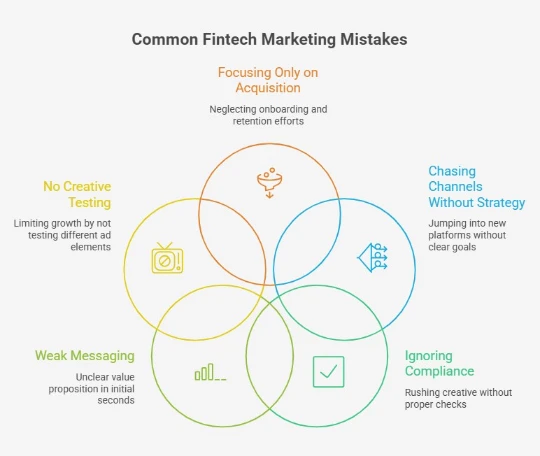
These are the ones that show up most frequently:
Chasing channels without strategy: Marketing teams can sometimes jump into new platforms, hoping for quick wins. Without a clear goal and funnel fit, traffic comes in, but conversion stays low because the message and your audience don’t match.
Ignoring compliance: Rushing creative without proper checks leads to delays or rejected ads. Worse, unclear claims reduce trust, which lowers click-through and conversion rates.
Weak messaging: If your value is not clear in the first seconds, users move on. Vague benefits or feature-heavy copy create confusion, which leads to low-quality leads and drop-offs.
No creative testing: Running a few ads and hoping they work limits growth. Without testing different hooks, formats, and angles, you miss what actually drives performance.
Focusing only on acquisition: Bringing in users is only part of the system. If onboarding, retention, and follow-ups are weak, you pay for users who never convert or stay.
Turning Fintech Marketing Into a Scalable System
By now, the pattern is clear. Strong fintech marketing comes from how well your strategy, creative, and execution work together.
When your audience definition is precise, your messaging builds trust, and your creative runs through a testing system, performance becomes easier to control and scale. At the same time, growth depends on how you connect channels, measure real outcomes, and focus on long-term value, not just short-term wins.
If your current setup feels inconsistent or hard to scale, Creative Milkshake can help you build a system that turns creative into a reliable growth engine. Contact us today to get moving.