
Fintech brands usually have good products, but marketing them on social media is difficult. Strict compliance requirements, high acquisition costs, and low initial user trust make it harder to convert attention into action, even with significant spend.
And that’s not all.
In many cases, campaigns struggle because the setup doesn’t reflect how fintech buyers actually behave. People compare options, read reviews, and revisit multiple times before taking action. When campaigns don’t account for that, results show up as low conversion rates, weak lead quality, and rising CPAs.
So in this guide, we’ll break down what actually works:
Which platforms drive results
How ad creatives should build trust
How to stay compliant without slowing down
How to measure performance beyond surface metrics
Let’s dive in!
P.S. If your ad campaigns are stuck or scaling is breaking performance, Creative Milkshake can help you rebuild the system behind them. Contact us today so we can create a plan together!
TL;DR
Fintech paid social is hard because trust, compliance, and long decision cycles slow down conversions, even when traffic looks strong.
Campaigns perform better when goals are clearly defined first, since that shapes targeting, creative, and measurement from the start.
Strong results come from precise audience segmentation using behavior, intent, and life-stage signals rather than broad demographics.
Creative needs to reduce perceived risk early, using simple messaging, social proof, and formats like UGC and explainers.
Mapping ads to funnel stages improves performance, especially since many users drop off before converting without proper nurturing.
Retargeting and structured A/B testing help improve efficiency by focusing on warm audiences and proven variables.
Tracking real metrics like CAC, CPQL, and conversion rates ensures decisions are based on outcomes, not surface-level performance.
What Is Paid Social for Fintech?
Paid social for fintech is running paid ads on social media platforms to reach specific audiences with messages that build trust and move them toward a financial action.
Basically, this means sponsored posts, video ads, carousels, and stories across platforms like Meta, LinkedIn, TikTok, and X.
And unlike search, where users already show intent, paid media here works earlier in the process. You’re shaping interest, guiding decisions, and moving people through the sales funnel step by step.
Revolut offers a good example:
For fintech, paid social channels are one of the fastest ways to reach defined audiences at scale while controlling both targeting and messaging. That matters because customer trust is the main driver of conversion in this category.
Cost also plays a role.
Fintech keywords in search can easily reach around $3.89 per click, while social gives you more control over cost per click and audience precision.
But that advantage only holds if your setup is aligned. If your message, targeting, or funnel is off, social will bring volume without meaningful results.
Check out this video to learn how much you should focus on social media:
Why Paid Social Is Uniquely Hard for Fintech Brands
Paid social is harder for fintech because conversion depends on trust, time, and strict rules.
Once you start running campaigns, these challenges show up quickly. You can get traffic, even engagement, but results don’t always follow in a predictable way. That’s because most playbooks don’t match how fintech actually works.
Here are the key factors behind that:
Trust is the main barrier: People are not just clicking an ad, they’re deciding whether to trust you with their money or data. That decision takes more than one touchpoint.
Longer decision cycles: Users compare options, read reviews, and come back multiple times before converting. A single interaction rarely leads to action.
Compliance constraints: Platforms and regulators set clear limits on what you can say, how you say it, and what needs to be disclosed.
Creative fatigue happens fast: Many brands repeat the same messaging, so users quickly stop paying attention.
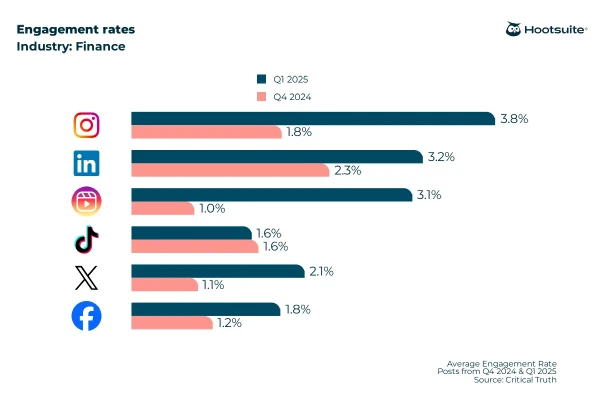
Low baseline engagement: Hootsuite reports that financial content typically sees around 1.6%-3.8% engagement, which limits how far weak creative can go.
The 9 Steps to Running Paid Social for Fintech Brands
Once you see where performance breaks, the next step is fixing it in the right order. We strongly believe that that’s what actually matters. So, here are the 9 steps that show how to structure your campaigns so results become more stable and easier to scale paid social.
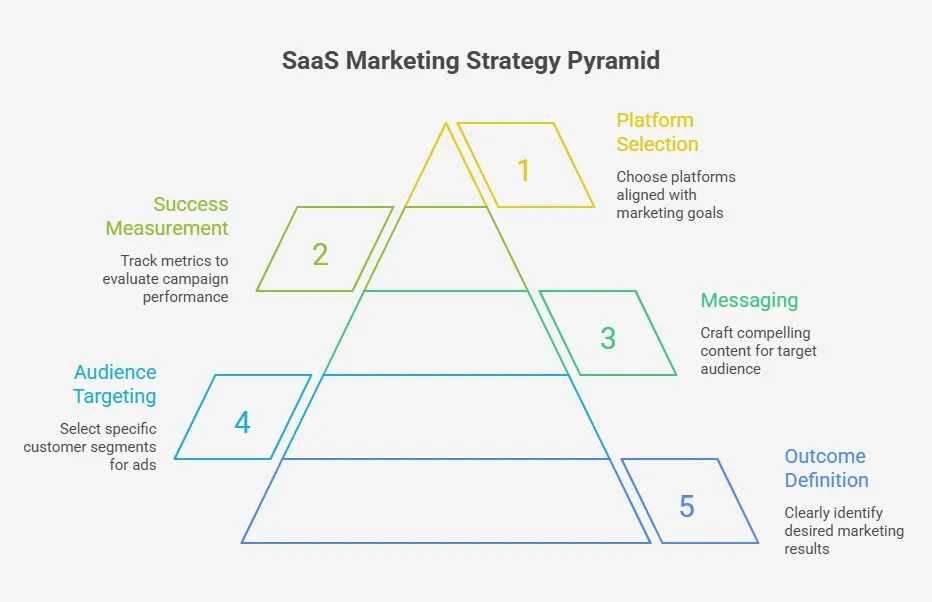
Step 1: Define Your Goal Before You Define Your Platform
We know that it’s tempting to start with platforms. But that’s where things usually go off track. Instead, we advise you to start with the outcome you actually want, such as:
Lead generation (qualified prospects for demos or trials).
App downloads and installs.
Brand awareness in a new market.
Customer education through explainer content.
Retargeting warm users toward conversion. After all, retargeted users are around 43% more likely to convert than first-time visitors.
That decision shapes everything, like your audience targeting, your messaging, and how you measure success.
Key point: When your goal is clear, your marketing strategy becomes easier to execute. Platform, creative, and conversion tracking all fall into place because they’re tied to one outcome. And that outcome becomes your North Star.
Step 2: Choose the Right Platform(s) for Your Fintech
When the goal is clear, you can choose a platform (or a mix of platforms) more easily. So, focus to where your audience already spends time and how they interact on each channel. That’s what should guide your decision.
Here’s how the main platforms compare in terms of their strengths and uses:
Now, it’s easy to spread too thin here. But more platforms don’t mean better results.
We recommend starting with one or two where your audience actually spends time. Then focus on getting your social media strategy right there first. Once performance is stable, expansion becomes a lot less risky and a lot more predictable.
Step 3: Segment Your Audience (Go Deeper Than Demographics)
Most fintech campaigns lose money at the targeting level. Broad audiences bring volume, but they don’t always bring the right users.
So instead of thinking in age, gender, or job titles, go one layer deeper. Strong fintech marketing segmentation usually comes down to three things:
Behavioural signals: App installs, product page visits, deposit activity, comparison site visits.
Intent-based targeting: People actively looking for financial solutions.
Life-stage targeting: New business owners, first-time investors, people who recently changed jobs or moved.
Each layer gives you a different level of clarity. When you combine them, your targeting becomes much more precise, and your messaging starts to land better.
Lookalikes also play a big role here, but your input matters.
If you seed them with average users, performance stays average. If you seed them with your highest-LTV customers, you start attracting users who behave in a similar way.
And one more thing.
We advise you to segment by risk profile, financial literacy, and product fit. When those don’t match your message, you end up with clicks that don’t convert and leads that don’t qualify.
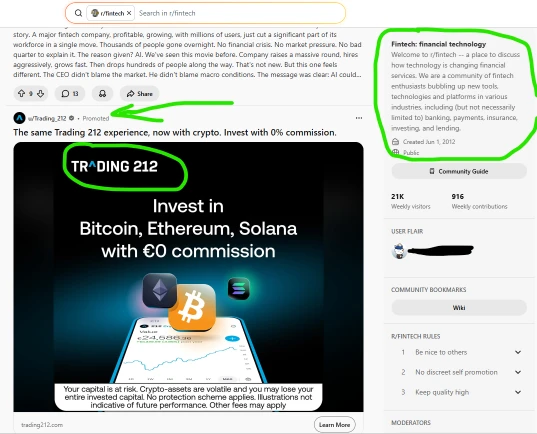
Here’s a good example from Trading 212 because it fits the audience’s profile on this subreddit:
Step 4: Build a Creative That Generates Trust First
This is where most campaigns miss the mark. The creative pushes too fast, too early, without building any brand trust.
In fintech, users evaluate both the product and the level of risk that comes with it. So high-performing ads reduce that risk before asking for action.
Here’s what tends to work:
UGC-style video: Simple, real content from creators or users because it feels more credible than polished brand ads.
Short explainer video: Helps people understand the product clearly, especially for lending, investing, or B2B tools.
Carousel ads: Break down features, comparisons, or steps in a simple flow.
Social proof ads: Reviews, ratings, trust badges, and security signals.
Copy matters just as much. So, try to keep it simple and use the language your audience already uses. Next, focus on outcomes, then run creative testing on headlines and angles so you can keep improving over time.
We’ve seen this play out directly.
In one of our campaigns, we helped N26 move from polished ads to user-generated content, which led to a 65% lower cost per registration, 40% lower cost per ad recall, and 19% lower cost per action intent.
This strategy improved both engagement and conversion efficiency.
Step 5: Navigate Compliance Without Killing Creative
Compliance shapes how fintech ads run, and when you handle it well, it strengthens credibility instead of slowing you down.
This comes down to a few things.
You need to include the right disclosures.
These can be things like “Capital at risk,” APR ranges, or investment disclaimers where required. At the same time, you have to stay away from claims that suggest certainty. This means no “guaranteed returns,” no “risk-free” language, and no implied outcomes that could mislead.
Then there’s the internal side.
Legal or compliance sign-off has to happen before launch, especially for regulated promotions. And each platform comes with its own rules. Meta, LinkedIn, and TikTok all have specific policies for financial products, so your content strategy has to account for those from the start.
What helps here is structure.
We recommend building a compliance-cleared library with pre-approved copy, headlines, and visual elements. That way, your team can move faster without restarting approvals every time. Over time, this also improves consistency across your campaigns and reduces friction between creative and legal teams.
Step 6: Map Your Ads to the Funnel Stage
A common mistake in digital marketing for fintech is pushing conversion ads to people who have just discovered the product. That gap is where performance drops.
Most users don’t convert right away. In fact, many funnels lose around 70% of leads between the first interaction and signup. That’s usually because the message doesn’t match where the user is in their decision process.
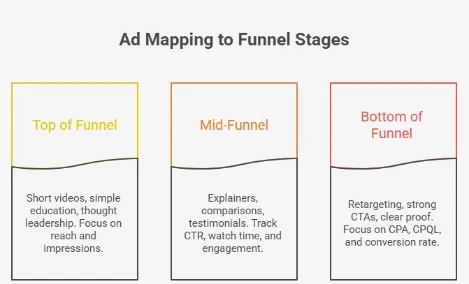
So the fix is simple in structure, but important in execution. Match your ads to the funnel stage:
Top of funnel (awareness): Short videos, simple education, thought leadership → focus on reach and impressions.
Mid-funnel (consideration): Explainers, comparisons, testimonials → track CTR, watch time, and engagement.
Bottom of funnel (conversion): Retargeting, strong CTAs, clear proof → focus on CPA, CPQL, and conversion rate.
From our experience, here’s what usually works best:
Start with bottom-of-funnel audiences first. These are users already close to action. Once you see what converts and why, you can scale upward with more confidence.
This approach also improves your user experience. People see the right message at the right time, which makes the journey feel clearer and more relevant.
Step 7: Use Retargeting as Your Conversion Engine
Retargeting drives a large share of conversions in fintech because it focuses on users who already showed interest.
Think about it.
Someone visited your pricing page, checked your product, or spent time on your landing pages. That user is already closer to a decision than someone seeing your brand for the first time. When you follow up with the right message, conversion rates improve because the context is already there.
What matters here is how you structure it.
We advise you to start by segmenting users based on what they actually did. A person who visited your pricing page needs a different message than someone who read a blog post. One is evaluating options, but the other is still learning.
Then adjust your message to match that intent.
Pricing page visitors respond better to clear value and proof. Blog readers usually need more context before they move forward. When that alignment is in place, your customer experience feels more natural, and conversions become easier to generate.
Pro tip: You can take this further with dynamic creative. Show users the exact product or feature they looked at. That keeps the message relevant and reduces friction.
Step 8: A/B Test the Right Variables
Testing only works when it’s structured. If you change too many things at once, it’s hard to understand what actually improved performance.
So keep it simple by testing one variable at a time, and follow a clear order:
Headline copy: Compare benefit-led, feature-led, and trust-led messaging.
CTA language: “Get started free” vs. “See how it works” vs. “Book a demo.”
Creative format: UGC, branded video, or static image.
Trust signals: Reviews, security icons, customer numbers.
Audience segments: Lookalike, interest-based, or intent-driven.
Each test gives you a clearer signal, and over time, those signals build into a system.
Over time, customer research translates into better performance, because your messaging is based on what actually resonates.
But make sure you document your results by keeping track of what wins and why. That turns testing into a repeatable process, and it helps reduce creative fatigue across your campaigns in social media marketing.
Side note: Here's why you should A/B test your content:
Step 9: Set Up Measurement Before You Launch
Before you launch anything, make sure you’re tracking the right metrics. Otherwise, you’ll see activity, but not real progress.
In fintech, vanity metrics don’t help you make decisions. Likes and impressions might look good, but they don’t tell you if you’re acquiring the right users or wasting budget.
So focus on metrics that connect directly to performance:
CPQL (Cost Per Qualified Lead) filters out low-intent traffic.
CAC (Customer Acquisition Cost) shows the real cost of acquiring a customer.
Conversion rate by funnel stage highlights where users drop off.
ROAS (Return on Ad Spend) measures revenue efficiency.
CTR and CPC help you understand how ads perform at a basic level.
Brand search lift signals if awareness is actually increasing.
Now, this only works if your tracking is set up properly. That means UTM parameters, platform pixels, and CRM integration are all in place from day one. Without that, your attribution modelling breaks, and it becomes hard to understand what’s driving results.
From there, we recommend you to review performance weekly.
Make small budget changes (around 10–15% at a time), so you can see what’s working without disrupting the system.
Pro tip: If you need help with running paid ads for your fintech brand, feel free to check out our guide on the best fintech marketing agencies that can help you out.
What Good Fintech Ad Creative Actually Looks Like
Once the structure is in place, creative becomes the lever that drives performance. Here are a few examples that show what this looks like in practice:
Creative Milkshake helped Wise improve performance by shifting to TikTok-first, localized creative that matched how users naturally consume content. This led to a 100% increase in conversion rates and a 26% drop in acquisition costs. The result came from aligning creative with user behavior and not just changing visuals.
Cleo’s “Roast Your Spending” campaign turned a stressful topic into something people wanted to share. Users posted their own spending roasts, creating large amounts of organic reach. The idea worked because it made the product feel human and directly showed how it works, which strengthened product-market fit.
Cash App Fridays on X kept things simple. Users shared their handles for a chance to receive money, which drove tens of thousands of interactions per post. The concept created participation by turning paid ad space into a social experience.
In each case, the pattern is clear. The creative matches how people behave, shows the product in action, and gives users a reason to engage.
Mistakes That Waste Fintech Paid Social Budget
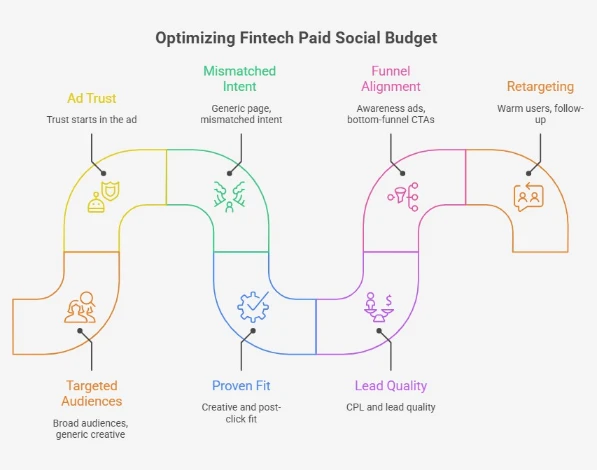
Even when campaigns look “fine” on the surface, a few small mistakes can quietly drain your budget. Here are the ones that show up most frequently:
Launching with broad audiences and generic creative: You get clicks and signups, but low activation, low deposit rates, or low-quality leads who never complete onboarding.
Treating trust as a landing-page issue only: Start building trust from the ad level. If your ads don’t show credibility signals (reviews, security, numbers), users drop off before they even click.
Sending all traffic to one generic page: Mismatched intent leads to drop-offs and poor conversion rates. That’s because when different users (e.g., investors vs. borrowers) land on the same page, they’re not persuaded by the probably generic messaging.
Scaling spend before creative and post-click fit are proven: Costs rise fast when the system isn’t stable.
Looking only at CPL and ignoring lead quality: Cheaper leads typically mean worse downstream performance. They don’t pass KYC, don’t deposit, or never become active users.
Running awareness ads with bottom-funnel CTAs too early: Users aren’t ready, so they don’t act. “Open an account” or “Start investing” don’t resonate with them because you didn’t build trust yet.
Forgetting retargeting and nurture paths: Warm users slip away without follow-up. Proof-based messaging can bring them back to the funnel and closer to conversion.
Individually, each mistake seems small, but together, they explain why campaigns struggle to scale.
Turning Fintech Paid Social Into a Scalable Growth System
Paid social in fintech works when everything lines up: clear goals, the right platforms, sharp targeting, trust-first creative, and measurement that reflects real outcomes. When those pieces connect, campaigns stop feeling unpredictable and start becoming easier to scale.
So instead of chasing quick wins, focus on building a system that matches how users actually evaluate financial services or products. That’s what improves conversion rates, lead quality, and long-term efficiency.
If you want help building or fixing that system, reach out to Creative Milkshake and let’s map out your next steps together!