

If you’ve ever tried scaling Facebook ads, you’ve probably seen this pattern. Things work at $50/day, look great at $100/day, and then completely fall apart at $300/day.
This isn’t bad luck. It’s how the Facebook algorithm behaves when you push it too fast or without the right structure. On paper, increasing the budget and expanding your campaign reach should bring in better results, but that’s not always the case.
Across industries, the numbers already show how fragile performance can be. The average cost per acquisition (CPA) sits around $18 to $23, while median return on ad spend (ROAS) hovers near 2.19. This means most advertisers are only doubling their money at baseline.
Scaling Facebook campaigns requires more than increasing budgets. It demands a structured approach to testing, strong creative systems, and clear performance signals. That’s what we’ll cover in this guide.
We’ll share:
What scaling Facebook ads without hurting performance actually means
Why does performance drop when you increase ad spend
Proven ways to grow campaigns through budget, audience, and creative strategies
When your campaigns are ready to increase spend safely
Key metrics to track so performance stays stable as you grow
If you're already increasing your ad spend but seeing performance drop, you're not alone. Creative Milkshake builds data-backed creative systems that can help you grow profitably without killing ROAS. Partner with us to scale your campaigns with confidence.
What ‘Scaling Without Killing Performance’ Means for Facebook Ads
Scaling Facebook ads means increasing your ad spend. But doing it without killing performance depends on whether your system can handle that growth without losing efficiency.
Your campaigns, creatives, audiences, and tracking setup all need to work together to support higher spend.
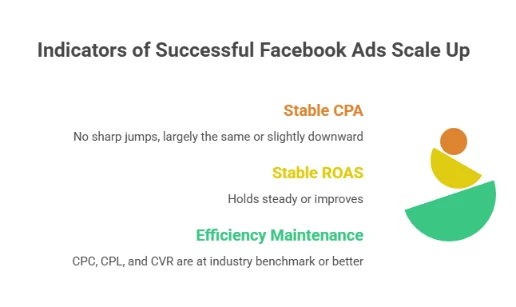
Let’s see what that looks like in practice:
Stable or improving CPA: When you scale correctly, your CPA should remain consistent or trend slightly downward as you optimize your data. You may see CPA stabilize after exiting the Facebook learning phase, provided budget increases stay within 20-30% increments. If CPA jumps sharply, that’s a signal your campaign structure or audience quality can’t support the new spend.
Sustained or increasing ROAS: Your ROAS should hold steady or improve as you scale. This usually happens when your ad creatives and audience targeting are aligned with intent. If ROAS drops significantly, it’s a tell-tale sign of weak creative, poor targeting, or misaligned offers.
Volume growth without efficiency collapse: The goal of scaling is to generate more purchases, leads, or conversions without sacrificing efficiency. That means increasing total conversions while keeping metrics like cost per click (CPC), cost per lead (CPL), and conversion rate within acceptable ranges.
To put it simply, scaling is a balance between growth and control. The advertisers who win are the ones who treat scaling as a system rather than just turning up the ad budget and hoping the Facebook algorithm figures it out.
However, even with the right setup, performance can still drop as you increase spend. To fix that, you need to understand what’s causing it in the first place. And that’s what we’ll cover in the next section.
Why Does Facebook Ads Performance Drop When Scaling?
Performance drops during scaling for a few clear reasons, and most of them show up across almost every ad account.
Below, we have shared four main reasons behind it and what you need to address proactively.

1. Audience Fatigue and Frequency Issue
One of the fastest ways to kill performance during scaling is to exhaust your target audience and fail to control the frequency of exposure to the same ad.
As you increase the budget without expanding audience targeting, your ads get shown more frequently to the same users. This drives up ad frequency, which leads to:
Lower CTR (people stop engaging)
Higher CPM (less efficient auctions)
Increased CPA
Data shows that exposure to the same ad 11 or more times can reduce conversion rate by 4.2%.
You can monitor this directly in Meta Ads Manager using frequency metrics. Once you see frequency climbing while CTR drops, you’re in fatigue territory.
In our daily practice, we have noticed this happens when campaigns rely too heavily on narrow custom audiences, small retargeting pools, and overlapping lookalike audiences.
In many cases, proper audience exclusions are missing, which leads to inefficiencies as spend increases.
<iframe src="https://www.youtube.com/embed/fVF5XBR7MaQ" style="width:100%; aspect-ratio:9/16; border-radius:12px;" allowfullscreen> </iframe>
<div style="display:flex; justify-content:center; margin:2rem 0;"> <div style="width:100%; max-width:360px; aspect-ratio:9/16;"> <iframe src="https://www.youtube.com/embed/fVF5XBR7MaQ" frameborder="0" allowfullscreen style="width:100%; height:100%; border-radius:12px;"> </iframe> </div> </div>
2. Learning Phase Disruption
Scaling too quickly can push your campaigns back into the Facebook Learning Phase, which leads to unstable performance.
The learning phase is when the system is still figuring out how to deliver your ads efficiently. If you make significant changes, like doubling the budget in one go, editing ad sets, or swapping ad creatives entirely, you reset that process.
Meta recommends getting at least 50 conversion events per week per ad set to exit learning. If you scale before hitting that threshold, or make aggressive changes, you might see volatile CPA or inconsistent delivery.
From what we’ve seen, this is where many teams lose stability. Sudden changes force the algorithm to recalibrate, which leads to higher CPA and uneven delivery.
Controlled budget increases help maintain performance as campaigns scale.
3. Budget Shocks for the Algorithm
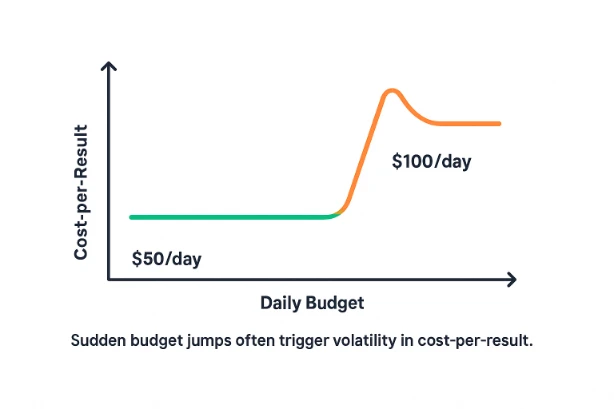
Remember: the Facebook algorithm doesn’t respond well to sudden spikes in advertising budget.
If you increase the budget too quickly (for example, doubling overnight), you create what we media buyers call a “budget shock.” The system is forced to re-enter auctions more aggressively without enough time to adapt.
In practice, this leads to:
Higher CPMs due to less efficient bidding
Lower-quality traffic entering your funnel
Declining ROAS and rising CPC
4. Creative Exhaustion
Even if your targeting and budget are perfect, scaling will fail if your ad Creative can’t support it. This particular situation leads to ‘creative fatigue.’
Creative fatigue happens when your messaging, angles, or formats stop resonating with your audience.
As you scale, relying on the same creative ideas leads to lower engagement and weaker conversion rates, even if delivery remains stable.
The good thing is that Meta itself points this out (you’ll see ‘Creative fatigue’ or ‘Creative limited’ status in the delivery column).
We have noticed that campaigns without a steady flow of new creatives struggle to maintain performance as spend increases.
Meta’s internal guidance (via the Power 5 framework) recommends continuous creative testing and optimization as a core lever for scale.
How to Scale Facebook Ads (the Right Way)
To scale Facebook Ads without destroying performance, you need to apply the right method at the right time based on how your ad campaigns are behaving.
We break this into three core levers:
Vertical scaling
Horizontal scaling, and
Creative scaling.
1. Vertical Scaling (Increasing Budget Safely)
Vertical scaling means increasing the ad budget within an existing campaign or ad set that’s already performing well.
This is the most straightforward way to grow, but it can quickly hurt performance if done too aggressively. Budget increases need to be gradual and controlled.
When to Use Vertical Scaling
You should only scale vertically when your campaign has earned it.
We suggest looking for these signals inside Meta Ads Manager:
Stable or improving CPA over at least 3-5 days
Consistent or rising ROAS (ideally above your break-even point)
At least 50+ weekly conversion events (out of the Facebook Learning Phase)
Stable conversion rate and CPC
Controlled ad frequency (generally under 2.5-3 for prospecting)
Safe Budget Increase Framework
Instead of making aggressive jumps, use controlled increments:
Increase budget by 20-30% every 48–72 hours
Avoid editing multiple variables at once (budget + creative + targeting)
Monitor performance metrics daily, especially CPA and CTR
Pause scaling if CPA increases more than 20-25%
Remember, the Facebook algorithm needs time to adjust to new spending levels. Gradual increases allow it to maintain delivery efficiency.
Budget Scaling Models
You can manage budget increases in two main ways within Facebook Ad Campaigns
a. Ad Set Budget Optimization (ABO scaling)
This increases the budget at the ad set level. It is best for testing and controlling specific audience targeting segments. And it’s ideal when scaling lookalike, interest-based, or custom audiences.
b. Campaign Budget Optimization (CBO scaling)
This approach increases the budget at the campaign level. You basically let the algorithm distribute spend across top-performing ad sets. It gives the algorithm more control over the budget, which looks at performance to allocate it to specific ad sets.
It works best when your campaign structure is clean and consolidated.
Insider tip: For higher spend accounts, we recommend using both. Test at the ad set level with ABO, then consolidate into CBO for scale.
Here’s a comparison of both approaches:
Aspect | Campaign Budget Optimization (CBO) | Ad Set Budget Optimization (ABO) |
Budget control | Budget is managed at the campaign level with limited control per ad set | Full control over how much budget each ad set receives |
Optimization approach | Budget is automatically distributed based on performance signals | Requires manual adjustments to shift budget between ad sets |
Efficiency | Can improve overall efficiency by prioritizing top performers | Performance depends on how well budgets are managed manually |
Time investment | Less hands-on, since allocation is handled automatically | Requires regular monitoring and adjustments |
Flexibility | Best suited for consolidated campaigns focused on overall results | Ideal for testing different audiences or strategies independently |
Best use case | Scaling campaigns with stable performance data | Testing and refining audience segments before scaling |
Risk factors | Budget may concentrate too heavily on a few ad sets early on | Budget can be wasted on underperforming ad sets if not monitored |
Risk Management
Vertical scaling isn’t without risk. This is because you’re pushing more money through the same system. It can backfire, but not when you manage it well.
Here’s what we recommend:
Use automated rules in Meta Ads Manager to prevent overspend. Example: pause ad sets if CPA exceeds $30 or ROAS drops below 1.8.
Monitor frequency metrics to catch early signs of fatigue.
Avoid scaling during unstable periods (e.g., right after major edits or during learning)
Keep backup campaigns or ad sets ready in your ad account
Accounts that rely purely on vertical scaling usually hit a ceiling quickly due to creative fatigue and audience saturation. That’s why vertical scaling should always be paired with expansion strategies (discussed next).
Facebook Ads: VERTICAL Scaling vs HORIZONTAL Scaling?
2. Horizontal Scaling (Expanding Reach Without Overloading)
Horizontal scaling focuses on increasing volume by expanding what already works, rather than putting more budget into the same setup.
This involves introducing new variables instead of only increasing spend. For example:
New audiences
New ad sets
New campaigns
New placement strategies (automatic placements vs manual placements)
This approach reduces pressure on a single audience and helps maintain stable performance.
Audience Expansion Strategies
To scale effectively, you need to expand your target audience without sacrificing quality. Of course, you don’t want to target users who aren’t relevant to your offering.
Some proven methods that we suggest are:
Slowly build larger lookalike audiences (e.g., 1% → 3% → 5%)
Layer interest-based audiences using detailed targeting
Use broader demographic ranges and let the algorithm optimize
Leverage audience Insights for new segments based on real data
Pro tip: Always manage audience overlap using exclusions and audience exclusion logic. Overlapping audiences compete against each other, driving up CPMs and hurting efficiency.
Duplication Framework
One of the most commonly used horizontal scaling tactics is controlled duplication, where you simply duplicate winning ad sets for new audiences.
It can be used to quickly test variations like new location targeting or broader age ranges and see whether the ad continues to win.
You’d keep the same high-performing ad creatives initially. But it’s important to avoid duplicating into identical audiences (this causes overlap).
You can also use the split test feature inside Meta Ads Manager for structured A/B testing and split testing frameworks to see how the duplicate ads perform with different audiences.
Many advanced buyers use “dark posting” (running ads without publishing on the page feed) to test variations at scale without affecting social proof.
We recommend combining vertical scaling with horizontal duplication to test both approaches and gradually increase spend without negatively affecting performance.
As this marketer said on a Reddit thread:
“I usually duplicate the winning ad set and scale the copy. Bumping the original budget too much can reset the learning phase. I stick to 20-30% increases at a time, whether it's the original or the duplicate. That keeps things stable while you ramp up.” |
3. Creative Scaling: The Real Growth Lever
If there’s one lever that truly unlocks scale, it’s creative. You can’t scale weak ads, no matter how good your targeting or budget strategy is. Otherwise, you’re just pouring in more money to get dismal results.
Creative scaling also addresses ad fatigue, which, again, is a major performance killer. As creative saturation grows, CTR goes down (shown in the graph below).
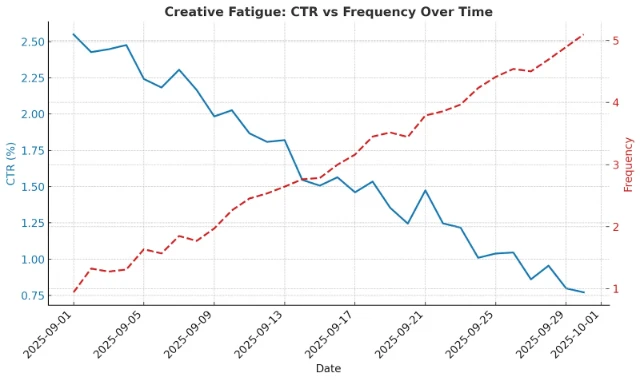
You need viable creative volume to keep ads impactful as you increase the budget (or even when you don’t). This can be done manually with a variety of creative variations.
Alternatively, some advertisers use automated options like dynamic creatives and Advantage+ creatives, which optimize images, videos, and text based on audience signals.
Creative Volume Strategy
Consistent output matters more than relying on a single winning ad. This is the approach we follow for our clients:
Launch 3-5 new ad creatives per week.
Iterate on winners instead of constantly chasing new ideas.
Use dynamic creative optimization to test combinations at scale.
Build a “creative flywheel” where winning angles generate new variations.
Types of Creative to Scale With
Of course, your ad creatives need to be impactful as well to maintain steady performance during scale-up. Based on our experience, the following formats consistently perform well:
User-Generated Content (UGC)
UGC is incredibly powerful. One study says it can increase conversion rate by 161%. That’s because people are more likely to buy products or services recommended by others. Relevance and social proof are the winning formula here.
For example, at Creative Milkshake, we’ve scaled many of our clients’ campaigns through UGC. For 8Sheep Organics, we used a variety of UGC videos in ads as we scaled the brand's Facebook campaigns. As the budget increased, performance actually improved with higher conversion and lower CPA.

Founder-Led Ads
Authenticity drives trust. Founder videos explaining the product can even outperform branded creatives in early-stage scaling. This type of creative can work particularly well for niches that require significant trust, such as health, wellness, and skincare.
How to make Founder Ads that actually convert in 2026
Problem-Solution Storytelling
This creative technique follows hook → pain point → solution → proof → CTA. For proof, again, UGC can be a great asset.
This format aligns perfectly with how users consume content on Facebook. You can set different creatives in the ad campaigns and use proof and CTA ones with retargeting ads, so the audience has had enough interaction to finally convert.
We did this for Napper, an app for navigating baby sleep patterns. With studio-quality UGC-based creatives, we highlighted the issue faced by new moms and how the app provides the solution.

When to Scale Facebook Campaigns
Even if you have the budget to go big with your Facebook campaigns, you should look out for clear signs that your ads are ready to be scaled. There should be enough data for the algorithm to go off of and make correct optimizations as you increase the budget and change course.
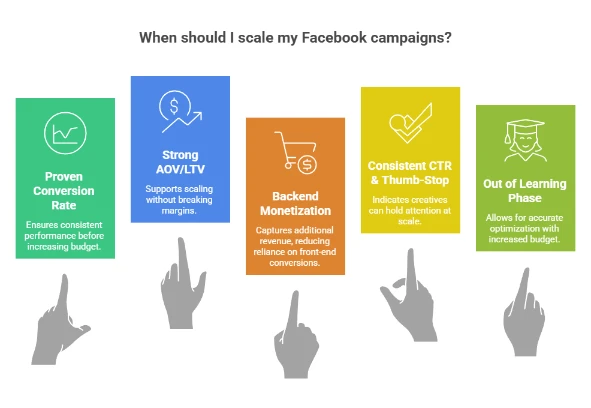
Consider the following as a go-ahead for scaling Meta ads:
Proven conversion rate: Your funnel must convert consistently before you scale traffic. Consider the most current CVR benchmarks for your specific industry. The average CVR for Facebook ads across all industries is 9.21%.
Strong AOV or LTV to support scaling: If your average order value (AOV) or lifetime value (LTV) is too low, even small increases in CPA will break your margins. Aim for Target ROAS ≥ 2.5–3.0 for most e-commerce brands. Higher LTV businesses (subscriptions, repeat purchase brands) can tolerate lower initial ROAS.
Backend monetization (email/SMS flows): Scaling is much easier when your backend captures additional revenue. If you rely only on front-end conversions from Facebook campaigns, your margin for error is very small. Before scaling, ensure you have fewer abandoned cart flows, post-purchase upsells, and Email/SMS campaigns increasing LTV.
Evidence of consistent CTR and thumb-stop rate: You need proof that your creatives can hold attention at scale. This can be indicated by a CTR above 1.5% to 2% across most industries. Also, there should be engagement on multiple creatives. If only one creative is performing, scaling will likely lead to creative fatigue quickly.
Campaigns are out of the learning phase: Your campaigns should be fully out of the Facebook Learning Phase before increasing the advertising budget.
How to Monitor & Optimize Facebook Ads During Scale: Key Metrics to Watch
As you scale Facebook Ads inside Meta Ads Manager, tracking the right performance metrics is what keeps your ad campaigns profitable.
Metric | What to Watch | Optimization Actions |
CPA (Cost Per Acquisition) |
|
|
ROAS (Return on Ad Spend) |
|
|
CTR (Click-Through Rate) |
|
|
CPM (Cost Per Mille) |
|
|
Frequency |
|
|
Conversion Rate (On-Site) |
|
|
Scale Facebook Ads with Confidence with Creative Milkshake
Scaling Facebook ads while maintaining performance requires a structured approach. Budget, creative, and targeting all need to work together, supported by clear data and consistent monitoring.
At Creative Milkshake, we help brands grow ad spend without losing efficiency. In many cases, performance improves as campaigns scale. For example, Revive achieved a 43% reduction in CAC along with a 25% increase in ROAS.
If you’re ready to take your Facebook campaigns further, collaborate with us to ensure your ad spend consistently delivers the results you want.
FAQs
How fast can you scale Facebook ads safely?
Scale Facebook ads safely by increasing the budget 20-30% every week. This rate maintains algorithm stability and preserves conversion data. Faster scaling resets learning and increases CPA. As you increase the spend, monitor frequency, CPA, and ROAS daily to confirm stable performance.
Should I duplicate or increase the budget for Facebook ads?
Increase the budget when performance is stable, and CPA meets targets. Duplicate campaigns when testing new audiences. Budget increases preserve data stability, while duplication introduces new learning phases and higher volatility. You can also combine the two approaches by duplicating the original ad set and slightly increasing its budget.
How does Creative Milkshake handle Facebook Ads?
Our team at Creative Milkshake manages and optimizes Facebook campaigns and handles the production of ad creatives. With our expertise in UGC, we can procure creators and produce high-quality ad assets that enable creative scaling with a heavy focus on conversion. See our process.
Why does CPA increase when scaling?
CPA increases during scaling because ad delivery expands into less qualified audiences. Higher spend, if not managed proactively, can increase frequency, which weakens conversion rates. Rapid scaling also resets the learning phase, and the campaign isn’t as optimized anymore.
How many creatives do I need to scale?
Scale ads effectively by using 4-8 active creatives per ad set. This volume prevents creative fatigue and sustains performance across larger audiences. Refresh creatives every 10-14 days, or when CTR drops below 1%, to maintain engagement and a stable CPA.
Is broad targeting better for scaling?
Broad targeting for scaling can work because it gives Meta’s algorithm more data to optimize conversions. You might see CPA rise initially. But over time, broad audiences improve delivery efficiency and reduce CPM. Combine broad targeting with strong creatives and conversion data to maintain performance at higher spend levels.

If you’ve ever tried scaling Facebook ads, you’ve probably seen this pattern. Things work at $50/day, look great at $100/day, and then completely fall apart at $300/day.
This isn’t bad luck. It’s how the Facebook algorithm behaves when you push it too fast or without the right structure. On paper, increasing the budget and expanding your campaign reach should bring in better results, but that’s not always the case.
Across industries, the numbers already show how fragile performance can be. The average cost per acquisition (CPA) sits around $18 to $23, while median return on ad spend (ROAS) hovers near 2.19. This means most advertisers are only doubling their money at baseline.
Scaling Facebook campaigns requires more than increasing budgets. It demands a structured approach to testing, strong creative systems, and clear performance signals. That’s what we’ll cover in this guide.
We’ll share:
What scaling Facebook ads without hurting performance actually means
Why does performance drop when you increase ad spend
Proven ways to grow campaigns through budget, audience, and creative strategies
When your campaigns are ready to increase spend safely
Key metrics to track so performance stays stable as you grow
If you're already increasing your ad spend but seeing performance drop, you're not alone. Creative Milkshake builds data-backed creative systems that can help you grow profitably without killing ROAS. Partner with us to scale your campaigns with confidence.
What ‘Scaling Without Killing Performance’ Means for Facebook Ads
Scaling Facebook ads means increasing your ad spend. But doing it without killing performance depends on whether your system can handle that growth without losing efficiency.
Your campaigns, creatives, audiences, and tracking setup all need to work together to support higher spend.

Let’s see what that looks like in practice:
Stable or improving CPA: When you scale correctly, your CPA should remain consistent or trend slightly downward as you optimize your data. You may see CPA stabilize after exiting the Facebook learning phase, provided budget increases stay within 20-30% increments. If CPA jumps sharply, that’s a signal your campaign structure or audience quality can’t support the new spend.
Sustained or increasing ROAS: Your ROAS should hold steady or improve as you scale. This usually happens when your ad creatives and audience targeting are aligned with intent. If ROAS drops significantly, it’s a tell-tale sign of weak creative, poor targeting, or misaligned offers.
Volume growth without efficiency collapse: The goal of scaling is to generate more purchases, leads, or conversions without sacrificing efficiency. That means increasing total conversions while keeping metrics like cost per click (CPC), cost per lead (CPL), and conversion rate within acceptable ranges.
To put it simply, scaling is a balance between growth and control. The advertisers who win are the ones who treat scaling as a system rather than just turning up the ad budget and hoping the Facebook algorithm figures it out.
However, even with the right setup, performance can still drop as you increase spend. To fix that, you need to understand what’s causing it in the first place. And that’s what we’ll cover in the next section.
Why Does Facebook Ads Performance Drop When Scaling?
Performance drops during scaling for a few clear reasons, and most of them show up across almost every ad account.
Below, we have shared four main reasons behind it and what you need to address proactively.

1. Audience Fatigue and Frequency Issue
One of the fastest ways to kill performance during scaling is to exhaust your target audience and fail to control the frequency of exposure to the same ad.
As you increase the budget without expanding audience targeting, your ads get shown more frequently to the same users. This drives up ad frequency, which leads to:
Lower CTR (people stop engaging)
Higher CPM (less efficient auctions)
Increased CPA
Data shows that exposure to the same ad 11 or more times can reduce conversion rate by 4.2%.
You can monitor this directly in Meta Ads Manager using frequency metrics. Once you see frequency climbing while CTR drops, you’re in fatigue territory.
In our daily practice, we have noticed this happens when campaigns rely too heavily on narrow custom audiences, small retargeting pools, and overlapping lookalike audiences.
In many cases, proper audience exclusions are missing, which leads to inefficiencies as spend increases.
<iframe src="https://www.youtube.com/embed/fVF5XBR7MaQ" style="width:100%; aspect-ratio:9/16; border-radius:12px;" allowfullscreen> </iframe>
<div style="display:flex; justify-content:center; margin:2rem 0;"> <div style="width:100%; max-width:360px; aspect-ratio:9/16;"> <iframe src="https://www.youtube.com/embed/fVF5XBR7MaQ" frameborder="0" allowfullscreen style="width:100%; height:100%; border-radius:12px;"> </iframe> </div> </div>
2. Learning Phase Disruption
Scaling too quickly can push your campaigns back into the Facebook Learning Phase, which leads to unstable performance.
The learning phase is when the system is still figuring out how to deliver your ads efficiently. If you make significant changes, like doubling the budget in one go, editing ad sets, or swapping ad creatives entirely, you reset that process.
Meta recommends getting at least 50 conversion events per week per ad set to exit learning. If you scale before hitting that threshold, or make aggressive changes, you might see volatile CPA or inconsistent delivery.
From what we’ve seen, this is where many teams lose stability. Sudden changes force the algorithm to recalibrate, which leads to higher CPA and uneven delivery.
Controlled budget increases help maintain performance as campaigns scale.
3. Budget Shocks for the Algorithm
Remember: the Facebook algorithm doesn’t respond well to sudden spikes in advertising budget.
If you increase the budget too quickly (for example, doubling overnight), you create what we media buyers call a “budget shock.” The system is forced to re-enter auctions more aggressively without enough time to adapt.
In practice, this leads to:
Higher CPMs due to less efficient bidding
Lower-quality traffic entering your funnel
Declining ROAS and rising CPC

4. Creative Exhaustion
Even if your targeting and budget are perfect, scaling will fail if your ad Creative can’t support it. This particular situation leads to ‘creative fatigue.’
Creative fatigue happens when your messaging, angles, or formats stop resonating with your audience.
As you scale, relying on the same creative ideas leads to lower engagement and weaker conversion rates, even if delivery remains stable.
The good thing is that Meta itself points this out (you’ll see ‘Creative fatigue’ or ‘Creative limited’ status in the delivery column).
We have noticed that campaigns without a steady flow of new creatives struggle to maintain performance as spend increases.
Meta’s internal guidance (via the Power 5 framework) recommends continuous creative testing and optimization as a core lever for scale.
How to Scale Facebook Ads (the Right Way)
To scale Facebook Ads without destroying performance, you need to apply the right method at the right time based on how your ad campaigns are behaving.
We break this into three core levers:
Vertical scaling
Horizontal scaling, and
Creative scaling.
1. Vertical Scaling (Increasing Budget Safely)
Vertical scaling means increasing the ad budget within an existing campaign or ad set that’s already performing well.
This is the most straightforward way to grow, but it can quickly hurt performance if done too aggressively. Budget increases need to be gradual and controlled.
When to Use Vertical Scaling
You should only scale vertically when your campaign has earned it.
We suggest looking for these signals inside Meta Ads Manager:
Stable or improving CPA over at least 3-5 days
Consistent or rising ROAS (ideally above your break-even point)
At least 50+ weekly conversion events (out of the Facebook Learning Phase)
Stable conversion rate and CPC
Controlled ad frequency (generally under 2.5-3 for prospecting)
Safe Budget Increase Framework
Instead of making aggressive jumps, use controlled increments:
Increase budget by 20-30% every 48–72 hours
Avoid editing multiple variables at once (budget + creative + targeting)
Monitor performance metrics daily, especially CPA and CTR
Pause scaling if CPA increases more than 20-25%
Remember, the Facebook algorithm needs time to adjust to new spending levels. Gradual increases allow it to maintain delivery efficiency.
Budget Scaling Models
You can manage budget increases in two main ways within Facebook Ad Campaigns
a. Ad Set Budget Optimization (ABO scaling)
This increases the budget at the ad set level. It is best for testing and controlling specific audience targeting segments. And it’s ideal when scaling lookalike, interest-based, or custom audiences.
b. Campaign Budget Optimization (CBO scaling)
This approach increases the budget at the campaign level. You basically let the algorithm distribute spend across top-performing ad sets. It gives the algorithm more control over the budget, which looks at performance to allocate it to specific ad sets.
It works best when your campaign structure is clean and consolidated.
Insider tip: For higher spend accounts, we recommend using both. Test at the ad set level with ABO, then consolidate into CBO for scale.
Here’s a comparison of both approaches:
Aspect | Campaign Budget Optimization (CBO) | Ad Set Budget Optimization (ABO) |
Budget control | Budget is managed at the campaign level with limited control per ad set | Full control over how much budget each ad set receives |
Optimization approach | Budget is automatically distributed based on performance signals | Requires manual adjustments to shift budget between ad sets |
Efficiency | Can improve overall efficiency by prioritizing top performers | Performance depends on how well budgets are managed manually |
Time investment | Less hands-on, since allocation is handled automatically | Requires regular monitoring and adjustments |
Flexibility | Best suited for consolidated campaigns focused on overall results | Ideal for testing different audiences or strategies independently |
Best use case | Scaling campaigns with stable performance data | Testing and refining audience segments before scaling |
Risk factors | Budget may concentrate too heavily on a few ad sets early on | Budget can be wasted on underperforming ad sets if not monitored |
Risk Management
Vertical scaling isn’t without risk. This is because you’re pushing more money through the same system. It can backfire, but not when you manage it well.
Here’s what we recommend:
Use automated rules in Meta Ads Manager to prevent overspend. Example: pause ad sets if CPA exceeds $30 or ROAS drops below 1.8.
Monitor frequency metrics to catch early signs of fatigue.
Avoid scaling during unstable periods (e.g., right after major edits or during learning)
Keep backup campaigns or ad sets ready in your ad account
Accounts that rely purely on vertical scaling usually hit a ceiling quickly due to creative fatigue and audience saturation. That’s why vertical scaling should always be paired with expansion strategies (discussed next).
Facebook Ads: VERTICAL Scaling vs HORIZONTAL Scaling?
2. Horizontal Scaling (Expanding Reach Without Overloading)
Horizontal scaling focuses on increasing volume by expanding what already works, rather than putting more budget into the same setup.
This involves introducing new variables instead of only increasing spend. For example:
New audiences
New ad sets
New campaigns
New placement strategies (automatic placements vs manual placements)
This approach reduces pressure on a single audience and helps maintain stable performance.
Audience Expansion Strategies
To scale effectively, you need to expand your target audience without sacrificing quality. Of course, you don’t want to target users who aren’t relevant to your offering.
Some proven methods that we suggest are:
Slowly build larger lookalike audiences (e.g., 1% → 3% → 5%)
Layer interest-based audiences using detailed targeting
Use broader demographic ranges and let the algorithm optimize
Leverage audience Insights for new segments based on real data
Pro tip: Always manage audience overlap using exclusions and audience exclusion logic. Overlapping audiences compete against each other, driving up CPMs and hurting efficiency.
Duplication Framework
One of the most commonly used horizontal scaling tactics is controlled duplication, where you simply duplicate winning ad sets for new audiences.
It can be used to quickly test variations like new location targeting or broader age ranges and see whether the ad continues to win.
You’d keep the same high-performing ad creatives initially. But it’s important to avoid duplicating into identical audiences (this causes overlap).
You can also use the split test feature inside Meta Ads Manager for structured A/B testing and split testing frameworks to see how the duplicate ads perform with different audiences.
Many advanced buyers use “dark posting” (running ads without publishing on the page feed) to test variations at scale without affecting social proof.
We recommend combining vertical scaling with horizontal duplication to test both approaches and gradually increase spend without negatively affecting performance.
As this marketer said on a Reddit thread:
“I usually duplicate the winning ad set and scale the copy. Bumping the original budget too much can reset the learning phase. I stick to 20-30% increases at a time, whether it's the original or the duplicate. That keeps things stable while you ramp up.” |
3. Creative Scaling: The Real Growth Lever
If there’s one lever that truly unlocks scale, it’s creative. You can’t scale weak ads, no matter how good your targeting or budget strategy is. Otherwise, you’re just pouring in more money to get dismal results.
Creative scaling also addresses ad fatigue, which, again, is a major performance killer. As creative saturation grows, CTR goes down (shown in the graph below).

You need viable creative volume to keep ads impactful as you increase the budget (or even when you don’t). This can be done manually with a variety of creative variations.
Alternatively, some advertisers use automated options like dynamic creatives and Advantage+ creatives, which optimize images, videos, and text based on audience signals.
Creative Volume Strategy
Consistent output matters more than relying on a single winning ad. This is the approach we follow for our clients:
Launch 3-5 new ad creatives per week.
Iterate on winners instead of constantly chasing new ideas.
Use dynamic creative optimization to test combinations at scale.
Build a “creative flywheel” where winning angles generate new variations.
Types of Creative to Scale With
Of course, your ad creatives need to be impactful as well to maintain steady performance during scale-up. Based on our experience, the following formats consistently perform well:
User-Generated Content (UGC)
UGC is incredibly powerful. One study says it can increase conversion rate by 161%. That’s because people are more likely to buy products or services recommended by others. Relevance and social proof are the winning formula here.
For example, at Creative Milkshake, we’ve scaled many of our clients’ campaigns through UGC. For 8Sheep Organics, we used a variety of UGC videos in ads as we scaled the brand's Facebook campaigns. As the budget increased, performance actually improved with higher conversion and lower CPA.

Founder-Led Ads
Authenticity drives trust. Founder videos explaining the product can even outperform branded creatives in early-stage scaling. This type of creative can work particularly well for niches that require significant trust, such as health, wellness, and skincare.
How to make Founder Ads that actually convert in 2026
Problem-Solution Storytelling
This creative technique follows hook → pain point → solution → proof → CTA. For proof, again, UGC can be a great asset.
This format aligns perfectly with how users consume content on Facebook. You can set different creatives in the ad campaigns and use proof and CTA ones with retargeting ads, so the audience has had enough interaction to finally convert.
We did this for Napper, an app for navigating baby sleep patterns. With studio-quality UGC-based creatives, we highlighted the issue faced by new moms and how the app provides the solution.

When to Scale Facebook Campaigns
Even if you have the budget to go big with your Facebook campaigns, you should look out for clear signs that your ads are ready to be scaled. There should be enough data for the algorithm to go off of and make correct optimizations as you increase the budget and change course.

Consider the following as a go-ahead for scaling Meta ads:
Proven conversion rate: Your funnel must convert consistently before you scale traffic. Consider the most current CVR benchmarks for your specific industry. The average CVR for Facebook ads across all industries is 9.21%.
Strong AOV or LTV to support scaling: If your average order value (AOV) or lifetime value (LTV) is too low, even small increases in CPA will break your margins. Aim for Target ROAS ≥ 2.5–3.0 for most e-commerce brands. Higher LTV businesses (subscriptions, repeat purchase brands) can tolerate lower initial ROAS.
Backend monetization (email/SMS flows): Scaling is much easier when your backend captures additional revenue. If you rely only on front-end conversions from Facebook campaigns, your margin for error is very small. Before scaling, ensure you have fewer abandoned cart flows, post-purchase upsells, and Email/SMS campaigns increasing LTV.
Evidence of consistent CTR and thumb-stop rate: You need proof that your creatives can hold attention at scale. This can be indicated by a CTR above 1.5% to 2% across most industries. Also, there should be engagement on multiple creatives. If only one creative is performing, scaling will likely lead to creative fatigue quickly.
Campaigns are out of the learning phase: Your campaigns should be fully out of the Facebook Learning Phase before increasing the advertising budget.
How to Monitor & Optimize Facebook Ads During Scale: Key Metrics to Watch
As you scale Facebook Ads inside Meta Ads Manager, tracking the right performance metrics is what keeps your ad campaigns profitable.
Metric | What to Watch | Optimization Actions |
CPA (Cost Per Acquisition) |
|
|
ROAS (Return on Ad Spend) |
|
|
CTR (Click-Through Rate) |
|
|
CPM (Cost Per Mille) |
|
|
Frequency |
|
|
Conversion Rate (On-Site) |
|
|
Scale Facebook Ads with Confidence with Creative Milkshake
Scaling Facebook ads while maintaining performance requires a structured approach. Budget, creative, and targeting all need to work together, supported by clear data and consistent monitoring.
At Creative Milkshake, we help brands grow ad spend without losing efficiency. In many cases, performance improves as campaigns scale. For example, Revive achieved a 43% reduction in CAC along with a 25% increase in ROAS.
If you’re ready to take your Facebook campaigns further, collaborate with us to ensure your ad spend consistently delivers the results you want.
FAQs
How fast can you scale Facebook ads safely?
Scale Facebook ads safely by increasing the budget 20-30% every week. This rate maintains algorithm stability and preserves conversion data. Faster scaling resets learning and increases CPA. As you increase the spend, monitor frequency, CPA, and ROAS daily to confirm stable performance.
Should I duplicate or increase the budget for Facebook ads?
Increase the budget when performance is stable, and CPA meets targets. Duplicate campaigns when testing new audiences. Budget increases preserve data stability, while duplication introduces new learning phases and higher volatility. You can also combine the two approaches by duplicating the original ad set and slightly increasing its budget.
How does Creative Milkshake handle Facebook Ads?
Our team at Creative Milkshake manages and optimizes Facebook campaigns and handles the production of ad creatives. With our expertise in UGC, we can procure creators and produce high-quality ad assets that enable creative scaling with a heavy focus on conversion. See our process.
Why does CPA increase when scaling?
CPA increases during scaling because ad delivery expands into less qualified audiences. Higher spend, if not managed proactively, can increase frequency, which weakens conversion rates. Rapid scaling also resets the learning phase, and the campaign isn’t as optimized anymore.
How many creatives do I need to scale?
Scale ads effectively by using 4-8 active creatives per ad set. This volume prevents creative fatigue and sustains performance across larger audiences. Refresh creatives every 10-14 days, or when CTR drops below 1%, to maintain engagement and a stable CPA.
Is broad targeting better for scaling?
Broad targeting for scaling can work because it gives Meta’s algorithm more data to optimize conversions. You might see CPA rise initially. But over time, broad audiences improve delivery efficiency and reduce CPM. Combine broad targeting with strong creatives and conversion data to maintain performance at higher spend levels.

If you’ve ever tried scaling Facebook ads, you’ve probably seen this pattern. Things work at $50/day, look great at $100/day, and then completely fall apart at $300/day.
This isn’t bad luck. It’s how the Facebook algorithm behaves when you push it too fast or without the right structure. On paper, increasing the budget and expanding your campaign reach should bring in better results, but that’s not always the case.
Across industries, the numbers already show how fragile performance can be. The average cost per acquisition (CPA) sits around $18 to $23, while median return on ad spend (ROAS) hovers near 2.19. This means most advertisers are only doubling their money at baseline.
Scaling Facebook campaigns requires more than increasing budgets. It demands a structured approach to testing, strong creative systems, and clear performance signals. That’s what we’ll cover in this guide.
We’ll share:
What scaling Facebook ads without hurting performance actually means
Why does performance drop when you increase ad spend
Proven ways to grow campaigns through budget, audience, and creative strategies
When your campaigns are ready to increase spend safely
Key metrics to track so performance stays stable as you grow
If you're already increasing your ad spend but seeing performance drop, you're not alone. Creative Milkshake builds data-backed creative systems that can help you grow profitably without killing ROAS. Partner with us to scale your campaigns with confidence.
What ‘Scaling Without Killing Performance’ Means for Facebook Ads
Scaling Facebook ads means increasing your ad spend. But doing it without killing performance depends on whether your system can handle that growth without losing efficiency.
Your campaigns, creatives, audiences, and tracking setup all need to work together to support higher spend.

Let’s see what that looks like in practice:
Stable or improving CPA: When you scale correctly, your CPA should remain consistent or trend slightly downward as you optimize your data. You may see CPA stabilize after exiting the Facebook learning phase, provided budget increases stay within 20-30% increments. If CPA jumps sharply, that’s a signal your campaign structure or audience quality can’t support the new spend.
Sustained or increasing ROAS: Your ROAS should hold steady or improve as you scale. This usually happens when your ad creatives and audience targeting are aligned with intent. If ROAS drops significantly, it’s a tell-tale sign of weak creative, poor targeting, or misaligned offers.
Volume growth without efficiency collapse: The goal of scaling is to generate more purchases, leads, or conversions without sacrificing efficiency. That means increasing total conversions while keeping metrics like cost per click (CPC), cost per lead (CPL), and conversion rate within acceptable ranges.
To put it simply, scaling is a balance between growth and control. The advertisers who win are the ones who treat scaling as a system rather than just turning up the ad budget and hoping the Facebook algorithm figures it out.
However, even with the right setup, performance can still drop as you increase spend. To fix that, you need to understand what’s causing it in the first place. And that’s what we’ll cover in the next section.
Why Does Facebook Ads Performance Drop When Scaling?
Performance drops during scaling for a few clear reasons, and most of them show up across almost every ad account.
Below, we have shared four main reasons behind it and what you need to address proactively.

1. Audience Fatigue and Frequency Issue
One of the fastest ways to kill performance during scaling is to exhaust your target audience and fail to control the frequency of exposure to the same ad.
As you increase the budget without expanding audience targeting, your ads get shown more frequently to the same users. This drives up ad frequency, which leads to:
Lower CTR (people stop engaging)
Higher CPM (less efficient auctions)
Increased CPA
Data shows that exposure to the same ad 11 or more times can reduce conversion rate by 4.2%.
You can monitor this directly in Meta Ads Manager using frequency metrics. Once you see frequency climbing while CTR drops, you’re in fatigue territory.
In our daily practice, we have noticed this happens when campaigns rely too heavily on narrow custom audiences, small retargeting pools, and overlapping lookalike audiences.
In many cases, proper audience exclusions are missing, which leads to inefficiencies as spend increases.
<iframe src="https://www.youtube.com/embed/fVF5XBR7MaQ" style="width:100%; aspect-ratio:9/16; border-radius:12px;" allowfullscreen> </iframe>
<div style="display:flex; justify-content:center; margin:2rem 0;"> <div style="width:100%; max-width:360px; aspect-ratio:9/16;"> <iframe src="https://www.youtube.com/embed/fVF5XBR7MaQ" frameborder="0" allowfullscreen style="width:100%; height:100%; border-radius:12px;"> </iframe> </div> </div>
2. Learning Phase Disruption
Scaling too quickly can push your campaigns back into the Facebook Learning Phase, which leads to unstable performance.
The learning phase is when the system is still figuring out how to deliver your ads efficiently. If you make significant changes, like doubling the budget in one go, editing ad sets, or swapping ad creatives entirely, you reset that process.
Meta recommends getting at least 50 conversion events per week per ad set to exit learning. If you scale before hitting that threshold, or make aggressive changes, you might see volatile CPA or inconsistent delivery.
From what we’ve seen, this is where many teams lose stability. Sudden changes force the algorithm to recalibrate, which leads to higher CPA and uneven delivery.
Controlled budget increases help maintain performance as campaigns scale.
3. Budget Shocks for the Algorithm
Remember: the Facebook algorithm doesn’t respond well to sudden spikes in advertising budget.
If you increase the budget too quickly (for example, doubling overnight), you create what we media buyers call a “budget shock.” The system is forced to re-enter auctions more aggressively without enough time to adapt.
In practice, this leads to:
Higher CPMs due to less efficient bidding
Lower-quality traffic entering your funnel
Declining ROAS and rising CPC

4. Creative Exhaustion
Even if your targeting and budget are perfect, scaling will fail if your ad Creative can’t support it. This particular situation leads to ‘creative fatigue.’
Creative fatigue happens when your messaging, angles, or formats stop resonating with your audience.
As you scale, relying on the same creative ideas leads to lower engagement and weaker conversion rates, even if delivery remains stable.
The good thing is that Meta itself points this out (you’ll see ‘Creative fatigue’ or ‘Creative limited’ status in the delivery column).
We have noticed that campaigns without a steady flow of new creatives struggle to maintain performance as spend increases.
Meta’s internal guidance (via the Power 5 framework) recommends continuous creative testing and optimization as a core lever for scale.
How to Scale Facebook Ads (the Right Way)
To scale Facebook Ads without destroying performance, you need to apply the right method at the right time based on how your ad campaigns are behaving.
We break this into three core levers:
Vertical scaling
Horizontal scaling, and
Creative scaling.
1. Vertical Scaling (Increasing Budget Safely)
Vertical scaling means increasing the ad budget within an existing campaign or ad set that’s already performing well.
This is the most straightforward way to grow, but it can quickly hurt performance if done too aggressively. Budget increases need to be gradual and controlled.
When to Use Vertical Scaling
You should only scale vertically when your campaign has earned it.
We suggest looking for these signals inside Meta Ads Manager:
Stable or improving CPA over at least 3-5 days
Consistent or rising ROAS (ideally above your break-even point)
At least 50+ weekly conversion events (out of the Facebook Learning Phase)
Stable conversion rate and CPC
Controlled ad frequency (generally under 2.5-3 for prospecting)
Safe Budget Increase Framework
Instead of making aggressive jumps, use controlled increments:
Increase budget by 20-30% every 48–72 hours
Avoid editing multiple variables at once (budget + creative + targeting)
Monitor performance metrics daily, especially CPA and CTR
Pause scaling if CPA increases more than 20-25%
Remember, the Facebook algorithm needs time to adjust to new spending levels. Gradual increases allow it to maintain delivery efficiency.
Budget Scaling Models
You can manage budget increases in two main ways within Facebook Ad Campaigns
a. Ad Set Budget Optimization (ABO scaling)
This increases the budget at the ad set level. It is best for testing and controlling specific audience targeting segments. And it’s ideal when scaling lookalike, interest-based, or custom audiences.
b. Campaign Budget Optimization (CBO scaling)
This approach increases the budget at the campaign level. You basically let the algorithm distribute spend across top-performing ad sets. It gives the algorithm more control over the budget, which looks at performance to allocate it to specific ad sets.
It works best when your campaign structure is clean and consolidated.
Insider tip: For higher spend accounts, we recommend using both. Test at the ad set level with ABO, then consolidate into CBO for scale.
Here’s a comparison of both approaches:
Aspect | Campaign Budget Optimization (CBO) | Ad Set Budget Optimization (ABO) |
Budget control | Budget is managed at the campaign level with limited control per ad set | Full control over how much budget each ad set receives |
Optimization approach | Budget is automatically distributed based on performance signals | Requires manual adjustments to shift budget between ad sets |
Efficiency | Can improve overall efficiency by prioritizing top performers | Performance depends on how well budgets are managed manually |
Time investment | Less hands-on, since allocation is handled automatically | Requires regular monitoring and adjustments |
Flexibility | Best suited for consolidated campaigns focused on overall results | Ideal for testing different audiences or strategies independently |
Best use case | Scaling campaigns with stable performance data | Testing and refining audience segments before scaling |
Risk factors | Budget may concentrate too heavily on a few ad sets early on | Budget can be wasted on underperforming ad sets if not monitored |
Risk Management
Vertical scaling isn’t without risk. This is because you’re pushing more money through the same system. It can backfire, but not when you manage it well.
Here’s what we recommend:
Use automated rules in Meta Ads Manager to prevent overspend. Example: pause ad sets if CPA exceeds $30 or ROAS drops below 1.8.
Monitor frequency metrics to catch early signs of fatigue.
Avoid scaling during unstable periods (e.g., right after major edits or during learning)
Keep backup campaigns or ad sets ready in your ad account
Accounts that rely purely on vertical scaling usually hit a ceiling quickly due to creative fatigue and audience saturation. That’s why vertical scaling should always be paired with expansion strategies (discussed next).
Facebook Ads: VERTICAL Scaling vs HORIZONTAL Scaling?
2. Horizontal Scaling (Expanding Reach Without Overloading)
Horizontal scaling focuses on increasing volume by expanding what already works, rather than putting more budget into the same setup.
This involves introducing new variables instead of only increasing spend. For example:
New audiences
New ad sets
New campaigns
New placement strategies (automatic placements vs manual placements)
This approach reduces pressure on a single audience and helps maintain stable performance.
Audience Expansion Strategies
To scale effectively, you need to expand your target audience without sacrificing quality. Of course, you don’t want to target users who aren’t relevant to your offering.
Some proven methods that we suggest are:
Slowly build larger lookalike audiences (e.g., 1% → 3% → 5%)
Layer interest-based audiences using detailed targeting
Use broader demographic ranges and let the algorithm optimize
Leverage audience Insights for new segments based on real data
Pro tip: Always manage audience overlap using exclusions and audience exclusion logic. Overlapping audiences compete against each other, driving up CPMs and hurting efficiency.
Duplication Framework
One of the most commonly used horizontal scaling tactics is controlled duplication, where you simply duplicate winning ad sets for new audiences.
It can be used to quickly test variations like new location targeting or broader age ranges and see whether the ad continues to win.
You’d keep the same high-performing ad creatives initially. But it’s important to avoid duplicating into identical audiences (this causes overlap).
You can also use the split test feature inside Meta Ads Manager for structured A/B testing and split testing frameworks to see how the duplicate ads perform with different audiences.
Many advanced buyers use “dark posting” (running ads without publishing on the page feed) to test variations at scale without affecting social proof.
We recommend combining vertical scaling with horizontal duplication to test both approaches and gradually increase spend without negatively affecting performance.
As this marketer said on a Reddit thread:
“I usually duplicate the winning ad set and scale the copy. Bumping the original budget too much can reset the learning phase. I stick to 20-30% increases at a time, whether it's the original or the duplicate. That keeps things stable while you ramp up.” |
3. Creative Scaling: The Real Growth Lever
If there’s one lever that truly unlocks scale, it’s creative. You can’t scale weak ads, no matter how good your targeting or budget strategy is. Otherwise, you’re just pouring in more money to get dismal results.
Creative scaling also addresses ad fatigue, which, again, is a major performance killer. As creative saturation grows, CTR goes down (shown in the graph below).

You need viable creative volume to keep ads impactful as you increase the budget (or even when you don’t). This can be done manually with a variety of creative variations.
Alternatively, some advertisers use automated options like dynamic creatives and Advantage+ creatives, which optimize images, videos, and text based on audience signals.
Creative Volume Strategy
Consistent output matters more than relying on a single winning ad. This is the approach we follow for our clients:
Launch 3-5 new ad creatives per week.
Iterate on winners instead of constantly chasing new ideas.
Use dynamic creative optimization to test combinations at scale.
Build a “creative flywheel” where winning angles generate new variations.
Types of Creative to Scale With
Of course, your ad creatives need to be impactful as well to maintain steady performance during scale-up. Based on our experience, the following formats consistently perform well:
User-Generated Content (UGC)
UGC is incredibly powerful. One study says it can increase conversion rate by 161%. That’s because people are more likely to buy products or services recommended by others. Relevance and social proof are the winning formula here.
For example, at Creative Milkshake, we’ve scaled many of our clients’ campaigns through UGC. For 8Sheep Organics, we used a variety of UGC videos in ads as we scaled the brand's Facebook campaigns. As the budget increased, performance actually improved with higher conversion and lower CPA.

Founder-Led Ads
Authenticity drives trust. Founder videos explaining the product can even outperform branded creatives in early-stage scaling. This type of creative can work particularly well for niches that require significant trust, such as health, wellness, and skincare.
How to make Founder Ads that actually convert in 2026
Problem-Solution Storytelling
This creative technique follows hook → pain point → solution → proof → CTA. For proof, again, UGC can be a great asset.
This format aligns perfectly with how users consume content on Facebook. You can set different creatives in the ad campaigns and use proof and CTA ones with retargeting ads, so the audience has had enough interaction to finally convert.
We did this for Napper, an app for navigating baby sleep patterns. With studio-quality UGC-based creatives, we highlighted the issue faced by new moms and how the app provides the solution.

When to Scale Facebook Campaigns
Even if you have the budget to go big with your Facebook campaigns, you should look out for clear signs that your ads are ready to be scaled. There should be enough data for the algorithm to go off of and make correct optimizations as you increase the budget and change course.

Consider the following as a go-ahead for scaling Meta ads:
Proven conversion rate: Your funnel must convert consistently before you scale traffic. Consider the most current CVR benchmarks for your specific industry. The average CVR for Facebook ads across all industries is 9.21%.
Strong AOV or LTV to support scaling: If your average order value (AOV) or lifetime value (LTV) is too low, even small increases in CPA will break your margins. Aim for Target ROAS ≥ 2.5–3.0 for most e-commerce brands. Higher LTV businesses (subscriptions, repeat purchase brands) can tolerate lower initial ROAS.
Backend monetization (email/SMS flows): Scaling is much easier when your backend captures additional revenue. If you rely only on front-end conversions from Facebook campaigns, your margin for error is very small. Before scaling, ensure you have fewer abandoned cart flows, post-purchase upsells, and Email/SMS campaigns increasing LTV.
Evidence of consistent CTR and thumb-stop rate: You need proof that your creatives can hold attention at scale. This can be indicated by a CTR above 1.5% to 2% across most industries. Also, there should be engagement on multiple creatives. If only one creative is performing, scaling will likely lead to creative fatigue quickly.
Campaigns are out of the learning phase: Your campaigns should be fully out of the Facebook Learning Phase before increasing the advertising budget.
How to Monitor & Optimize Facebook Ads During Scale: Key Metrics to Watch
As you scale Facebook Ads inside Meta Ads Manager, tracking the right performance metrics is what keeps your ad campaigns profitable.
Metric | What to Watch | Optimization Actions |
CPA (Cost Per Acquisition) |
|
|
ROAS (Return on Ad Spend) |
|
|
CTR (Click-Through Rate) |
|
|
CPM (Cost Per Mille) |
|
|
Frequency |
|
|
Conversion Rate (On-Site) |
|
|
Scale Facebook Ads with Confidence with Creative Milkshake
Scaling Facebook ads while maintaining performance requires a structured approach. Budget, creative, and targeting all need to work together, supported by clear data and consistent monitoring.
At Creative Milkshake, we help brands grow ad spend without losing efficiency. In many cases, performance improves as campaigns scale. For example, Revive achieved a 43% reduction in CAC along with a 25% increase in ROAS.
If you’re ready to take your Facebook campaigns further, collaborate with us to ensure your ad spend consistently delivers the results you want.
FAQs
How fast can you scale Facebook ads safely?
Scale Facebook ads safely by increasing the budget 20-30% every week. This rate maintains algorithm stability and preserves conversion data. Faster scaling resets learning and increases CPA. As you increase the spend, monitor frequency, CPA, and ROAS daily to confirm stable performance.
Should I duplicate or increase the budget for Facebook ads?
Increase the budget when performance is stable, and CPA meets targets. Duplicate campaigns when testing new audiences. Budget increases preserve data stability, while duplication introduces new learning phases and higher volatility. You can also combine the two approaches by duplicating the original ad set and slightly increasing its budget.
How does Creative Milkshake handle Facebook Ads?
Our team at Creative Milkshake manages and optimizes Facebook campaigns and handles the production of ad creatives. With our expertise in UGC, we can procure creators and produce high-quality ad assets that enable creative scaling with a heavy focus on conversion. See our process.
Why does CPA increase when scaling?
CPA increases during scaling because ad delivery expands into less qualified audiences. Higher spend, if not managed proactively, can increase frequency, which weakens conversion rates. Rapid scaling also resets the learning phase, and the campaign isn’t as optimized anymore.
How many creatives do I need to scale?
Scale ads effectively by using 4-8 active creatives per ad set. This volume prevents creative fatigue and sustains performance across larger audiences. Refresh creatives every 10-14 days, or when CTR drops below 1%, to maintain engagement and a stable CPA.
Is broad targeting better for scaling?
Broad targeting for scaling can work because it gives Meta’s algorithm more data to optimize conversions. You might see CPA rise initially. But over time, broad audiences improve delivery efficiency and reduce CPM. Combine broad targeting with strong creatives and conversion data to maintain performance at higher spend levels.
